
By guiding circularly polarized light through an ultra‑thin optical fiber, researchers have now pushed and separated metallic chiral nanoparticles solely by handedness, turning a longstanding nanoscale challenge into a working laboratory reality. The demonstration, reported in Nature Communications (Volume 17, Article 3463; April 16, 2026; DOI: 10.1038/s41467-026-71585-8), offered a concrete answer to a persistent hurdle in nano‑optics: how to produce reliable, chirality‑selective forces when thermal agitation normally drowns out subtle optical effects. A collaboration linking Tokyo University of Science, the Institute for Molecular Science in Japan, and Seoul National University showed that a nanofiber’s evanescent field can translate the spin of light into directed motion that depends on particle handedness. Rather than relying on elaborate resonators or complex microfluidics, the team used a tapered fiber platform that concentrated light near the surface, creating a stable stage for transport and separation that operated with reversible control via polarization.
Why Chirality and Circular Polarization Matter
Chirality determines how objects interact in contexts that span catalysis, sensing, and medicine, because mirror images can behave like different species. A drug’s enantiomers, for example, can diverge in efficacy and safety, while chiral nanostructures can exhibit distinct optical signatures that define material performance. Circularly polarized light carries its own handedness through spin angular momentum, providing a natural handle to exert different forces on left‑ and right‑handed targets. When that rotating field couples to a chiral object, the interference between electric and magnetic dipoles can alter both the magnitude and direction of momentum transfer. In free space, this contrast often proves too faint at the nanoscale. Yet if the field is confined and structured, the subtle difference can become actionable, enabling selective propulsion that functions as a sorting mechanism without chemical tags, surface tethers, or moving parts.
Chiral light–matter coupling is not a new concept, but its practical execution at nanometer dimensions demanded a field environment that magnifies differences without introducing artifacts. The physics is intuitive when framed through momentum balance: photons carry linear and spin momentum; objects scatter and absorb that momentum; chirality breaks mirror symmetry so that the balance shifts with polarization. The open problem has been signal‑to‑noise. As size decreases, optical cross sections contract faster than Brownian kicks, masking handed responses. Circular polarization also must be preserved with high purity at the interaction site, or the enantioselective signature fades. The approach demonstrated here addressed both needs. It maintained well‑defined polarization at the fiber waist and leveraged near‑field intensities to lift chiral‑dependent forces above the stochastic background, creating a regime where spin sets the sign of the push.
Overcoming Nanoscale Roadblocks
Conventional optical tweezers apply gradient and scattering forces through focused beams, but the gradients required for nanoparticles often necessitate high powers, risking heating and loss of control. Moreover, Gaussian beams disperse energy over a larger volume, reducing the local field and limiting chirality sensitivity. The key move in this study was to replace free‑space illumination with an optical nanofiber, which squeezes guided light into a subwavelength cross‑section and pushes a strong evanescent component into the surrounding medium. In that sheath, intensity decays over hundreds of nanometers, creating a localized corridor where particles experience amplified forces that are inherently directional along the fiber axis. Importantly, the guided mode preserves the polarization state at the waist, letting the spin of light couple cleanly to chiral scatterers in contact with the field.
This geometry naturally curbs several nuisances that plague nanoscale manipulation. The fiber provides a physical reference that stabilizes particle trajectories, taming lateral diffusion without complex traps. The evanescent field establishes a near‑surface potential that resists detachment while still permitting longitudinal motion, so particles ride the field rather than hopping randomly. Because momentum flow follows the propagation direction of the guided mode, propulsion acquires a built‑in vector that flips when the circular polarization reverses. By tuning the waist diameter and the wavelength, the team could balance gradient forces that keep particles near the surface against scattering‑driven thrust that carries them forward, yielding a regime where enantioselective transport is not only detectable but robust over distances suitable for separation.
What This Study Did Differently
The experiment combined three ingredients: metallic chiral nanoparticles, a tapered optical fiber with a submicron waist, and precise control of circular polarization. The particles were nanocubes with twisted facets, a geometry that gives an intrinsic left‑ or right‑handed form and boosts light–matter coupling through plasmonic resonances characteristic of metals. Compared with common dielectric beads, these cubes interact more strongly with the local field, magnifying any spin‑dependent scattering asymmetry. The fiber acted as both a waveguide and a manipulation surface, confining the mode while exposing an intense evanescent tail. Light launched into the fiber waist created a structured near field with a defined handedness, setting the stage for spin‑momentum coupling that converts polarization into a longitudinal force.
On the control side, the team alternated between left‑ and right‑circular polarization without otherwise modifying the setup, making the response a clean function of optical handedness. This is critical for attribution: if direction changes track polarization reversals while all other conditions hold, chirality‑dependent forces are the parsimonious explanation. In addition, the use of a fiber platform minimized alignment drift and enabled sustained observation windows, allowing raw trajectories to reveal differences in speed and direction for opposite enantiomers. The study thus reframed enantioselective manipulation as a guided‑wave problem, where engineering the mode profile and polarization purity does the heavy lifting, rather than relying on shaped beams in bulk solutions that struggle to maintain consistent conditions across the sample volume.
Key Observations and Separation
When individual chiral nanocubes approached the fiber waist, they settled near the surface and began to move along its axis under the evanescent drive. Crucially, the direction and speed of travel depended jointly on particle handedness and the spin of the guided light. Under one polarization, left‑handed cubes advanced downstream while right‑handed cubes lagged or moved upstream; under the opposite polarization, the roles reversed. This symmetry made the effect unmistakable: flipping the spin flipped the transport signature. Because the forces were large enough to stand out against Brownian motion, trajectories showed sustained drift rather than flickering hops, and velocity distributions formed distinct bands that mapped to enantiomer and polarization.
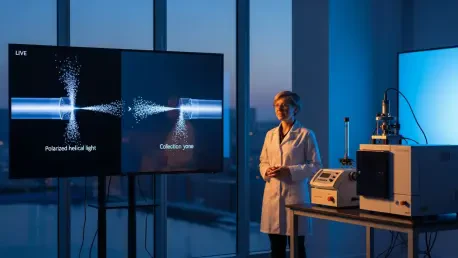
That behavior enabled a practical separation protocol within the same fiber segment. By choosing a polarization state, one enantiomer could be propelled toward a collection region while the other remained near the launch zone or migrated the other way. Switching the spin then allowed recovery of the second enantiomer without moving the fiber, changing the medium, or reconfiguring optics. The clarity of the signal in raw data underscored the advantage of the near‑field platform: it turned subtle spin–chirality coupling into a direct handle on transport with minimal averaging. Beyond proof of principle, this indicates a route to scalable implementations. Multiple fibers could be arrayed in parallel, each tuned by waist diameter and wavelength to target different particle sizes, and polarization modulation could be automated to run batch or continuous separation cycles.
Applications, Limits, and Next Steps
The immediate implications span purification, assembly, and sensing. For materials synthesis, a fiber‑integrated sorter could serve as an inline purification stage that wicks off the desired enantiomer of chiral nanoparticles after growth, improving yield without extra chemistry. In photonics, chirality‑selective placement along waveguides could pattern meta‑surfaces or fiber claddings with enantiomerically pure building blocks to tune circular dichroism or nonreciprocal responses. Analytical platforms might infer chirality from motion signatures under rapid polarization switching, enabling contactless assays that operate in microdroplets. The approach also dovetails with efforts to manipulate ever smaller objects; if field enhancements are increased through optimized tapers or hybrid plasmonic coatings, similar protocols could reach macromolecules, potentially complementing chiral chromatography with a fiber‑based, label‑free alternative.
Practical deployment still demands answers. Downscaling by 10–100× will likely require stronger near‑field intensities, reduced heating, and perhaps resonant coupling to specific vibrational or electronic transitions. Throughput must be lifted by controlling particle loading, synchronizing flow along the fiber, and integrating reservoirs for collection. Material generality remains an open question: twisted metallic cubes were ideal for strong coupling, but dielectric or semiconductor particles with varied shapes and surface chemistries need validation. Environmental robustness in buffers and complex media also warrants study. The reported effort, led by Dr. Georgiy Tkachenko and Akiyoshi Suda at Tokyo University of Science, with chiral nanoparticle fabrication by Dr. Hyo‑Yong Ahn at the Institute for Molecular Science and contributions from collaborators at Seoul National University, was enabled by KAKENHI grants JP22H05135 and JP21H04641 and declared no competing interests. For readers considering adoption, the most actionable path involved starting with metallic chiral test particles, a calibrated tapered fiber, and polarization‑pure sources, then incrementally tuning waist geometry and wavelength to balance retention and thrust.