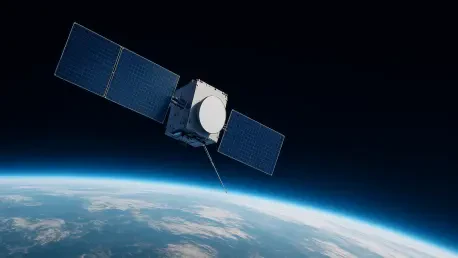

Experts monitoring the MMT-9 survey confirm that STARLINK-11444 remains invisible to the naked eye while performing sophisticated maneuvers in the lower thermosphere. This specialized hardware represents a critical evolution in satellite-to-cellular technology, functioning as an orbital cell tower that bridges the gap between traditional telecommunications and space-based infrastructure. Operating within the Starlink Group 12-2-01, this spacecraft provides connectivity directly to standard mobile devices. Unlike conventional broadband satellites at higher altitudes, this unit occupies a lower orbital shell to maximize signal strength for handheld devices. The success of this mission is paramount for global mobile coverage in regions where terrestrial towers are impractical. By maintaining a steady position in a high-drag environment, the satellite demonstrates the viability of long-term direct-to-cell services using current propulsion.
Platform
Design
The physical construction of STARLINK-11444 is optimized for the rigors of low Earth orbit while accommodating the unique demands of cellular communication. Built on the V2 Mini platform, the satellite features a 4.1-meter wide body and massive solar arrays that span 29 meters, providing the power required to penetrate the atmosphere with a clear signal. This large surface area acts like a sail, catching residual gas particles at the edge of space and complicating its flight path significantly.
Despite its size, the satellite maintains a launch mass of 730 kilograms, including a precise allocation of propellant. With only a 30-kilogram margin of fuel remaining, every maneuver is calculated to balance longevity with performance. This efficiency is necessary because the direct-to-cell link requires the satellite to remain physically closer to the user, creating a struggle against the physical forces that seek to drag the craft back toward the Earth.
Control
The primary technical challenge involves the link budget necessary to talk to small phone antennas from hundreds of miles away. To achieve this, the satellite hovers at an average altitude of 362 kilometers, placing it well below the 550-kilometer altitude used by standard broadband units. This proximity reduces the path loss of the radio signals, ensuring that even a standard smartphone can lock onto the signal without requiring specialized hardware or bulky external antennas.
However, this low altitude comes at a price in terms of orbital maintenance. The density of the atmosphere at 362 kilometers causes decay for any passive object, yet data shows this satellite has stayed within a tight 1.5-kilometer range over several months. This stability confirms that the Hall-effect thrusters are firing with high frequency to counteract drag, proving that the active station-keeping systems are managing the harsh environment with unprecedented precision and control.
Mission
Metrics
Photometric observations indicate that despite its size, the satellite remains remarkably dim, averaging a magnitude of 7.31. This low visibility is achieved through advanced coating and orientation strategies designed to minimize light pollution for astronomers on the ground. The consistency of these brightness readings suggests that the craft is not experiencing any tumbling, as a destabilized satellite would show rhythmic flashing as its surfaces catch the sun during its orbital transit.
Steady inclination data at 43 degrees reinforces the conclusion that the satellite is performing exactly as intended within its assigned orbital shell. Monitoring systems have detected no significant deviations from its path, indicating that the guidance and control software is successfully navigating the density fluctuations of the thermosphere. This level of steady-state operation is a prerequisite for scaling the direct-to-cell constellation to thousands of units in 2027.
Strategy
The stable performance of STARLINK-11444 established a blueprint for the next phase of global telecommunications. By successfully navigating the high-drag environment of the lower thermosphere, the mission proved that active propulsion could overcome the physical limitations of low-altitude orbits