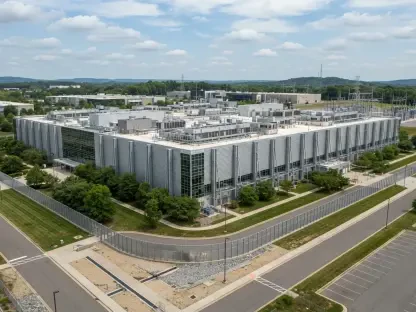

A global surge in NVIDIA AI Aerial and Sionna adoption marks a pivotal shift toward software-defined radio architectures as the standard for future connectivity research. As the industry transitions beyond the limitations of 5G, the focus in 2026 has shifted toward creating AI-native networks that integrate intelligence directly into the physical layer. This transformation is driven by the realization that future telecommunications challenges, such as extreme latency requirements and massive device density, cannot be solved through traditional hardware-centric approaches alone. By utilizing high-performance GPU computing and advanced neural network libraries, global researchers are redefining the architecture of the radio access network. The adoption of these platforms has seen a tenfold increase over the past year, with downloads exceeding the one million mark across thousands of institutions. This widespread engagement highlights a significant consensus within the scientific community: the path to 6G requires a departure from fixed mathematical algorithms toward adaptive, software-driven solutions that can learn and optimize in real-time. The integration of specialized development frameworks allows for a seamless bridge between theoretical signal processing and the practical deployment of next-generation infrastructure.
Revolutionizing Machine Intelligence with Semantic Communication
King’s College London has recently pioneered a concept known as goal-oriented semantic communication, which is designed to enhance the efficiency of robotic systems operating within industrial environments. In traditional wireless setups, a robot often transmits raw, high-resolution visual data to a central server for processing, a method that consumes significant bandwidth and introduces critical latency. This delay can be catastrophic for real-time operations, such as collaborative manufacturing or automated logistics. To address this, researchers developed a method that identifies and transmits only the semantic meaning or the specific task-relevant information. For example, instead of sending a complete video stream of a warehouse floor, the system transmits compact numerical descriptions of object coordinates and their spatial relationships. This approach ensures that the network is not just a pipe for raw data but an intelligent participant that understands the context of the information it carries.
The practical impact of this semantic approach was demonstrated through a series of complex robotic tasks involving industrial packing and item stacking. In these scenarios, the research team achieved a 52.6% reduction in task completion times compared to traditional periodic image transmission methods. This efficiency gain is particularly impressive because it was maintained even when intentional signal faults were introduced to simulate challenging wireless conditions. These findings suggest that the 6G era will likely be defined by machine-to-machine intelligence, where connectivity is optimized for the specific outcome of a task rather than just the volume of bits delivered. For industrial operators, this translates to faster production cycles and higher reliability in automated systems. As robots and humans work in closer proximity, the ability of the network to prioritize meaningful information over redundant background data becomes a fundamental requirement for safety and operational fluidity.
Optimizing Signal Recovery Through Neural Receivers
Wireless signal reception is inherently difficult due to physical obstacles, atmospheric conditions, and electromagnetic interference, which are typically managed by rigid, pre-programmed mathematical algorithms. SoftBank and ETH Zurich have explored a more dynamic alternative by integrating AI-based neural receivers into their network architectures. Unlike traditional receivers that use fixed logic to decode radio waves, a neural receiver can be trained to recognize and filter out specific types of noise and interference that are unique to a particular environment. This capability allows the system to adapt its signal processing strategies in real-time, effectively learning how to better recover data from corrupted or weak radio signals. By moving this processing to a software-defined layer powered by high-performance GPUs, operators can update and refine the receiver’s performance without the need for expensive hardware replacements or physical site visits.
During experimental testing, SoftBank integrated a neural receiver into a CUDA-accelerated radio access network and tested it against a standard 5G smartphone in a high-interference environment. The results showed a maximum improvement of 60.5% in uplink throughput, demonstrating that AI can significantly outperform conventional signal recovery techniques. In a complementary study, researchers at ETH Zurich focused on localized tuning, where AI models are specifically trained on the unique topography and signal reflections of a specific base station site. This site-specific optimization resulted in a reduction of signal error rates by more than one-third. The consensus from these projects indicates that the future of wireless connectivity will move away from one-size-fits-all hardware solutions toward software-defined neural networks that are perfectly calibrated to their physical surroundings. This evolution ensures that even in dense urban centers or crowded public venues, the quality of service remains high and predictable.
Tackling the Sustainability Crisis in Telecommunications
The exponential rise in global data demand has brought the energy consumption of radio access networks to the forefront of industry concerns. As telecommunications operators scale their infrastructure to meet the needs of 2026 and beyond, the carbon footprint and operational costs of maintaining always-on base stations have become increasingly difficult to justify. The University of Leeds addressed this sustainability challenge by developing a predictive AI system designed for dynamic power management. By creating a digital twin of a cellular environment, researchers were able to train an AI model to forecast network demand ten minutes into the future. This foresight allows the network to make intelligent decisions about which components of the base station are necessary at any given moment, rather than leaving the entire system running at full power during periods of low user activity.
The experimental results from the Leeds study provided a clear roadmap for achieving significant energy savings without compromising the user experience. The AI-managed system achieved a 45.6% reduction in radio access network power consumption compared to baseline operations. Crucially, the system ensured that whenever a base station transitioned into a low-power sleep mode, neighboring active stations were pre-emptively adjusted to maintain coverage for any remaining devices in the area. This seamless transition prevents dropped calls or data interruptions, addressing the primary concern of network reliability. For telecommunications providers, these findings offer a practical strategy for reducing operational expenditures while aligning with global environmental sustainability goals. As the density of base stations increases for 6G deployment, such predictive intelligence will be essential for managing the total energy load of the global communication grid.
Accelerating the Innovation Cycle with GPU Simulation
Developing and validating the next generation of wireless standards requires testing millions of potential network configurations, a process that has historically required months or even years of physical field trials. Spain’s Center Tecnològic de Telecomunicacions de Catalunya has significantly accelerated this innovation cycle by leveraging GPU acceleration for complex network simulations. By integrating advanced radio channel models into standard simulators, the researchers replaced traditional, slow CPU-based methods with high-speed ray tracing. This technology allows for the precise modeling of how radio waves bounce off buildings, trees, and other obstacles in a virtual environment. The ability to simulate these interactions with high fidelity and speed allows researchers to identify the most efficient network designs long before any physical equipment is manufactured or deployed.
The transition to GPU-based simulation led to a dramatic reduction in processing time, condensing a workflow that previously required three hours into just ten to twenty minutes. This 90% reduction in simulation time enables research teams to iterate rapidly, testing more scenarios and configurations in a single afternoon than was previously possible in an entire week. Such a leap in productivity democratizes high-level research, allowing smaller institutions and innovative startups to contribute to the global 6G standard. This trend highlights a broader shift in the industry: the pace of hardware standardization is now being dictated by the speed of software development and virtual validation. As simulation technology continues to evolve, the gap between theoretical research and commercial deployment will continue to shrink, leading to a more agile and responsive telecommunications industry that can adapt to new demands as they arise.
Synthesizing the Future of Intelligent Connectivity
The combined efforts of these global research partners point toward a future where artificial intelligence is not merely an add-on feature but is embedded into the very physical layer of communication. There is a clear industry consensus that the transition to 6G cannot be achieved through raw bandwidth or spectrum increases alone. Instead, intelligence must act as a substitute for the physical limits of power and spectrum availability. The move toward software-defined architectures and the use of digital twins for validation has become the new industry standard for developing complex, context-aware networks. This convergence of telecommunications and high-performance computer science has effectively turned the radio tower into a localized data center, capable of supporting the high-speed, low-latency demands of embodied AI and real-time human-machine interaction.
The findings released in late 2026 established a technical and economic foundation for the next decade of global connectivity. Researchers at King’s College London demonstrated how semantic data could cut robotic task times by over half, while SoftBank’s work on neural receivers proved that AI could boost throughput by over 60%. Simultaneously, the University of Leeds showed that predictive power management could slash energy usage by nearly 46%, and CTTC proved that simulation cycles could be accelerated by 90%. These outcomes provided the industry with actionable data for designing more sustainable, reliable, and intelligent infrastructure. By prioritizing open-source collaboration and software-led innovation, the telecommunications community moved closer to a hyper-connected world where the network itself is capable of learning and evolving. These milestones ensured that the path toward 6G remained focused on practical solutions that benefited both industrial efficiency and environmental responsibility.