
The challenge of powering remote sensors for extended periods is addressed by a module design that supports autonomous battery operation for up to two years. This achievement, represented by the Sfernice WLMO wireless module, marks a significant shift in how industrial facilities manage machine-to-machine communication without the logistical burden of extensive wiring. By utilizing the license-free 2.4 GHz ISM band, the hardware facilitates high-precision analog sensor data transmission over impressive distances of up to 2 kilometers in open environments. This long-range capability is vital for expansive industrial sites where running cables to every actuator is economically infeasible. The integration of LoRa modulation ensures that signals remain robust even in crowded radio-frequency landscapes. Consequently, operators can now achieve granular visibility into remote assets that were previously considered too expensive to monitor effectively within existing factory budgets. This balance of power efficiency and signal strength represents a crucial evolution in the deployment of Industrial Internet of Things infrastructure, providing a solid foundation for responsive automation.
Physical Architecture and Efficiency
Technical Specifications: Analog Precision
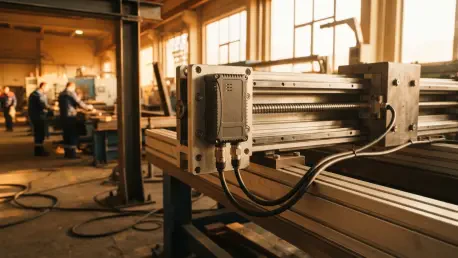
At the heart of the module lies a sophisticated 12-bit analog-to-digital converter that ensures the precision of every reading taken from the field. This high resolution is critical when monitoring sensitive equipment such as linear actuators or rotary potentiometers, where minor deviations can indicate the onset of mechanical failure. The system supports up to two separate sensors through sealed M8x1 connectors, providing a rugged interface that prevents moisture ingress and maintains electrical contact in harsh conditions. With a transmit power capped at 7.08 mW and a carefully controlled 10% duty cycle, the device manages its energy reserves with extreme discipline. This efficiency is what enables the multiyear lifespan on a single battery, reducing the need for frequent maintenance cycles. Such technical refinement allows engineers to deploy the unit in hard-to-reach locations with the confidence that data will continue to flow consistently for several years without requiring constant physical access or battery replacements.
Design Durability: Industrial Hardening
Durability is a non-negotiable requirement for industrial components, and the module addresses this through a resilient IP67-rated enclosure. Measuring 89 mm by 55.5 mm by 21.6 mm, the housing is constructed from UV-resistant materials that protect the internal electronics from sunlight degradation and chemical exposure. This level of protection is essential for outdoor installations in agriculture or energy metering where environmental stressors are constant. Beyond its physical toughness, the module simplifies the commissioning process through a secure mechanical switch that facilitates quick pairing with the local network. A built-in battery level monitoring system provides real-time feedback on the power status, allowing maintenance crews to plan interventions well before a failure occurs. This proactive approach to hardware management ensures that the wireless network remains operational and reliable, even when deployed in demanding ecosystems where traditional electronic devices often succumb to vibration, heat, or moisture.
Strategic Connectivity and Performance
Network Optimization: Signal Reliability
Reliability in wireless communication is achieved through a combination of high receiver sensitivity and configurable transmission parameters. This module offers an exceptional sensitivity of -140 dBm, which allows it to pick up weak signals over long distances or through structural obstacles. To avoid the pitfalls of frequency congestion, the system provides five selectable frequency bands and six configurable spreading factors. This flexibility enables system integrators to fine-tune the wireless performance based on the specific interference profile of their facility. Bidirectional communication capabilities further enhance the system by allowing for acknowledgment signals and remote configuration updates, ensuring that the link is not just a one-way broadcast but a robust conversation. Such versatility is indispensable when building a scalable monitoring network that must coexist with other wireless technologies like Wi-Fi, ensuring that critical sensor data always reaches its destination regardless of the radio-frequency environment.
Strategic Implementation: Actionable Outcomes
The introduction of this LoRa-based module provided a clear roadmap for organizations seeking to modernize their legacy monitoring systems without a complete infrastructure overhaul. Decision-makers recognized that the initial investment in wireless sensing significantly lowered the total cost of ownership by eliminating the need for expensive cabling and specialized labor. Future considerations now involved the integration of these data points into broader artificial intelligence frameworks to further automate response protocols. By adopting this technology, industrial leaders established a more flexible and scalable approach to asset management that prepared them for the complexities of the 2026 to 2028 operational cycle. The move toward autonomous sensing effectively bridged the physical and digital realms, ensuring that every movement within a facility was analyzed. This strategy proved essential for maintaining competitiveness in an era where data-driven efficiency became the primary metric for industrial success and long-term sustainability.