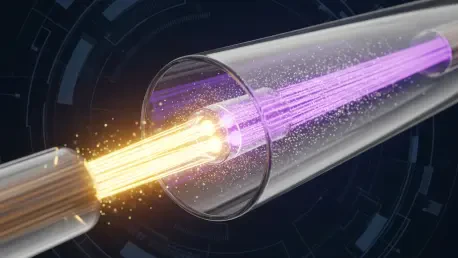

The exponential growth of global data consumption has forced telecommunications providers to reconsider the fundamental efficiency of existing subterranean and undersea fiber-optic infrastructures. While laying down entirely new cables remains a prohibitively expensive and time-consuming endeavor, the industry has pivoted toward maximizing the utility of every single strand of glass through bidirectional (BiDi) transmission technologies. This approach allows for simultaneous upstream and downstream data flow on a single fiber, effectively doubling the capacity without the need for additional physical hardware installations in crowded urban conduits. However, the elegance of this solution is frequently compromised by a phenomenon that engineers have termed ghost noise. This interference occurs when light pulses traveling in opposite directions interact with the medium in ways that generate phantom signals, creating a significant barrier to achieving the theoretical maximum throughput of modern optical networks across the globe.
Physical Mechanisms: Signal Disruption
The primary culprit behind ghost noise is a well-documented physical interaction known as Rayleigh backscattering, which arises from unavoidable microscopic variations in the density of the silica fiber. Even the most precisely manufactured optical strands contain minute structural inconsistencies that cause a tiny fraction of the transmitted laser light to bounce backward toward the origin point. In a traditional unidirectional setup, this backscattered light is largely ignored or easily filtered out, as the receiver is located at the far end of the link. In a bidirectional configuration, however, the receiver shares the same fiber end as the local transmitter. This proximity means that the backscattered echo of the outbound signal lands directly into the sensitive local receiver, appearing as a chaotic background of noise that mimics the actual incoming data. This persistent spectral interference severely limits the distance over which clear signals can be maintained without significant data loss.
Beyond simple scattering, more complex nonlinear effects like Stimulated Brillouin Scattering (SBS) introduce a sophisticated layer of signal degradation that traditional filters struggle to manage. SBS occurs when the intense electromagnetic field of the laser light generates acoustic vibrations, or phonons, within the glass structure of the fiber itself. These vibrations create a periodic index of refraction that acts like a moving mirror, reflecting a portion of the signal power backward toward the source with a specific frequency shift. Because this shifted reflection often overlaps with the intended signal wavelength coming from the opposite direction, it cannot be easily separated by standard hardware components. The resulting interference is particularly problematic in high-power long-haul links, where the intensity of the light is sufficient to trigger these acoustic-optical interactions. This creates a ceiling for the amount of power that can be injected into the fiber before the noise becomes insurmountable.
Analytical Methodology: System Impacts
To address these persistent challenges, engineering teams have recently employed sophisticated diagnostic methodologies that combine high-fidelity computational modeling with precise laboratory validation. By utilizing digital twin simulations that replicate the exact physical properties of specific fiber types, researchers have been able to isolate the unique spectral fingerprints of various noise components. These models allow for the adjustment of variables such as fiber length, core diameter, and ambient temperature to see how they influence the intensity of ghost noise across different environmental scenarios. In the laboratory, these findings are verified by varying the input power levels and observing the corresponding changes in the bit error rate and signal-to-noise ratio. This comprehensive analytical approach has moved the industry away from trial-and-error troubleshooting toward a more data-driven strategy for identifying exactly how and where signal corruption originates in a given link.
One of the most concerning impacts identified through this research is the systematic degradation of inline optical amplifiers, which are vital components for maintaining signal integrity over vast distances. When ghost noise enters an erbium-doped fiber amplifier (EDFA), it competes with the legitimate data signal for the limited energy available within the amplification medium. Because these devices are generally designed to boost everything within a specific wavelength band, they inadvertently amplify the backscattered noise alongside the intended traffic. This dynamic range consumption means that as the link grows longer and passes through more amplification stages, the noise floor rises disproportionately fast compared to the signal strength. The result is a compounding effect where the ghost noise eventually saturates the system, leaving no room for the data to be recovered. This realization has forced a shift in how network architects plan the placement and gain settings of amplifiers in bidirectional deployments.
Multi-Layered Strategies: Noise Suppression
The modern response to ghost noise relies heavily on advanced digital signal processing (DSP) algorithms that operate in real-time at the receiver end of the optical link. These algorithms are designed to perform sophisticated mathematical subtractions, effectively identifying the predictable patterns of the local transmitter’s backscatter and removing them from the incoming data stream. By monitoring frequency offsets and temporal delays with extreme precision, the DSP can distinguish between the ghost of the local signal and the legitimate signals arriving from the distant transmitter. This capability is especially important because the characteristics of Rayleigh and Brillouin scattering can shift based on mechanical stress or temperature fluctuations along the fiber line. A dynamic DSP approach ensures that the suppression remains effective even as the physical environment changes, allowing for high-performance communication in external fiber plants that are exposed to the elements.
While digital solutions handle the remaining interference, physical hardware improvements act as the first line of defense to prevent noise generation at the source. Implementing Angled Physical Contact (APC) connectors has become standard practice, as the eight-degree tilt on the fiber end-face ensures that any back-reflected light is directed out into the cladding rather than back into the core. Additionally, the integration of specialized Fiber Bragg Gratings (FBG) provides a narrow-band filtering solution that can be tuned to block specific frequency-shifted reflections associated with Brillouin scattering. These gratings act as highly selective gates that allow the intended signal through while reflecting the noise back toward a localized absorber. By combining these passive optical components with high-quality isolators, manufacturers have successfully reduced the total volume of reflected light that reaches the sensitive photodetector electronics. This hardware-centric foundation significantly lightens the computational load on the DSP.
Power Management: Future Innovations
A radical departure from traditional networking philosophy involves the use of asymmetric power management to disrupt the conditions that foster noise accumulation. For decades, the industry standard was to maintain balanced power levels for both directions of traffic in a bidirectional link to simplify system design. However, recent breakthroughs have shown that intentionally offsetting the power levels—for example, transmitting at a higher power in one direction and a lower one in the other—can prevent the constructive interference patterns that lead to ghost noise artifacts. This asymmetry prevents the two signals from interacting symmetrically with the acoustic waves in the fiber, effectively breaking the cycle of Stimulated Brillouin Scattering. This method has proved to be a low-cost and highly effective tool for optimizing existing links, allowing technicians to tune the performance of a fiber strand without needing to replace any of the underlying physical infrastructure or specialized components.
The successful suppression of ghost noise represented a pivotal moment for the expansion of global connectivity and the eventual transition to hybrid networking architectures. As machine learning models became more integrated into network management, they allowed for the automated identification of even the most subtle noise profiles before they impacted user experience. This progress paved the way for the coexistence of classical data and quantum-secure signals on the same physical fiber strands, which was previously thought impossible due to the delicate nature of quantum states. By eliminating the overwhelming presence of spectral echoes, engineers established a stable environment where single photons could travel alongside high-bandwidth commercial traffic. This achievement ensured that fiber-optic infrastructures remained relevant and capable of meeting the demands for increased security and speed. The shift toward these sophisticated suppression methods provided the blueprint for a more resilient telecommunications landscape.