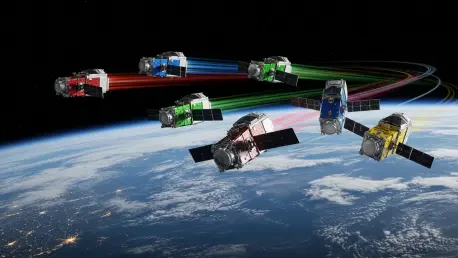

The competitive landscape of the orbital economy has shifted from a theoretical exercise in engineering to a high-stakes geopolitical and commercial battlefield where billions of dollars are deployed with every rocket launch. As of 2026, the aspiration to provide high-speed, low-latency internet from space has moved beyond the experimental phase, evolving into a crowded theater of operations featuring two of the world’s most prominent billionaires. This modern space race aims to blanket the planet with low-Earth orbit (LEO) satellites, promising high-speed broadband and direct-to-device connectivity from almost any point on the globe, effectively challenging a century of terrestrial telecommunications dominance. While tech enthusiasts often envision a future world entirely free from ground-based towers and local cable monopolies, the current reality remains a complex mix of billionaire ambition, massive capital expenditure, and the rigid, unforgiving constraints of physical science that govern radio frequency propagation and orbital mechanics.
The Competitive Landscape in Orbit
Comparing Market Leaders and Newcomers
Starlink currently dominates the orbital landscape with a constellation of over 10,000 satellites, yet its actual financial footprint remains surprisingly small when compared to the established traditional telecom giants that have controlled the market for decades. Even with its impressive rate of deployment and high-profile marketing, the revenue and subscriber base for the service represent a tiny fraction of the multi-trillion-dollar global internet market, serving less than one percent of total connected users. Musk’s lead is significant in terms of sheer hardware numbers and brand recognition, but the company still operates as a relatively small niche player in the broader context of the two-trillion-dollar global telecommunications industry. This disparity highlights a central tension in the industry: while the technology is groundbreaking, the business model must still contend with the massive economies of scale enjoyed by terrestrial carriers that use fiber optics and cellular towers to serve billions of urban and suburban customers.
Jeff Bezos is aggressively playing catch-up through Amazon’s Project Kuiper, utilizing strategic acquisitions and massive capital injections to secure the specific spectrum licenses necessary to challenge Musk’s substantial head start. Amazon’s multi-billion-dollar bid for Globalstar highlights a significant shift in strategy, where the company is prioritizing the ownership of valuable frequency ranges over just the rapid deployment of satellite hardware. By securing these specific spectrum assets, Bezos aims to bypass years of grueling regulatory hurdles and international coordination efforts, positioning Project Kuiper to offer hybrid services that combine space-based connectivity with existing terrestrial capabilities. This strategy suggests that Amazon views the satellite race not just as a standalone ISP venture, but as a critical infrastructure layer for its existing cloud computing and logistics empire, potentially allowing for a more integrated ecosystem than Starlink’s consumer-focused approach.
The Scale of Billionaire Ambition
The sheer scale of these projects requires a level of investment that few entities outside of national governments can afford, leading to a unique duopoly in the private space sector. Musk has frequently noted that the primary goal for Starlink is simply to avoid the bankruptcy that has historically plagued almost every previous attempt at a large-scale LEO constellation. To reach a state of true financial viability, the project may require upwards of $30 billion in investment, a figure that covers not just the manufacturing of satellites but the continuous cycle of replenishing those that de-orbit and burn up in the atmosphere. This high “burn rate” of capital means that the project must scale rapidly to millions of high-paying customers just to keep pace with its own operational costs, creating a high-pressure environment where technical failures or launch delays can have catastrophic financial consequences.
In contrast, Amazon’s approach is backed by the diversified revenue streams of a global retail and technology giant, providing a safety net that Musk’s ventures often lack. However, this does not mean the path for Project Kuiper is without significant hurdles, as the company faces strict regulatory deadlines requiring the launch of 1,600 satellites by the middle of the current decade. This regulatory pressure forces a compressed development timeline that increases the likelihood of hardware malfunctions and logistical bottlenecks. Furthermore, the cost of securing launch capacity in an industry where Musk’s SpaceX is the dominant provider creates a paradoxical situation where Bezos must often rely on his rival’s rockets to get his own competing hardware into orbit. This dynamic underscores the reality that the “space race” is as much about controlling the means of transportation and the invisible airwaves as it is about the satellites themselves.
Technical Barriers and Physical Constraints
Fixed Services versus Mobile Connectivity
The satellite industry is currently split between fixed satellite services, which require specialized rooftop dishes with a clear line of sight, and the “holy grail” of direct-to-device connectivity that works with standard smartphones. While fixed dishes have proven to be a genuine lifeline for remote rural areas and maritime environments where fiber or cable is physically impossible to install, they cannot yet handle the extreme user density found in developed urban environments. The bandwidth available from a single satellite must be shared among all users in its current “footprint,” meaning that in a city like London or New York, the available speed per person would plummet to unusable levels if everyone tried to connect simultaneously. Consequently, the fixed service model is naturally limited by geometry and spectrum reuse, making it a complementary tool for the “digital divide” rather than a replacement for high-capacity city fiber.
Direct-to-cell technology is even further behind the fixed model, currently restricted to low-bandwidth emergency messaging and basic text communication rather than the high-speed data streams users expect from modern 5G devices. The engineering challenge of connecting a standard smartphone to a satellite orbiting 350 miles away is immense, as the antenna inside a typical phone is designed to communicate with a tower just a few miles away. While there is significant hype around the prospect of “unlimited” space-based data for phones, the technical reality is that the data rates are currently measured in kilobits rather than megabits. This ensures that for the foreseeable future, direct-to-device satellite features will remain a premium safety feature for hikers and travelers rather than a primary method for browsing the web or streaming high-definition video in suburban neighborhoods.
The Problem of Signal Propagation
Physics presents a daunting and perhaps insurmountable challenge for satellite-to-phone communication, as terrestrial signals from nearby cell towers easily overpower those coming from hundreds of miles above the Earth. A smartphone’s internal logic is fundamentally programmed to lock onto the strongest and most stable available signal, meaning satellites are almost always the second or third choice for a device unless the user is in a total “dead zone.” This fundamental gap in signal strength ensures that traditional ground-based infrastructure remains the primary backbone for mobile connectivity for the majority of the population. Even with massive advances in beamforming technology and larger satellite antennas, the inverse-square law of physics dictates that a signal traveling from orbit will always be significantly weaker than one coming from a small-cell node located just a few hundred feet down the street.
Another significant hurdle that is often overlooked in marketing materials is the inability of satellite signals to penetrate buildings and provide reliable indoor coverage. Since the vast majority of mobile data consumption happens indoors—often through Wi-Fi or cellular boosters—a satellite-only model fails to meet the most basic connectivity needs of the average modern user. The high-frequency waves used by satellite constellations are easily blocked by concrete, steel, and even specialized energy-efficient glass, requiring a clear line of sight to the sky that is rarely available inside a home or office. Overcoming this limitation would require a total redesign of building materials or a massive change to device hardware, including the addition of larger, more power-hungry antennas that would compromise the form factor of modern smartphones. Because of these physical realities, the “Internet in the sky” will likely remain a background utility rather than a daily interface for the urban masses.
Economic Risks and Market Realities
High Stakes and Niche Markets
The financial risks associated with these massive constellations are staggering, with both Musk and Bezos pouring billions into projects that carry high execution risks and uncertain long-term returns. The history of the satellite industry is littered with the remains of companies that underestimated the cost of maintaining a fleet of satellites in a harsh space environment where radiation and orbital decay are constant threats. Every satellite launched has a finite lifespan, typically five to seven years, meaning that the operators must constantly launch new hardware just to maintain their existing service levels. This creates a perpetual cycle of capital expenditure that requires a massive, steady stream of subscription revenue to sustain. If subscriber growth plateaus or if the price of launches increases, the entire economic foundation of these constellations could become unstable, leading to potential consolidation or service interruptions.
Despite the intense media coverage and the perception of a global revolution, the consensus among industry analysts is that satellite internet will remain a niche service for “hard-to-reach” locations rather than a mass-market solution. It serves as a vital tool for rural residents, emergency responders, and research stations, but it lacks the inherent bandwidth to support millions of simultaneous high-speed users in a small geographic area. The revenue generated by this sector, while growing, is still a pittance compared to what established national carriers earn from their legacy terrestrial networks. For example, a single mid-sized European carrier often generates more annual revenue from its localized ground-based network than the entire global Starlink project currently does. This disparity suggests that while the satellite race is technologically impressive, it is not yet a disruption of the fundamental economics of the global telecommunications industry.
Strategic Infrastructure and Next Steps
Ultimately, the battle between Musk and Bezos is as much about long-term strategic legacy as it is about current-year profits or technological milestones. While their efforts will drastically improve connectivity for underserved regions and provide a critical safety net for emergency communications, the dream of a completely tower-free world remains more of a tongue-in-cheek fantasy than a likely reality. Organizations and government agencies should view these satellite constellations not as replacements for fiber and 5G, but as essential redundancy layers that provide resilience during natural disasters or infrastructure failures. The terrestrial telecom sector remains firmly grounded in the physical reality of urban density and indoor usage, and for the vast majority of the world’s five billion internet users, the connection will continue to come from the streets rather than the stars.
Moving forward, the industry is likely to see a trend toward “hybrid connectivity,” where devices seamlessly switch between terrestrial towers and satellite links depending on availability. For telecommunications providers, the next logical step is to integrate these satellite capabilities into their existing service bundles rather than viewing them as direct competitors. This would allow a consumer to maintain a basic level of connectivity even in remote national parks or in the middle of the ocean, using the satellite layer as a specialized “roaming” partner. For businesses, investing in satellite-compatible hardware for fleet management and remote monitoring will become a standard operational requirement. As the orbital infrastructure matures, the focus will shift from the novelty of space-based internet to the practical application of building a more resilient, multi-layered global network that leaves no corner of the map truly disconnected. In the end, the success of Musk and Bezos will be measured not by the destruction of terrestrial telcos, but by how well their celestial networks integrate with the world we have already built on the ground.