
Regional fiber providers now face devastating financial penalties if large-scale AI connectivity projects are delayed by unforeseen geological issues or local labor shortages during the construction process. This current environment represents a stark departure from the collaborative industry norms that defined the previous decade of infrastructure development. As the demand for massive computing clusters accelerates, the pressure on regional operators to deliver high-capacity, low-latency connections has reached a fever pitch, often outpacing the logistical capabilities of smaller firms. These companies are navigating a landscape where the reward for successful deployment is immense, yet the margin for error has effectively vanished. The rapid expansion of artificial intelligence infrastructure is not merely a technical challenge but a financial tightrope walk that forces providers to rethink their entire operational model. Balancing the need for rapid growth against the threat of catastrophic insolvency has become the defining characteristic of the modern telecommunications sector today.
Financial Liability: The Shift in Risk Management
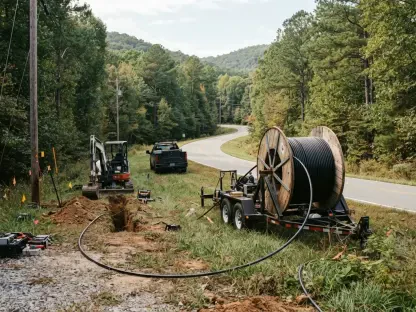
Historically, technology giants and hyperscalers were willing to share the financial burden of fiber construction to ensure their facilities went online according to aggressive schedules. However, as the market matures, these dominant players are increasingly utilizing their leverage to push the entirety of project risks onto the fiber providers. Modern contracts are now characterized by rigid, fixed-pricing models and unforgiving delivery timelines that leave little room for the realities of field construction. If a provider encounters a pocket of hard rock that requires specialized blasting or if a regional labor shortage halts progress, the financial fallout rests solely with the contractor. This shift has eliminated the informal cost-plus safety nets that previously allowed operators to absorb unexpected expenses without compromising their corporate stability. Today, the negotiation table is dominated by legal terms that prioritize the buyer’s protection over the supplier’s viability, creating a high-pressure environment for mid-tier telecommunications companies.
Financial Liability: Precision and Penalty Clauses
In this new era of contract negotiations, the burden of performance lies squarely on the shoulders of the telecom companies. If a project faces significant delays, providers often encounter steep financial penalties that can erase thin profit margins in a matter of weeks. This environment demands extreme precision during the initial scoping phase, as there is no longer a financial safety net provided by the client to cover unexpected expenses. Operators are responding by employing advanced predictive analytics and enhanced geological surveying techniques before even submitting a bid. The goal is to identify potential choke points in the construction timeline that could lead to liquidated damages. This transition from a collaborative growth mindset to one of defensive risk mitigation reflects a broader trend of professionalization in the fiber industry. Companies that fail to adapt their internal auditing and project management protocols find themselves exposed to liabilities that can easily outpace their annual revenue, leading to a climate where only the most disciplined firms survive.
Unprecedented Scale: The Existential Threat of Size
The sheer size of artificial intelligence-related builds is far beyond the typical scope of regional fiber projects, turning manageable risks into potential existential threats for smaller players. While a traditional commercial build might cost several million dollars and cover a few dozen miles, an AI data center route can easily exceed the $100 million mark and require complex subterranean engineering. A minor percentage error in budgeting that would have been a mere nuisance in the past can now result in a multi-million dollar deficit that threatens a company’s total stability. This massive increase in capital intensity means that a single failed project can bankrupt a provider that has operated successfully for decades. Consequently, the industry is seeing a shift in how these companies approach their project pipelines, with many moving away from a volume-based strategy toward a more selective, high-margin model. The complexity of these builds often involves navigating multiple municipal jurisdictions simultaneously, each with its own permitting hurdles and environmental regulations.
Unprecedented Scale: The Necessity of Capital Discipline
To navigate this era of exponential scale, regional providers are being forced to adopt a much higher level of capital discipline than ever before. Many are now choosing to focus exclusively on geographic areas where they have deep-rooted expertise and established relationships with local authorities. Venturing into unfamiliar territory is increasingly viewed as a dangerous gamble, as the financial consequences of a failed large-scale project are too high to ignore. This localized focus allows firms to leverage existing knowledge of soil conditions, utility right-of-ways, and political landscapes to minimize surprises. Furthermore, the reliance on internal labor rather than third-party subcontractors has become a key differentiator for successful providers, as it offers greater control over quality and timing. By refusing to chase every available contract, these operators are attempting to build sustainable growth that can withstand the cyclical nature of the tech industry. This strategic retrenchment ensures that companies are not overextending their balance sheets during a period of high costs.
Remote Logistics: The Hazard of Geographic Isolation
AI data centers are increasingly being built in remote, off-the-beaten-path locations to secure the massive amounts of land and electricity they require for their high-density cooling systems and server racks. Connecting these isolated campuses is a logistical nightmare, requiring multiple physically diverse fiber paths to ensure constant uptime and redundancy. The risk is that a provider might invest millions in engineering, easements, and permitting for a bridge to nowhere if the data center project is eventually canceled due to local opposition or power grid limitations. The financial drain of these projects often begins long before construction, with feasibility studies and specialized permitting drawings costing a fortune. If a data center development falls through, the fiber provider is left with a highly specialized asset in a rural area that cannot be repurposed for other enterprise clients. This lack of a secondary market makes remote AI builds significantly riskier than traditional urban infrastructure projects where fiber density always has high utility value.
Strategic Resilience: Future-Proofing and Sustainable Growth
Industry leaders focused on creating resilient growth by prioritizing the installation of larger conduits than were strictly necessary for initial project requirements. This forward-thinking strategy allowed operators to accommodate future expansions without the need for expensive new excavation projects, effectively turning a single-purpose build into a long-term utility asset. By sticking to their core geographic territories and building with the future in mind, regional operators successfully navigated the financial traps that had claimed less disciplined competitors in earlier expansion cycles. The implementation of rigorous due diligence processes during the pre-contract phase became the standard for protecting against the volatility of the construction process. Moving forward, the industry must continue to balance the technical demands of high-performance computing with the financial realities of physical infrastructure deployment. The ultimate success of the AI revolution will likely depend on the ability of fiber providers to maintain this cautious approach, ensuring that the digital backbone remains robust for many years.