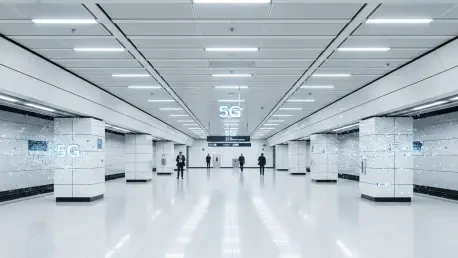

The subterranean labyrinth of New York’s Pennsylvania Station is witnessing a shift that extends far beyond physical renovation into the realm of invisible digital architecture, fundamentally altering how millions of passengers traverse the city’s most critical transit artery. This massive modernization project, led by a strategic alliance between the Metropolitan Transportation Authority and Boingo Wireless, involves the widespread deployment of high-speed 5G and Wi-Fi networks throughout the Long Island Rail Road Concourse. By embedding cutting-edge telecommunications directly into the transit hub’s core, planners are moving toward a vision where the commute is no longer a period of disconnection but a seamless digital experience. This transformation represents a critical response to the evolving needs of a hyper-connected society that demands reliability even deep beneath the city streets. The integration of these technologies serves as the backbone for future urban mobility initiatives within New York, ensuring the station remains a competitive global landmark.
Enhancing the Passenger Experience
Eliminating Subterranean Signal Dead Zones
For decades, the dense concrete and steel framing of Penn Station acted as a nearly impenetrable shield against cellular signals, creating a frustrating series of dead zones for the hundreds of thousands of commuters who pass through its gates daily. These physical barriers meant that the moment a passenger descended below the street level, their ability to conduct business, communicate with family, or access real-time information was effectively severed by the architecture itself. However, the current 5G infrastructure deployment is specifically designed to penetrate these subterranean environments, providing consistent and robust signal strength throughout the concourse. This initiative effectively bridges the gap between the surface world and the platforms below, ensuring that the high-bandwidth requirements of modern devices are met without interruption. By addressing these long-standing structural challenges, the station is being reclaimed as a space where digital productivity can thrive regardless of depth or density.
Implementing Neutral Host Shared Architecture
The technical strategy employed here utilizes a neutral host architecture, which allows multiple cellular carriers to operate on a shared set of equipment rather than installing separate, redundant hardware for each provider. This sophisticated approach ensures that every passenger, regardless of their specific mobile service subscription, enjoys the same high-speed access to 5G and Wi-Fi 6 technology. This dual-layered network provides a necessary redundancy that guarantees stability even during periods of extreme congestion, which are frequent in a hub of this magnitude. Travelers now have the capacity to stream high-definition video, engage in complex remote work tasks, or download large files during their wait for a train, turning unproductive time into a flexible extension of the office or home environment. By prioritizing high-speed connectivity as a fundamental utility, Penn Station is moving toward a standard where digital infrastructure is considered just as essential as the physical tracks that keep the trains moving daily.
Streamlining Station Operations
Integrating Smart Management and Operations
Beyond the obvious benefits to the individual commuter, the integration of high-speed 5G and Wi-Fi serves as a foundational tool for the MTA to optimize its own complex daily operations within the facility. Modern transit management relies heavily on low-latency data transmission to power a wide array of systems, from contactless ticketing kiosks to dynamic digital signage that informs passengers of platform changes in real time. This robust network infrastructure also significantly bolsters the station’s safety protocols by enabling the use of connected cameras and environmental sensors that provide immediate feedback to central control. This digital overhaul highlights a successful model for public-private collaboration, where specialized expertise in shared networks allows for a more efficient and cost-effective installation process. By consolidating these systems into a single infrastructure, the agency has avoided the clutter of redundant hardware while ensuring the station remains adaptable to future technical demands.
Establishing a Blueprint for Future Resilience
The deployment of 5G connectivity into the Penn Station ecosystem established a new paradigm for how transit authorities integrated digital utility into physical space. It was not merely an upgrade to internet speeds, but a comprehensive strategy that recognized the necessity of ubiquitous access for the modern workforce. Stakeholders realized that the success of urban centers depended on their ability to offer seamless transitions between different modes of life and travel. This project provided a durable blueprint for future investments across the regional rail network, ensuring that the city remained competitive in an increasingly complex global environment. By leveraging private-sector expertise, the MTA mitigated the risks of technical obsolescence through a shared system that was both scalable and cost-effective. Ultimately, the station’s digital transformation demonstrated that investing in high-bandwidth infrastructure was essential for maintaining the facility’s role as a vital engine of the regional economy.