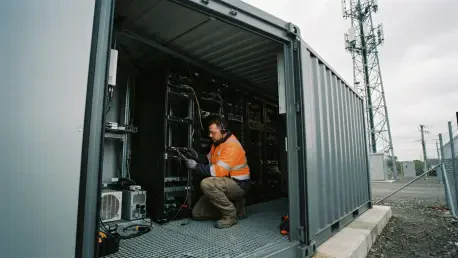

The traditional telecommunications model of selling raw bandwidth is rapidly eroding as specialized industries demand intelligence and immediacy that standard fiber backbones simply cannot deliver in an era of ubiquitous artificial intelligence. As of 2026, the global landscape is shifting from providing basic data pipes to delivering high-value, proximity-based compute services. This evolution positions communications service providers as essential partners in the B2B value chain. By merging dedicated network slices with localized compute, the industry is creating a new tier of infrastructure that bridges the gap between digital intent and physical reality.
Transforming Connectivity into an Intelligent Infrastructure Platform
Transitioning to an intelligent infrastructure platform requires a departure from the volume-based data billing that has historically defined the sector. Instead, providers are reinventing their core identity by offering a hybrid of connectivity and computation that resides closer to the end user. This strategic realignment addresses the growing need for real-time responsiveness in industrial environments where every millisecond counts toward operational safety and efficiency.
Moreover, the integration of dedicated network slices allows for the isolation of critical traffic, ensuring that high-priority AI workloads do not compete with standard consumer data. This technical partitioning is fundamental to providing the reliability required by enterprise clients. By embedding GPU resources directly within these slices, providers can facilitate complex inferencing tasks that were previously relegated to distant, centralized data centers.
This evolution is not merely a technical upgrade but a shift in the economic structure of the telecommunications industry. As artificial intelligence matures, providers are leveraging 5G network slicing to solve the inherent latency constraints of centralized cloud architectures. This positions them as essential partners for applications that demand instantaneous data processing, allowing them to capture revenue from mission-critical workflows rather than just raw transit.
Navigating the Shift Toward AI-Driven Edge Ecosystems
The rise of real-time computer vision, autonomous systems, and remote healthcare is driving a move away from centralized cloud models. Enterprises now prioritize the smarter placement of resources to bypass the physical bottlenecks of long-distance fiber optics. This trend is fueled by the demand for service-level agreements that guarantee not just uptime, but specific latency and processing thresholds.
Emergence of Proximity-Based Performance Standards
As autonomous systems become standard requirements, the industry is seeing the emergence of new proximity-based performance standards. Enterprises now prioritize the local placement of resources to bypass the physical bottlenecks caused by the distance packets must travel. This trend is fueled by the demand for agreements that guarantee specific processing thresholds essential for the safe operation of remote equipment.
Furthermore, the rise of remote healthcare applications underscores the necessity of these performance guarantees. Surgeons using robotic assistance or diagnostic tools using real-time AI cannot afford the jitter associated with traditional cloud routes. Consequently, the ability to provide a guaranteed compute bundle is becoming a primary differentiator for providers seeking to penetrate high-stakes vertical markets.
Market Projections for Edge-Integrated Services
Financial forecasts from 2026 to 2028 indicate a significant revenue pivot toward managed AI workloads and edge-as-a-service offerings. As the B2B sector integrates AI into daily operational workflows, the market for 5G AI slicing is expected to grow at an accelerated pace. This growth is tied to the industry’s ability to transition from volume-based billing to outcome-based pricing models.
Future growth is also dependent on the ability of providers to reclaim value from hyperscale cloud giants. By leveraging an existing physical footprint of base stations and central offices, telecommunications firms can offer localized performance that purely digital companies struggle to replicate. This creates a defensible market position that rewards proximity over sheer processing scale.
Overcoming Physical and Operational Integration Barriers
The primary challenge facing providers is the physics problem, where the speed of light limits the effectiveness of distant data centers for sub-10-millisecond applications. Even with the fastest fiber optics, the distance between a user and a server introduces a delay that is unacceptable for real-time AI. To solve this, providers are deploying GPU clusters at the network edge, bringing compute capability directly to the local point of presence.
Beyond the physical constraints, operational integration poses a hurdle regarding the limitations of legacy business support systems. Managing distributed GPU resources requires a level of agility that many older systems lack. Strategies for overcoming these barriers include the implementation of automated orchestration layers and AI-assisted intent probing to verify network capacity before committing to enterprise contracts.
Additionally, these orchestration layers must be capable of dynamic scaling to handle fluctuating workloads without human intervention. This automation ensures that the network remains responsive even during peak usage periods or unexpected hardware failures. By removing manual bottlenecks, providers can offer the seamless experience that modern enterprise customers expect from high-tech infrastructure partners.
Establishing New Standards for Network Assurance and Compliance
The regulatory and operational landscape for 5G AI slicing requires strict adherence to emerging standards, such as the TM Forum Open APIs for intent management. Compliance now involves real-time monitoring of both connectivity and compute performance to ensure transparency in multi-party revenue sharing. As networks become more complex, these open standards are crucial for maintaining interoperability across different vendors and regional boundaries.
Security measures must also be localized to the edge to protect sensitive enterprise data as it is processed in the slice. Ensuring that data remains within a specific logical boundary helps meet regional data sovereignty requirements and industry-specific safety regulations. This localized security model provides an extra layer of protection, making the edge-integrated approach more attractive to sectors like finance and public safety.
Future Horizons for Distributed AI Powerhouses
The future of the industry lies in the seamless integration of network nodes as distributed AI compute hubs. Emerging technologies like AI-driven closed-loop assurance allow networks to self-heal and maintain intent-based states without human intervention. As providers modernize their commercial systems, they will become the primary facilitators for a diverse ecosystem of hardware vendors and application developers.
Moving beyond the commodity market, providers are positioning themselves to dominate the high-value edge compute landscape. This shift enables the creation of sophisticated new pricing models based on compute cycles and API calls. By becoming the foundation for the global AI economy, these organizations ensure their relevance in a world where data processing is as vital as the connectivity that carries it.
Summary of the Strategic Value of Proximity
The integration of 5G AI slicing and edge compute provided the definitive path for providers to move into the high-value infrastructure tier. Organizations that invested in modern business support systems and GPU-enabled infrastructure successfully bypassed the limitations of traditional cloud models. They established a new standard for reliability that allowed enterprises to deploy autonomous systems with full confidence in the underlying network.
Ultimately, the strategic focus on localized performance secured a competitive advantage that hyperscalers could not easily match. By prioritizing the physical placement of compute resources and adopting outcome-based pricing, the industry transformed its commercial potential. Providers that embraced these changes moved beyond simple data transit to become indispensable leaders in a decentralized, intelligence-driven global economy.