
The Department of Human Settlements is evaluating data from the Empangeni pilot to potentially update national norms and standards for state-supported housing. This strategic review arrives as the contrast between mobile connectivity and fixed-line stability highlights a deep-seated economic rift within the country. Recent surveys indicate that while over eighty-five percent of the population accesses the internet via mobile devices, only twenty percent of households possess a fixed broadband connection. This discrepancy fosters a tiered digital society where residents in high-income neighborhoods benefit from uncapped, high-speed fiber, while those in lower-income areas struggle with expensive and limited data. Such a connectivity trap places students, job seekers, and micro-entrepreneurs at a severe disadvantage. To address this, there is an urgent movement to reclassify digital infrastructure as an essential utility, similar to water or electricity, ensuring that access is no longer a luxury but a standard.
Infrastructure Innovation: Addressing the High Cost of Connectivity
Traditional methods of expanding fiber networks into established residential areas often encounter severe logistical and financial roadblocks. Retrofitting a neighborhood involves invasive and costly construction processes, such as excavating existing roads and navigating a tangled network of older underground utilities. These complexities significantly inflate the capital expenditure required by internet service providers, often rendering projects in lower-income communities commercially unviable. When developers must repair damaged pavements or reroute old pipes, the overhead costs frequently deter investment in the very areas that need connectivity most. This historical reliance on retrofitting has inadvertently reinforced the digital divide by prioritizing wealthy suburbs where the return on investment is immediate and predictable. Moving away from this reactive model requires a shift toward proactive infrastructure planning that treats data pathways as a foundational element.
The economic logic behind pre-provisioning centers on altering the affordability equation for both the telecommunications operator and the end-user. By integrating fiber pathways into the initial construction phase of a housing project, the long-term costs of network activation are drastically reduced. Installing underground ducts and access boxes while homes are still being built allows for a seamless transition to high-speed internet without the need for future disruptive construction. This proactive approach significantly lowers the barrier to entry for service providers, enabling them to offer more competitive pricing models to residents. When the physical infrastructure is already present, the cost of providing service transitions from a massive capital investment to a manageable operational expense. Consequently, this model facilitates a more equitable distribution of technology, ensuring that a household’s income level does not dictate its ability to participate in the economy.
Strategic Implementation: Lessons From the Empangeni Pilot Project
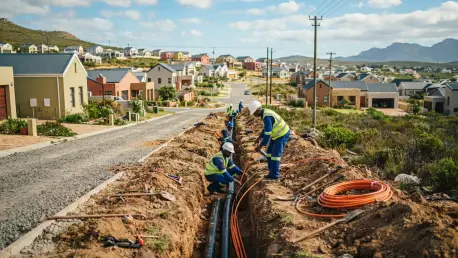
The Empangeni pilot project serves as a definitive proof of concept for this integrated infrastructure model through a robust multi-stakeholder collaboration. This initiative brought together engineering expertise from technology leaders like Huawei and network deployment insights from Openserve, alongside provincial and local government bodies. By utilizing a specific Pipe and Box methodology, the project successfully installed fiber ducts alongside essential power and water lines for more than four hundred new homes. This streamlined execution demonstrated how synchronized planning can eliminate the redundancies of modern urban development. The pilot functioned as a real-world laboratory, meticulously tracking the time and financial savings achieved compared to traditional retrofitting methods. The data gathered here provides a clear framework for how public-private partnerships can efficiently deploy technology within state-supported housing initiatives across the region.
The successful completion of the pilot project established a transformative precedent for national housing policy and construction standards. Decision-makers recognized that pre-provisioning offered a superior alternative to the inefficient cycles of retrofitting seen in the past. This initiative validated the requirement for every new state-supported community to be born fiber-ready, effectively aligning digital ambitions with urban planning goals. Local authorities discovered that this model catalyzed economic activity by allowing residents to access digital markets and educational resources immediately upon moving into their homes. Furthermore, the collaboration proved that high-speed connectivity could be delivered affordably when treated as a primary utility. By adopting these standardized frameworks, the government and private sector took a decisive step toward dismantling the digital divide. Ultimately, the transition to this integrated model ensured that geographical location no longer limited the potential of South African citizens.