
Vladislav Zaimov stands at the forefront of the modern telecommunications landscape, a seasoned strategist who has spent decades navigating the high-stakes world of enterprise connectivity and network resilience. As the industry undergoes a radical metamorphosis, moving away from the physical and financial weight of legacy infrastructure, Zaimov’s perspective offers a rare blend of technical depth and market foresight. He understands that the current shift is not merely about replacing one wire with another, but about a fundamental reimagining of how a global carrier operates in an era defined by artificial intelligence and ubiquitous connectivity. This discussion explores the aggressive decommissioning of copper networks, the strategic pursuit of a converged fiber-and-wireless fabric, and the nuanced role of emerging technologies like direct-to-device satellite services and data center interconnects in shaping the next decade of digital interaction.
Significant investments are being made to transition from legacy copper to high-speed fiber, aiming for a leaner and more agile operational model. How do you view the physical and financial magnitude of stripping away these decades-old assets, and what does it mean for the future of the network?
The sheer scale of this transition is staggering when you consider that we are essentially dismantling a century of industrial history to make room for a unified digital future. When we talk about retiring copper, we aren’t just talking about wires; we are liquidating what is effectively the fifth largest copper mine in the United States, a move that is projected to eliminate approximately $6 billion in legacy costs. This process involves the physical closure of numerous central offices, the removal of massive, energy-hungry mainframes, and the decommissioning of industrial “chillers” that have kept these legacy systems running for decades. By stripping away this “unglamorous” infrastructure, the goal is to emerge by the end of this decade as a streamlined metropolitan fiber provider supported by a high-capacity nationwide wireless network. It is a massive undertaking that replaces complexity with a clarity of purpose, allowing the company to focus entirely on two core fabrics—dense, rich fiber and a powerful wireless layer—rather than hauling around the weight of the past.
As fiber deployment continues to scale toward ambitious targets for the end of the decade, what are the primary drivers behind reaching these millions of locations and how does the current progress align with long-term growth?
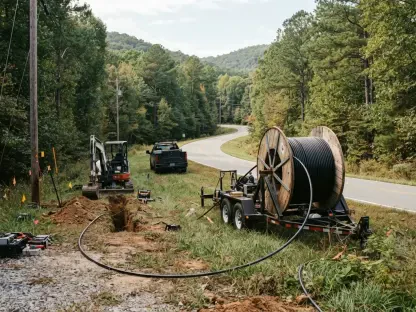
The roadmap for fiber expansion is a testament to the belief that high-quality infrastructure is the ultimate competitive advantage in a market hungry for bandwidth. We have seen a remarkable climb from the low-20 million range for fiber locations just a few years ago to 30 million today, bolstered by strategic acquisitions and organic builds. By the end of this year, the target is to hit 40 million locations, with a definitive eye on reaching 60 million by 2030 through a combination of internal projects and open-access ventures like Gigapower. This isn’t just about building footings; it’s about creating a scale provider that can deliver better profitability and a superior product offering compared to fragmented legacy competitors. By the latter part of this decade, once the physical build-out is largely wrapped up, the focus will shift entirely from construction to harvesting the returns of this massive, unified footprint.
The concept of “convergence” is often discussed in the industry, but there is a move toward a deeper technical integration beyond simple service bundling. How will managing different access technologies as a single, seamless proposition change the experience for both consumers and enterprises?
We are currently moving past the “early innings” of convergence, where the primary focus was simply on discounts and billing bundles, into a much more sophisticated phase of network management. The next step is a seamless connectivity proposition where the network layers—fiber, wireless, and even satellite—are managed as a unified software fabric rather than separate silos. Products like OneConnect are early evidence of this, where home broadband and mobile are no longer just two items on a bill, but a single, always-on service that prioritizes the best connection available at any given moment. For an enterprise, this means a “second act” where they can manage quality of service and security across every layer, whether a session starts on a 5G device or a fixed fiber connection. This technical maturity creates a product that fundamentally works better, offering a level of consistency and reliability that moves the conversation away from price and toward genuine functional value.
While consumer services often dominate the headlines, there is a renewed focus on the enterprise sector, particularly in the mid-market. What strategies are being employed to increase relevance for businesses that fall outside the traditional top-tier corporate bracket?
There is a candid acknowledgment that effectiveness in the business sector has historically lagged behind the consumer side, but that is changing through a more aggressive distribution strategy and better infrastructure placement. While the focus used to be almost exclusively on the Fortune 300, there is now a deliberate push to become a primary partner for the mid-market and smaller enterprises by developing specific capabilities they need. This includes better access to cloud tools and the augmentation of bandwidth to support the growing demands of artificial intelligence. We are seeing low single-digit growth here, which provides the confidence that as fiber reaches the “right places,” these businesses will shift their loyalty to a provider that offers integrated security and quality of service management. It is about proving to these smaller players that they can have the same high-end network sophistication that was once reserved only for the largest global conglomerates.
Data center interconnect (DCI) has become a critical area of interest due to the explosion of AI workloads in the cloud. How does a major carrier balance the need for high-capacity interconnects without letting them overshadow the core mission of serving end-user customers?
The strategy here is to be a participant in the DCI space where it makes strategic sense, particularly in connecting big AI engines to metro centers at the edge, but without making it the mainstay of the business. The primary value lies in getting traffic to the end-user, and DCI serves as a supporting infrastructure to ensure that those customers can access their cloud workloads with minimal latency. It is a tactical return to a game that wasn’t a priority for the last decade, allowing the network to drop traffic into any major cloud provider’s infrastructure efficiently. By building these routes for internal traffic needs first, the carrier can then offer that excess capacity to AI players who need robust, symmetrical fiber systems. This ensures that the network supports the “primary business” of connectivity while still capturing the lucrative opportunities presented by the massive infrastructure build-out required by the AI economy.
The recent multi-billion dollar spectrum deals highlight a significant push to strengthen 5G capabilities. Can you elaborate on how specific frequency bands like the 3.45 GHz and 600 MHz spectrum are being used to enhance the network’s performance, particularly for upstream traffic?
The $23 billion deal for 30 MHz of mid-band and 20 MHz of low-band spectrum is a calculated move to address the asymmetrical nature of mobile networks, which have traditionally been downlink-heavy. By the end of last year, nearly 23,000 cell sites across 5,300 cities were already being updated to utilize this 3.45 GHz capacity, providing the massive bandwidth needed for 5G. The 600 MHz low-band spectrum, deployed with advanced radios, is even more critical for the “engineered uplink” that modern applications like autonomy, robotics, and real-time video processing require. As we move more analysis into the cloud, the upstream channel becomes a bottleneck, so having this specific spectrum mix allows the network to handle dense video processing flawlessly. It’s about tuning the wireless business to behave more like fiber, ensuring that the hop from a device to an antenna is as robust and reliable as the glass in the ground.
Artificial intelligence is often framed as a futuristic concept, but it is already being applied to “meat and potatoes” operational functions. In what ways is AI currently being used to improve internal efficiency and customer satisfaction?
AI is already deeply embedded in our daily operations, focusing on high-impact areas like call center flows where effectiveness and customer satisfaction are the primary metrics. We are seeing these “meat and potatoes” applications yield significant results in churn forecasting and the creation of more bespoke, dynamic offers for individual customers. Interestingly, we’ve found that you don’t always need expensive frontier models or the latest high-end chips to see a return; many of these functions can be handled efficiently with open-source models and last year’s hardware. This pragmatic approach to apportioning workloads—saving the high-end infrastructure for only the most complex tasks—is driving higher productivity in software development and engineering. It turns AI from a buzzword into a functional tool that handles customers better and makes the entire organization more agile without unnecessary capital expenditure.
There has been a great deal of noise surrounding satellite-to-mobile (D2D) technology. How do you reconcile the excitement over satellite connectivity with the reality that terrestrial fiber and wireless still handle the vast majority of traffic?
It is important to remember that about 98 percent of mobile use cases are solved by terrestrial infrastructure that has been meticulously built over decades, including robust systems inside stadiums and high-rise buildings. While satellites are a valuable niche, a hop to a low-Earth orbit satellite 300 miles above us can never compete with the speed and reliability of a short hop to a cellular antenna connected directly to fiber. The industry’s goal, evidenced by the three-way joint venture with other major carriers, is to collaborate on technical specifications to seamlessly capture that remaining two percent of use cases where terrestrial coverage disappears. Satellite is a complement, not a replacement; the faster we can get traffic into a fiber line, the better the experience will be for the user. We want to ensure that whether a fan is at a World Cup game or a hiker is in a remote valley, the connection feels consistent, but fiber remains the undisputed king of the network hierarchy.
What is your forecast for the telecommunications industry as we move toward 2030?
By the end of this decade, I expect the industry to have completely shed its identity as a provider of “utility pipes” and fully transitioned into a software-defined connectivity fabric where the distinction between fixed and mobile disappears. We will see the final monetization of the “copper mines” as those legacy assets are recycled to fund the last mile of a 60-million-location fiber footprint that serves as the backbone for the AI economy. The real winners will be those who have mastered “convergence” in the later innings—not just as a billing trick, but as a technical reality where AI-driven network management automatically optimizes traffic across fiber, 5G, and satellite. We are moving toward a world of “always-on” connectivity that is so seamless and reliable it becomes invisible, supporting a new generation of autonomous and robotic applications that we are only just beginning to deploy today.