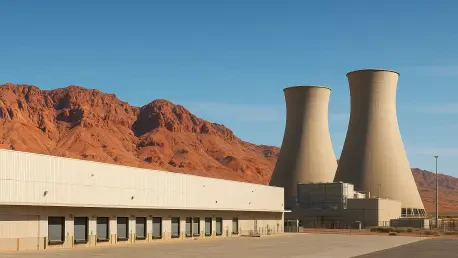

The Townsite case study serves as a national warning that federal land management strategies may be used to skirt local environmental protections and ignore established community planning efforts. This specific instance in Boulder City highlights a growing trend across the American West, where the insatiable demand for high-performance computing power has forced a collision between digital expansion and physical preservation. As artificial intelligence models become increasingly complex, the physical infrastructure required to sustain them has ballooned into massive campuses that often dwarf the small towns neighboring them. In Nevada, where the federal government maintains control over approximately eighty percent of the territory, developers have identified a path of least resistance through the Bureau of Land Management. This pivot from private land to federal acreage allows projects to advance under guidelines that may not align with the zoning desires or the environmental standards of local communities.
The Tactical Shift: Bypassing Local Governance
A primary driver of the current friction is the perceived disenfranchisement of local residents who find their zoning decisions overridden by federal authorities. In the Townsite project, developers successfully sought federal approval for a massive data center complex immediately after being blocked by municipal voters who voiced significant concerns regarding the long-term impact on their city’s infrastructure. This maneuver has created a sense of public betrayal, as citizens feel that the federal permitting process is being used as a loophole to circumvent community standards and local democratic will. By moving project sites just across a jurisdictional line onto federal land, companies effectively mute the voices of the people most directly affected by the construction and operation of these facilities. This tactic has transformed the Bureau of Land Management into a secondary planning board that operates independently of the urban growth boundaries established by the state’s residents.
Furthermore, the emergence of these data center cities represents a new frontier in the tension between national technological advancement and the preservation of local sovereignty. When a municipality says no to a project based on resource management or aesthetic concerns, the subsequent federal approval of that same project on adjacent land undermines the very concept of local self-governance. Residents in Nevada have begun to report a feeling of being kept in the dark, as federal agencies process applications with a level of opacity that contrasts sharply with the public hearings required at the local level. This lack of transparency has fueled a narrative that the tech industry is engaging in a modern land grab, where federal partnerships are leveraged to expedite industrialization at the expense of regional stability. The result is a fractured relationship between the government and its constituents, as the physical reality of these massive warehouses begins to permanently alter the desert landscape.
Resource Constraints: Environmental Impact and National Security
The sheer scale of these facilities, some occupying footprints equivalent to dozens of football fields, has raised alarms regarding the ecological stability of arid regions across the Southwest. Residents and environmental advocacy groups are particularly concerned about the massive consumption of water and electricity required to cool and power the high-density hardware essential for generative AI operations. In an environment where every gallon of water is a precious resource, the introduction of industrial cooling systems that evaporate millions of gallons daily is seen by many as an existential threat to the region’s long-term sustainability. The desert ecosystem is notoriously fragile, and the large-scale disruption of soil and native vegetation required to build these campuses can lead to increased dust pollution and the loss of critical habitats for protected species. These environmental costs are often viewed as permanent scars that offer little ecological benefit in return.
At the federal level, the push for AI infrastructure is often framed as a matter of national security and global competition, leading to executive orders designed to accelerate the permitting process. Proponents argue that the United States must maintain its technological edge against international rivals, which requires a rapid build-out of computing capacity that cannot afford the delays typically associated with local planning cycles. However, this haste has hit significant legal roadblocks regarding the integrity of environmental reviews required by federal law. Recent court rulings have stalled construction after finding that the government improperly used outdated assessments intended for solar farms to justify data centers. Judges concluded that the ecological impact of a high-tech warehouse is fundamentally different from that of a renewable energy site, as the noise, water consumption, and power demands of AI computing centers create a distinct and more intensive environmental footprint.
Political Realities: The Evolution of Federal Oversight
In the political arena, Governor Joe Lombardo and Attorney General Aaron Ford navigated these tensions with differing priorities that reflected the complexity of Nevada’s economic landscape. Governor Lombardo attempted to balance pro-growth agendas with public outcry by increasing tax requirements and community benefit obligations. Meanwhile, Attorney General Ford advocated for affordable housing as the primary use for public lands, highlighting the internal friction regarding how best to utilize federal acreage. This political maneuvering occurred against a backdrop of a unique bipartisan alliance between liberal environmentalists and conservative rural residents. Both groups remained united by a shared demand for transparency and a rejection of the ‘gold rush’ mentality that treated public lands as a low-cost solution for the tech industry. This coalition forced political leaders to implement stricter guardrails, illustrating that federal strategies were eventually limited by local sentiment.
Ultimately, the lessons learned from the Townsite litigation demonstrated that bypassing local sentiment resulted in costly delays and a loss of public trust that was difficult to rebuild. Future strategies prioritized the repurposing of brownfield sites and urban industrial zones rather than the encroachment into pristine federal landscapes. This redirected focus allowed for technological progress without sacrificing the ecological and social integrity of rural areas. By establishing clear federal guidelines that mandated local consent, authorities provided a pathway for responsible growth that respected the democratic process. The conclusion of this era of friction highlighted that the digital frontier could not thrive in isolation from the physical communities that support it. Sustainable development proved to be the only viable route for an industry that initially attempted to move faster than the law allowed. These shifts in policy ensured that national interests and local rights could coexist.