
Traditional farming methods that relied on seasonal intuition and manual labor are rapidly disappearing as the global agricultural sector transitions toward a sophisticated, high-tech, and data-driven operational model. This shift is driven by the urgent need to feed a growing population while navigating increasingly volatile climate patterns that threaten traditional crop yields. At the center of this transformation lies 5G telecommunications, which acts as the digital nervous system for modern fields. By providing ultra-high speeds and incredibly low latency, 5G connects an array of sensors, autonomous machinery, and sophisticated management software into a single, cohesive ecosystem. This connectivity allows for real-time monitoring of soil conditions, moisture levels, and crop health, ensuring that resources are used with surgical precision. As farmers embrace these digital tools, the industry is moving toward a state of heightened efficiency where food security and operational sustainability are no longer mutually exclusive goals but rather standard outcomes.
Economic Growth and Financial Drivers
The financial landscape of the agricultural industry is currently experiencing a massive surge in capital investment directed toward advanced connectivity solutions and digital upgrades. Market valuations indicate that the 5G agricultural sector is poised to grow from approximately $3.88 billion in late 2025 to more than $15 billion by 2030, representing a remarkable trajectory. This expansion is characterized by a consistent compound annual growth rate of over 31%, highlighting a deep-seated appetite among global agribusinesses for high-tech efficiency gains. Financial investors are increasingly prioritizing these upgrades as they recognize that traditional methods can no longer keep pace with the intensifying demands of the global food supply chain. This influx of capital is not merely speculative; it is a direct response to the necessity of modernizing rural infrastructure to support a more resilient and profitable farming model. As these investments materialize, they provide liquidity for farms to integrate complex digital systems.
Beyond general infrastructure, this financial boom is largely fueled by the rapid adoption of Internet of Things (IoT) devices and the critical need for precision agriculture. Farmers are aggressively moving away from legacy models based on fixed, scheduled operations and are instead embracing a reactive model driven by real-time environmental insights. By utilizing high-bandwidth 5G connections, agricultural operators can access immediate data regarding everything from nutrient levels in the soil to the hydration status of individual plants. This level of granularity allows for the optimization of inputs such as water, fertilizer, and pesticides, which in turn leads to significant reductions in overhead costs. The ability to make informed, data-backed decisions on the fly allows farms to maximize their harvest yields while simultaneously minimizing their environmental footprint. This shift toward data-driven management is becoming the primary economic driver for the industry, as the return on investment for these technologies becomes clearer.
The Technological Infrastructure of Precision Farming
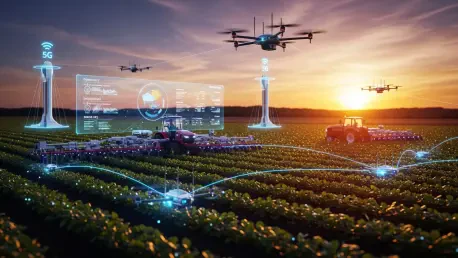
The physical architecture of a modern 5G-enabled farm is defined by the seamless integration of diverse hardware components that communicate across a high-speed network. In this environment, autonomous drones equipped with multi-spectral cameras fly over vast acreages, capturing high-resolution images that reveal crop stress long before it is visible to the naked eye. At the same time, thousands of soil sensors buried throughout the fields transmit continuous streams of data regarding temperature, acidity, and moisture. Because 5G can support up to one million devices per square kilometer, the density of these sensors can be incredibly high without causing network congestion or data bottlenecks. This hardware does not operate in isolation; it functions as a distributed sensory network that feeds information into centralized processing units. This technological backbone provides the foundation for what is called smart farming, where every piece of equipment is part of a unified digital conversation.
Complementing the robust hardware is a layer of sophisticated cloud-based software that processes massive volumes of raw data into actionable insights for the farm manager. These software platforms utilize machine learning algorithms to analyze patterns and predict potential issues, such as pest outbreaks or irrigation failures, before they escalate into crises. The ultra-low latency of 5G allows these computations to occur almost instantaneously, enabling autonomous machinery to adjust their operations in real time. For example, a sprayer can use computer vision to identify a specific weed among thousands of healthy plants and apply a micro-dose of herbicide only where it is needed. This degree of granularity allows farmers to manage their land down to the individual plant or animal rather than treating a whole field or a large herd as a single, uniform unit. By moving toward such hyper-localized management, operations can drastically reduce chemical use and improve the overall health of their ecosystem and soil.
Regional Expansion and Market Leadership
North America currently maintains a leading position in the global 5G agricultural market, benefiting from a long history of large-scale industrial farming and proactive infrastructure investment. With a substantial portion of American farms already incorporating some form of precision agriculture, the shift toward 5G represents a natural evolution of existing workflows. Many of these large-scale operations have opted to deploy private 5G networks, allowing them to maintain full control over their connectivity and data security. These private networks are essential for operating fleets of autonomous tractors and harvesters that require constant, high-speed communication to navigate safely and efficiently. By bypassing the limitations of public cellular towers in rural areas, these farms ensure that their high-resolution field imaging and telematics data are transmitted without delay. This trend toward private infrastructure is particularly strong in regions where the scale of operations demands a level of reliability that only dedicated 5G spectrum provides.
While North America leads in total market share, the Asia-Pacific region is recognized as the fastest-growing market due to aggressive government-backed initiatives. Countries like China and India are prioritizing the digitization of their agricultural sectors to ensure food security for their massive populations. These nations are leveraging their internal strengths in hardware manufacturing and telecommunications expertise to implement high-tech solutions at a pace that often exceeds that of other regions. In these areas, 5G is being used to power large-scale drone-based pesticide spraying programs and to manage highly complex vertical farming operations in urban centers. These government-led efforts are often designed to overcome the fragmentation of small-scale land ownership by providing shared digital platforms and infrastructure. By subsidizing the cost of 5G equipment and encouraging the development of local agricultural apps, these governments are accelerating the transition to a more efficient food production model that reduces the reliance on food imports.
Overcoming Barriers through Strategic Collaboration
Strategic alliances between major telecommunications companies and agricultural equipment manufacturers have become essential for proving the real-world viability of 5G technology. These collaborations often take the form of global proof-of-concept projects that demonstrate how integrated systems can solve specific regional problems. For instance, the partnership between Turk Telekom and ZTE in Turkey successfully integrated autonomous drones and IoT sensors to improve resource efficiency and lower the overall carbon footprint of test farms. These projects are crucial because they provide tangible data on the performance and benefits of high-speed connectivity, helping to demystify the technology for traditional farmers. By showcasing successful implementations in diverse climates and soil types, these partnerships help to build the confidence necessary for wider market adoption. Furthermore, these alliances often lead to the development of standardized protocols, making it easier for equipment from different manufacturers to work together seamlessly.
The transition toward a fully connected agricultural landscape progressed through the deliberate resolution of economic and technical barriers that once hindered widespread adoption. To achieve this, industry leaders prioritized the standardization of data protocols and the expansion of private 5G spectrum for rural cooperatives. While the initial costs of hardware were significant, the focus shifted toward modular, scalable solutions that allowed smaller farms to participate in the digital revolution. Successful implementations demonstrated that the integration of 5G was a fundamental requirement for maintaining competitiveness in a globalized market. Stakeholders who invested in robust data security and edge computing capabilities secured a long-term advantage in yield stability and resource efficiency. Future developments then turned toward integrating satellite-to-5G handovers to eliminate remaining coverage gaps. This proactive approach established a new global standard for food production, proving that connectivity was the most vital input for modern operational success.