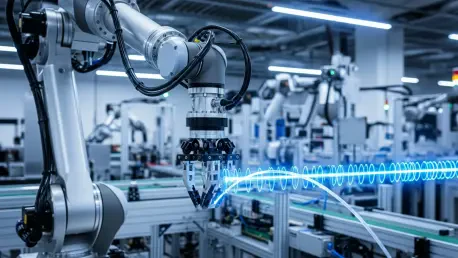

Modern industrial manufacturing facilities are increasingly defined by a complex web of autonomous mobile robots and high-speed robotic arms that depend on instantaneous data transfer to maintain synchronization across the factory floor. As these automated systems reach new levels of sophistication, the reliance on fiber optic cables has become absolute, primarily due to their ability to carry massive amounts of data without being affected by the heavy electromagnetic interference common in factory settings. However, the physical reality of these connections is surprisingly fragile, as the entire communication loop depends on a core that is only nine microns wide. This is roughly one-tenth the diameter of a human hair, meaning that even a microscopic speck of dust can act like a massive boulder blocking a tunnel. When light cannot pass through the interface cleanly, the precision of the robot is compromised, leading to a cascade of errors that can halt an entire production line. For engineers managing these advanced facilities, ensuring the cleanliness of these optical links is not merely a maintenance task but a fundamental requirement for operational stability. Without pristine connections, the benefits of high-speed fiber—such as ultra-low latency and massive throughput—are effectively nullified, leaving the most advanced robotics vulnerable to simple environmental contamination.
The Cascading Effects: Signal Loss and Jitter
When a contaminant settles on the end face of a fiber optic connector, the most immediate consequence is insertion loss, which refers to the reduction in signal power as light travels through the mated pair. In the context of high-speed robotics, this loss manifests as a weakened signal that forces the receiving hardware to work harder to interpret incoming data packets. If the signal drops below a certain threshold, the system experiences intermittent connectivity issues often referred to as jitter, where the robotic arm or autonomous vehicle receives instructions with slight, unpredictable delays. For a robot performing delicate tasks like micro-soldering or high-speed sorting, a delay of even a few milliseconds can result in physical misalignment, causing the machine to miss its target or collide with other equipment. This degradation of signal quality effectively creates a bottleneck in the communication stream, turning a high-performance network into a liability. The subtle nature of insertion loss makes it particularly dangerous, as it often allows a system to continue functioning in a degraded state rather than failing outright, leading to inconsistent performance that is notoriously difficult for technicians to troubleshoot during active shifts.
Beyond the simple blockage of light, contamination also triggers a phenomenon known as back reflection, where the light signal bounces off the debris and travels back toward the laser source. This return loss creates internal noise within the optical system, destabilizing the laser transmitter and significantly increasing the bit-error rate of the data stream. In a landscape where robotic systems rely on real-time sensor feedback and cloud-based processing, even a minor increase in data errors can cause erratic behavior, such as sudden stops or jerky movements that stress mechanical components. The resulting instability in the communication loop can lead to software timeouts and protocol failures, often triggering emergency shutdown sequences that require manual intervention to reset. Furthermore, back reflection can cause physical heat buildup at the transmitter interface, potentially shortening the lifespan of expensive optical modules. Maintaining a clean optical path is therefore essential not just for the immediate movement of the robot, but for the long-term health of the entire network infrastructure, ensuring that the lasers and receivers operate within their intended thermal and electrical specifications without the interference of reflected light energy.
Environmental Hazards: Pollutants in Industrial Spaces
The industrial environments where modern robotics are most prevalent are often the same places where optical contaminants are most abundant, creating a constant struggle for system integrity. Activities such as welding, metal grinding, and heavy machining generate a constant cloud of airborne particles, ranging from metallic shavings to microscopic silica dust that can easily penetrate supposedly sealed cabinets. These pollutants are remarkably mobile, often migrating toward optical ports during routine filter changes or when equipment panels are opened for adjustment. In high-vibration environments, particles that have settled on the exterior of a connector can eventually work their way into the physical interface through the repeated microscopic movements of the machinery. This migration is a silent threat, as a connection that was clean at the time of installation can slowly become compromised over weeks of operation in a high-particle environment. The challenge is compounded by the fact that many robotic cells are located in areas with complex airflow patterns, which can concentrate dust in the very niches where fiber optic junctions are situated, making environmental control a secondary but vital aspect of optical maintenance.
Human interaction remains a primary vector for fiber contamination, as even the most experienced technicians can inadvertently transfer skin oils or moisture to a connector end face. These oils act as a powerful adhesive, trapping airborne dust that might otherwise blow away and creating a sticky film that is particularly difficult to remove without specialized cleaning agents. Furthermore, the plastic housings and protective sleeves used in robotic components are highly susceptible to building up static electricity during movement. This electrostatic charge actively attracts dust from the surrounding air, pulling particles toward the fiber end face with significant force. When a technician disconnects a fiber to move a robotic arm or perform an update, the exposed ferrule becomes a magnet for these charged particles. If the connector is then re-plugged without a thorough cleaning cycle, the trapped debris is subjected to immense pressure within the mated interface. This pressure can lock the particles into the glass, sometimes creating a permanent bond or causing the debris to grind against the polished surface, which turns a temporary cleaning issue into a permanent hardware failure that requires the total replacement of the fiber jumper.
Operational Excellence: Specialized Tools and Inspection
Ensuring the reliability of optical links in a robotic environment requires a shift away from traditional cleaning methods toward high-precision, fiber-specific protocols. Standard industrial solvents, such as low-grade isopropyl alcohol or general-purpose degreasers, are often more harmful than the dust they are intended to remove, as they frequently leave behind a thin chemical film or halos that scatter light just as effectively as solid particles. Instead, technicians must utilize specialized optical-grade fluids that are engineered to be non-flammable, fast-evaporating, and entirely residue-free. These fluids work in tandem with lint-free wipes or specialized cleaning sticks designed to reach deep into the recessed ports of robotic controllers and sensors. The use of these precision tools ensures that the microscopic surface of the glass is not just clear of debris, but also chemically pure, allowing for the maximum possible light transmission. By standardizing these high-end materials across the maintenance department, organizations can eliminate the variability that comes with improper cleaning techniques, creating a predictable baseline for network performance that supports the rigorous demands of automated production lines.
A cornerstone of modern fiber maintenance is the inspect-clean-inspect workflow, which utilizes digital fiber microscopes to verify the condition of an end face before it is ever mated. This protocol is essential because it prevents the accidental scratching of the delicate glass surface that occurs when a contaminated connector is plugged in. By viewing the ferrule at high magnification, technicians can identify specific types of contamination, such as oil smears or hard metallic shards, and choose the appropriate cleaning method to address the specific issue. This proactive approach moves the maintenance team away from guesswork and toward a data-driven strategy where no connection is made without visual confirmation of purity. Many of these inspection tools have been integrated with automated software that provides a pass or fail rating based on industry standards, removing human error from the assessment process. This rigorous adherence to inspection protocols ensures that the physical layer of the robotic network remains a reliable foundation, preventing the kind of ghost in the machine errors that arise when intermittent signal issues are caused by microscopic debris trapped within a connector.
Economic Impacts: Safety and Long-Term Reliability
The economic implications of prioritizing fiber cleanliness are profound, especially in high-volume manufacturing sectors where a single hour of downtime can cost hundreds of thousands of dollars. By maintaining pristine optical connections, companies can significantly reduce the frequency of unexpected robotic stoppages and the lengthy troubleshooting sessions that typically follow a signal failure. Furthermore, consistent signal integrity plays a critical role in the safety systems of modern industrial robots, particularly regarding the real-time functioning of emergency stops and proximity-based collision avoidance sensors. These safety-critical data streams must be transmitted with absolute reliability, as any latency or packet loss caused by a dirty connector could delay a safety response by a fraction of a second, potentially leading to equipment damage or personnel injury. Therefore, a disciplined approach to cleaning is not just an operational preference but a safety necessity that protects the physical assets and the workforce. The investment in specialized cleaning equipment and technician training pays for itself through improved uptime, longer hardware lifecycles, and a safer working environment, ensuring that the full potential of robotic automation is realized without the hidden costs of poor optical hygiene.
The shift toward integrated fiber-optic maintenance protocols represented a turning point for industrial facilities seeking to maximize the performance of their autonomous systems. As robotics became more central to global supply chains, the industry moved away from reactive repairs and adopted a culture of precision cleanliness that addressed the vulnerabilities of optical interfaces at the source. Management teams realized that the high-bandwidth capabilities of modern sensors and control loops were only as strong as the physical connection points between them. By implementing standardized inspection workflows and utilizing specialized cleaning materials, organizations successfully mitigated the risks of signal jitter and permanent hardware damage. This transition ensured that the massive investments made in robotic technology provided the expected returns in efficiency and reliability. Technicians who embraced these rigorous standards found that they spent less time diagnosing erratic behavior and more time optimizing system performance. Ultimately, the industry established that maintaining optical purity was the most effective way to safeguard the integrity of the data links that powered the automated world, proving that even the most complex machines depended on the most basic levels of microscopic care.