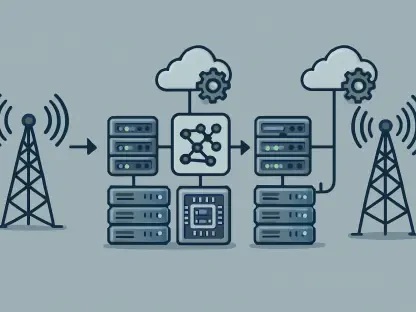

Innovations in photonic-enabled backbones are making it possible for the network to be programmable at the deepest physical levels of the infrastructure. This shift marks a departure from the historical era where the transport layer was a static, opaque utility provided by distant telecommunications carriers. As we navigate the landscape of 2026, the enterprise is no longer content with being a passive consumer of bandwidth. Instead, the focus has pivoted toward building a responsive environment where every connection is optimized for the specific application it serves. This transformation is driven by the need for unprecedented precision in data delivery, especially as organizations integrate advanced intelligence into every facet of their operations. The old models of connectivity, which relied on rigid hardware and manual provisioning, are proving inadequate for the demands of modern digital business. By reimagining the relationship between the application and the physical wires, leaders are setting the stage for a new generation of high-performance networking that prioritizes agility and predictability.
From Carrier Dominance to Software Independence
The Legacy of Centralized Control and Early Connectivity
In the final decades of the 20th century, the enterprise Wide Area Network was defined by a rigid power dynamic that favored the telecommunications provider. Companies requiring reliable connectivity between regional offices were forced to rely on expensive leased lines, which offered stability but lacked any form of scalability or cost-efficiency. During this period, the carrier owned the infrastructure, the hardware, and the routing logic, leaving the customer with virtually no control over how their data moved. If a business needed to increase capacity or change a routing path, the process involved lengthy manual requests and significant delays. This centralized model treated bandwidth as a scarce, expensive commodity rather than a flexible business resource. Enterprises were essentially locked into long-term contracts for fixed circuits that could not adapt to fluctuating traffic patterns, creating a bottleneck for growth and preventing the kind of rapid digital expansion that would eventually define the modern era of global commerce.
The introduction of Multiprotocol Label Switching (MPLS) in the early 2000s offered a significant technical upgrade by providing predictable performance and traffic engineering capabilities. While MPLS allowed for better Service Level Agreements and prioritized traffic for sensitive applications like voice and video, it did not fundamentally disrupt the carrier’s control over the network. The enterprise remained a tenant on the provider’s private infrastructure, and the complexity of managing these circuits often required specialized staff and expensive proprietary equipment at every branch location. Despite the reliability of MPLS, it remained a costly and inflexible solution that struggled to accommodate the explosive growth of internet-based services and remote work. The high price per megabit ensured that only the most critical data traveled over these private paths, while less important traffic was often relegated to less reliable public connections, creating a fragmented and difficult-to-manage environment for IT departments trying to maintain a consistent user experience.
The Software-Defined Revolution and Enterprise Autonomy
The emergence of Software-Defined WAN (SD-WAN) represented the first major paradigm shift, effectively decoupling the network’s control layer from the underlying physical hardware. This innovation empowered organizations to use a mix of transport methods, including standard broadband, LTE, and fiber, while managing them through a centralized software interface. For the first time, network administrators could define business-intent policies that automatically routed traffic based on real-time conditions such as latency, packet loss, and jitter. This move toward software-defined independence allowed companies to reduce their reliance on expensive private circuits without sacrificing performance for mission-critical applications. By abstracting the network logic, SD-WAN turned the transport layer into a programmable resource that could be adjusted in minutes rather than weeks. This flexibility proved essential as businesses began to move their workloads out of centralized data centers and into a distributed cloud-first environment.
Building on the foundation of software-defined routing, the integration of Secure Access Service Edge (SASE) further solidified enterprise autonomy by combining networking and security into a single cloud-native framework. SASE eliminated the need for “hairpinning” traffic through a central hub for security inspection, a practice that frequently introduced unnecessary latency and degraded the user experience. By moving security functions like firewalls and web gateways to the network edge, organizations were able to provide secure, direct access to cloud applications for a global workforce. This architectural evolution meant that the network was no longer just a collection of pipes but a secure, intelligent fabric that could verify identity and enforce policy at the point of connection. In the period from 2026 to 2028, this model has become the standard for any organization seeking to balance high-speed access with rigorous security requirements, effectively ending the era where the physical location of the user or the server dictated the quality of the network service.
The Influence of Cloud Giants and Performance Barriers
The Shift Toward Hyperscaler Backbones
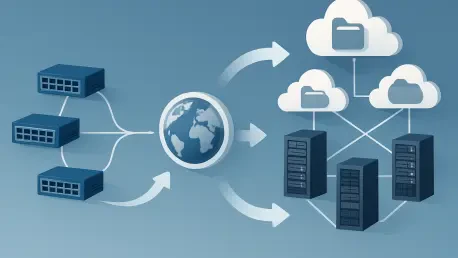
As the majority of enterprise applications migrated to public cloud environments, the center of gravity for global networking shifted from traditional carriers to hyperscalers such as Amazon, Microsoft, and Google. These cloud giants invested billions of dollars to build massive, private fiber-optic networks that now span the globe, often rivaling or exceeding the footprints of the largest telecommunications firms. Today, when a user accesses a cloud-hosted service, their data often only travels a short distance over the public internet before reaching a cloud “on-ramp.” Once inside the hyperscaler’s private backbone, the traffic is managed with extreme efficiency, benefiting from the provider’s massive scale and optimized routing protocols. This transition has largely rendered traditional long-haul carrier circuits obsolete for many organizations, as the cloud providers effectively become the new primary transit layer. While this offers incredible performance, it also introduces a new layer of complexity in how enterprises monitor and manage their end-to-end connectivity.
This shift toward hyperscaler-dominated infrastructure has fundamentally changed how network architects approach capacity planning and disaster recovery. Instead of managing a complex web of individual carrier relationships, teams now focus on optimizing their connections to regional cloud data centers and ensuring redundant access to multiple availability zones. The quality of the digital experience is now deeply intertwined with the internal performance of these cloud backbones, making visibility into these “invisible” networks a top priority for IT leaders. Organizations must now account for the specific peering arrangements and routing behaviors of their chosen cloud providers, as these factors often have a greater impact on application performance than the local internet service provider. As we move through 2026, the reliance on these global cloud fabrics continues to grow, necessitating a more sophisticated approach to multi-cloud networking that ensures consistent performance across different provider environments without increasing operational overhead.
The Limitations of Best-Effort Networking in the AI Era
Despite the agility afforded by software-defined tools and cloud backbones, the vast majority of modern WANs still operate on a “best-effort” delivery model. While this is acceptable for asynchronous tasks like email or web browsing, it is increasingly becoming a bottleneck for high-demand, real-time workloads. The rapid adoption of Artificial Intelligence (AI) has exposed the inherent weaknesses of traditional packet-switched architectures, where even minor fluctuations in latency can disrupt the synchronization of massive GPU clusters or the integrity of real-time data streams. AI training and inference require a level of network predictability that standard internet protocols were never designed to provide. When a network experiences a sudden spike in congestion or a momentary routing loop, the resulting jitter can cause significant delays in processing, leading to wasted compute cycles and increased costs. This friction between modern application requirements and legacy transport methods is forcing a re-evaluation of how performance is guaranteed at the hardware level.
The challenge of best-effort networking is further complicated by the massive volume of data being moved for real-time analytics and distributed ledger technologies. These workloads demand a constant, high-throughput connection with zero tolerance for packet loss or reordering. Software overlays can attempt to mitigate these issues by steering traffic around congested paths, but they cannot fix the underlying physics of a saturated or inefficient physical link. For industries such as high-frequency trading, remote robotic surgery, or autonomous vehicle management, the “best-effort” approach is simply not a viable option. As we progress through the current year and toward the end of the decade, the industry is seeing a clear push toward “deterministic” networking. This approach seeks to provide hard guarantees on performance by reserving specific paths and resources at the physical layer, ensuring that critical applications always have the bandwidth and low-latency characteristics they need to function correctly regardless of other traffic on the network.
The Future of Application-Centric Infrastructure
Programmable Networks and the Photonic Frontier
The network is entering its most ambitious phase yet, where the application itself takes direct control of the physical transport layer through technologies like the All-Photonics Network (APN). By eliminating the need for repeated conversions between optical and electrical signals at every switch and router, APN significantly reduces energy consumption and latency. This architectural shift creates a truly programmable infrastructure where bandwidth can be allocated on-demand to specific high-performance tasks without the overhead of traditional packet processing. In this environment, an application can signal the network to establish a dedicated, low-latency lightpath for a specific duration, such as during a massive data migration or a high-definition video broadcast. This represents a move away from static, pre-provisioned capacity toward a dynamic, consumption-based model that mirrors the flexibility of the cloud itself. The physical network finally becomes as elastic as the virtual machines and containers it connects, allowing for a more efficient use of global resources.
As photonics-enabled backbones become more prevalent between 2026 and 2030, the role of the network engineer is evolving from a focus on manual configuration to one of orchestration and policy design. Instead of managing individual ports and VLANs, engineers will define the performance parameters that different classes of applications require, and the photonic layer will automatically adjust its configuration to meet those needs. This level of automation is essential for supporting the massive scaling required by the next generation of digital services. For example, a global financial application might require a guaranteed 10-millisecond latency between two specific cities for a high-priority trading window. In the past, this would have required a dedicated, permanent circuit. In the photonic era, the application can request this specific performance tier for only the few hours it is needed, paying only for the specialized service it consumes. This granular control over the physical underlay is the missing piece of the puzzle that will finally allow the network to keep pace with the speed of software innovation.
Strategic Imperatives for Navigating Architectural Debt
One of the most significant risks facing modern organizations is the accumulation of architectural debt, where new, high-performance applications are deployed on top of aging, inefficient networking foundations. Many businesses are attempting to launch sophisticated AI initiatives and real-time data platforms while still relying on legacy routing protocols and hardware that were designed for a different era of computing. This mismatch often leads to performance bottlenecks that are difficult to diagnose and even more expensive to fix after the fact. To avoid this, IT leaders must prioritize the modernization of the “underlay”—the physical and logical transport layer—as a foundational component of their digital strategy. This involves not only upgrading hardware to support higher speeds but also adopting a more holistic view of how data flows across the entire organization. Aligning network capabilities with long-term business goals ensures that the infrastructure remains an enabler of growth rather than a recurring cost center that restricts the adoption of new technologies.
Navigating this transition requires a disciplined approach to investment, focusing on modular and scalable solutions that can adapt to future requirements. Organizations that continue to patch old systems with temporary fixes will find themselves at a disadvantage compared to those that embrace a clean-slate approach to network design. The goal is to create a unified fabric that can support a wide variety of workloads, from standard office productivity to extreme high-performance computing, without requiring constant manual intervention. This strategic alignment also extends to the workforce, as teams must be retrained to think in terms of application outcomes rather than just connectivity. By treating the network as a strategic asset that must be continually refined and optimized, businesses can ensure they are prepared for the unpredictable demands of the digital economy. The period from 2026 to 2028 is a critical window for organizations to retire their technical debt and build a robust, future-ready infrastructure that can support the next decade of innovation without reaching its limits.
Mitigating Vendor Lock-in and Embracing Automation
While the move toward integrated networking and security platforms offers significant operational benefits, it also carries the risk of deep vendor lock-in that can limit an organization’s future flexibility. As vendors expand their ecosystems to cover everything from the branch office to the multi-cloud edge, businesses must be careful not to become entirely dependent on a single provider’s roadmap and pricing structure. Maintaining a degree of strategic independence allows a company to adopt “best-of-breed” technologies as they emerge, ensuring that the network can always take advantage of the latest innovations. This requires the use of open standards and APIs that allow different systems to communicate and share telemetry data seamlessly. By designing for interoperability from the beginning, organizations can avoid the high costs and technical hurdles associated with migrating away from a proprietary stack. This balanced approach ensures that the business remains in control of its technological destiny rather than being beholden to the interests of a single vendor.
The complexity of managing a modern, multi-vendor environment is driving the adoption of “agentic” infrastructure, where AI-driven systems autonomously manage the network’s health and security. These advanced systems use deep learning to analyze massive amounts of telemetry data in real-time, identifying patterns that would be impossible for a human operator to detect. When a performance degradation occurs, the agentic system can automatically diagnose the root cause and implement a fix, such as rerouting traffic or adjusting security policies, before the user even notices a problem. This move toward self-healing networks is essential for maintaining the high availability required by modern business operations. It also frees up IT staff to focus on higher-value tasks, such as optimizing application performance and exploring new ways to leverage the network for competitive advantage. Between 2026 and 2030, the widespread deployment of these autonomous systems will redefine the standard for network reliability, turning the WAN into a truly “hands-off” utility that proactively manages its own performance.
Designing a Responsive and Intelligent Network
The journey toward a fully application-centric infrastructure has reached a pivotal stage where the network is no longer a separate utility but a core component of the software itself. Organizations that successfully transitioned to this model realized significant gains in operational efficiency and application performance by removing the traditional barriers between the logical and physical layers of the WAN. The shift was characterized by a move away from best-effort connectivity toward a system of guaranteed, programmable results that adapted in real-time to the needs of the business. Leaders who prioritized the elimination of architectural debt and embraced photonic-enabled backbones found themselves better equipped to handle the massive data demands of the current era. This evolution demonstrated that the value of the network is not found in the raw bandwidth it provides, but in the precision and intelligence with which it delivers every packet to its destination.
To maintain this momentum, enterprises must focus on the continuous integration of automation and the expansion of their edge capabilities. The past years showed that relying on static configurations was the primary cause of service disruptions and performance bottlenecks. Moving forward, the strategy should involve the deployment of agentic systems that can manage the increasing complexity of multi-cloud and hybrid environments without human intervention. Strategic flexibility remains a top priority, requiring a commitment to open architectures that prevent lock-in while allowing for the rapid adoption of emerging photonic and AI-driven tools. By viewing the network as a dynamic, intelligent organism that responds to the heartbeat of the application, businesses ensured that their infrastructure remained a powerful driver of success. The next logical step involves deepening the partnership between application developers and network architects to create even more specialized, high-performance environments tailored for specific industry outcomes.