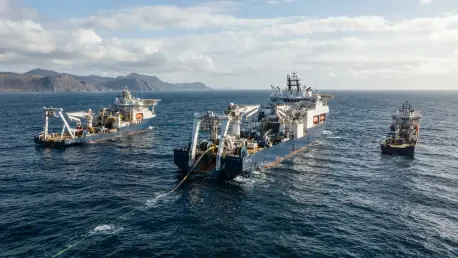

Deep beneath the restless ocean currents lies a sprawling web of glass fibers that silently carries the digital heartbeat of our modern civilization at the speed of light. Without these subsea cables, the global economy would stall, yet they remain largely invisible until a massive financial move like the $1.03 billion package secured by OMS Group demands the world’s attention. This landmark investment marks a transformative milestone, signaling a bold commitment to expanding the physical architecture required to sustain an increasingly interconnected planet.
Introduction to a Landmark Financial Milestone in Global Connectivity
The recent $1.03 billion financing package obtained by the group represents one of the largest specialized investments in the subsea sector to date. This capital injection is not merely a budgetary increase; it serves as a critical catalyst for scaling global connectivity during a period of record-breaking data demand. By securing these funds, the organization has positioned itself to lead the next wave of underwater infrastructure development.
The significance of this investment extends beyond the company’s internal balance sheet, impacting the entire global subsea landscape. As the modern digital economy becomes more dependent on seamless data transfer, the resilience of these underwater networks has become a matter of international importance. This funding ensures that the physical links connecting continents remain robust enough to support future technological advancements.
Foundations of OMS Group and the Subsea Infrastructure Sector
Based in Malaysia, the company has evolved from a regional service provider into a dominant force in the subsea cable industry. This transition reflects the historical shift of subsea connectivity from a niche telecommunications endeavor into a high-demand, mission-critical infrastructure sector. Over the years, the group has adapted its expertise to meet the growing complexities of underwater deployments in diverse marine environments.
The current global climate has created an unprecedented need for specialized cable-laying and maintenance vessels. As older systems reach their capacity limits, the industry is witnessing a transition toward more sophisticated, high-capacity fiber networks. The company’s foundational expertise allows it to bridge the gap between traditional maritime operations and the high-tech requirements of modern digital communications.
Strategic Achievements and the Fleet Expansion Roadmap
The $1.03 billion financing structure was met with overwhelming market confidence, resulting in a significant oversubscription by both regional and international lenders. This enthusiastic response highlights the financial community’s belief in the long-term viability of subsea assets. For the OMS Telco division, this achievement provides the necessary liquidity to execute an ambitious roadmap that will redefine its operational capacity.
Acquisition of Advanced Fiber-Optic Cable-Laying Vessels
A primary objective of this roadmap is the integration of four state-of-the-art vessels into the fleet from 2027 to 2028. These ships are designed to handle the most advanced fiber-optic technologies, offering greater precision and efficiency during the installation process. By expanding the fleet during this specific timeframe, the group ensures it can meet the rising demand from major tech enterprises and telecommunications providers.
Sophisticated International Financing Structure
The deal’s complexity is showcased through a blend of corporate loans and Export Credit Agency support from the Netherlands and Norway. This structured approach leverages international partnerships to secure favorable terms while mitigating the risks associated with large-scale maritime construction. Such a multi-faceted financial strategy allows the company to maintain a stable capital structure while pursuing aggressive growth.
Collaborative Financial Advisory and Global Backing
Strategic advisory from major institutions like HSBC, Standard Chartered, and KKR Capital Markets was instrumental in finalizing this massive transaction. These partners provided the global perspective needed to coordinate such a diverse group of lenders and agencies. Their involvement underscores the institutional backing that the group has cultivated through years of consistent performance and strategic planning.
Distinctive Capabilities in a Competitive Subsea Landscape
The group differentiates itself through an end-to-end digital infrastructure model that offers comprehensive solutions from initial marine surveys to long-term maintenance. This integrated approach provides clients with a single point of accountability, which is a significant advantage in the high-risk environment of underwater engineering. By controlling the entire lifecycle of a project, the company ensures a higher standard of quality and resilience.
Maintaining a specialized and modern fleet is essential for handling the complex deployments required by today’s high-capacity networks. While many competitors rely on aging vessels, the group’s commitment to modernization allows it to navigate more challenging environments with greater reliability. Corporate values centered on infrastructure stability and long-term resilience continue to drive the group’s competitive edge in an evolving market.
Current Operations and the Push Toward Future Readiness
The active fleet is currently deployed across several high-profile subsea projects, addressing the immediate needs of a data-hungry world. The surge in demand, driven largely by AI, cloud computing, and the expansion of massive data centers, has necessitated a more agile operational response. The group has optimized its current resources to ensure that existing networks remain operational while new ones are being laid.
Recent developments have focused on streamlining international operations to ensure that the financing is used effectively across all regions. This push toward future readiness involves not only physical assets but also the refinement of logistical and technical processes. By coordinating its global efforts, the group is prepared to handle the increasing volume of data traffic that defines the current technological era.
Reflection and Broader Impacts
Reflection
Analyzing the strengths of the group’s financial strategy reveals a disciplined approach to managing high-cost technological assets. The challenge of balancing massive capital expenditures with the need for rapid technological upgrades is a constant pressure in the subsea industry. However, the successful oversubscription of this loan suggests that the group has mastered the art of aligning its expansion goals with market expectations.
Broader Impact
This expansion significantly influences global internet growth by providing the physical pathways necessary for future innovations. The trend of public-private financial collaboration, as seen in the involvement of export credit agencies, suggests a new model for funding essential tech infrastructure. As the world becomes more digitally integrated, these collaborative efforts will be vital for maintaining a secure and efficient global network.
Conclusion: Setting the Standard for Future Digital Growth
The successful orchestration of this billion-dollar investment solidified the group’s role as a primary architect of the physical internet. Stakeholders recognized that maintaining a competitive edge required a proactive approach to fleet modernization and financial agility. By looking toward future technological shifts, the project established a new benchmark for how digital infrastructure should be funded and deployed in an era of unprecedented data consumption. Moving forward, the focus shifted to ensuring that these new assets integrated seamlessly with existing global networks to prevent bottlenecks in international data flow. The emphasis remained on sustainable growth and the continuous evolution of subsea engineering to meet the demands of a virtual world that remained entirely dependent on physical cables.