
Vladislav Zaimov is a seasoned telecommunications strategist who has spent years hardening enterprise networks and navigating the complexities of high-stakes risk management. As the industry pivots from the consumption-heavy video era to the autonomous “agentic AI” era, he provides a critical perspective on how infrastructure must evolve to handle machines that think, act, and transmit as much data as they receive. His expertise bridges the gap between raw hardware capabilities and the strategic foresight required to keep global connectivity stable in a period of unprecedented traffic shifts.
This conversation explores the radical inversion of network priorities, shifting focus from traditional download speeds to robust upstream capacity. We examine the strategic utilization of 600 MHz low-band spectrum for deep indoor penetration, the massive scaling of fiber backbones to support a projected surge in global bandwidth consumption, and the integration of artificial intelligence into the very fabric of network operations to achieve significant energy efficiency. We also delve into the implications of direct cloud-to-edge interconnections and the future of deterministic connectivity in industrial environments.
The shift toward agentic AI represents a fundamental change in how data moves, moving away from simple consumption toward a more interactive, upstream-heavy model. How does the rise of autonomous systems like drones and AR glasses redefine our traditional understanding of network capacity and the way we build for the future?
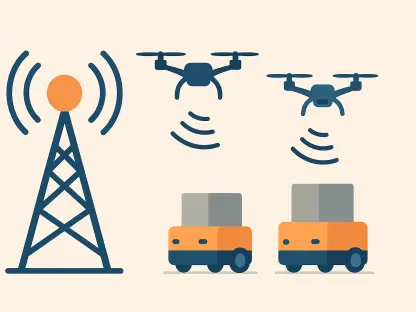
For decades, we have obsessed over download speeds because our primary goal was delivering high-definition video to passive consumers, but agentic AI completely flips that script. When you have billions of agents—potentially scaling to trillions by 2036—sensing and acting on their own, the network becomes a two-way street where the upstream is just as vital as the downstream. We are looking at a world where daily global bandwidth consumption could surge from roughly 100 exabytes today to a staggering 8,100 exabytes over the next decade, a compound annual growth rate north of 50%. This isn’t just about more data; it is about time-sensitive data from drones, robotics, and AR glasses that must be pushed from the edge back toward the network core for processing. Even conservative modeling suggests that AI inference alone will account for about a quarter of all network traffic, which means our legacy architectures, which were built to favor the “downlink,” are rapidly becoming obsolete.
AT&T is making a distinct strategic bet by prioritizing 600 MHz low-band and EchoStar mid-band spectrum over the high-band millimeter-wave approach that many competitors have chased. What is the logic behind focusing on deep indoor penetration for the next generation of connectivity?
The logic rests on the fact that if an AI agent cannot maintain a continuous, stable connection, it effectively ceases to function, and those connections often happen in the most challenging environments. While millimeter-wave offers incredible speeds, it struggles to pass through a single pane of glass or a brick wall, which is a dealbreaker for indoor robotics or enterprise AI applications. By leveraging 600 MHz low-band holdings as the linchpin, the strategy ensures that the signal reaches deep into the heart of office buildings and factory floors where these autonomous systems live. This creates a reliable “blanket” of coverage that high-band spectrum simply cannot match without an impossible number of small cells. We are seeing an inversion of decades of network priorities where the goal is no longer just “peak speed” in an open park, but “constant reliability” inside a concrete warehouse.
The infrastructure requirements for this “flatter network” involve massive wireline upgrades, including 400G wavelengths and moves toward 1.6 Tbps. How do these improvements specifically support the latency-sensitive demands of distributed AI workloads compared to traditional cloud-centric models?
A flatter network is all about reducing the “hops” or the number of intermediate points a data packet has to travel through, which is the ultimate enemy of latency-sensitive AI. By rolling out 400G wavelength connectivity to 40 metro markets and 130 interconnection nodes, the architecture allows for direct, lightning-fast links between data centers and enterprise sites. When you have direct fiber connections to approximately 600 data centers and 5,000 central offices already in place, you possess a structural advantage that even the biggest cloud hyperscalers find difficult to replicate without massive new construction. Upgrading long-haul routes to 1.6 Tbps provides the necessary headroom for the immense inter-data-center bandwidth that distributed workloads require. This means that when a robotic arm on a factory floor needs to make a split-second decision based on an AI model, the data doesn’t get stuck in a bottleneck three states away; it stays local, fast, and deterministic.
Managing a footprint of 75,000 cell sites is a massive operational challenge. How are internal AI tools like the “Geo Modeler” and “cell site sleep” features changing the actual physical labor and economic reality of network maintenance?
We are finally using AI to run the network, not just carry its traffic, and the economic implications are quite profound for the bottom line. The “Geo Modeler” uses a 3D ray-tracing propagation environment to simulate exactly how wireless coverage will behave before a single technician ever steps into the field, which drastically cuts down on the trial-and-error of site placement. Perhaps even more impressive is the “cell site sleep” feature, which uses machine learning to dynamically turn down radios during off-peak hours when traffic is low. This isn’t just a minor tweak; it yields an energy efficiency improvement of 20% to 30% without any noticeable impact on performance for the end user. Those savings in power and labor are then redeployed into capital for even heavier edge investments, creating a self-sustaining cycle where the AI essentially pays for its own infrastructure growth.
With the “AWS Interconnect – last mile” preview scheduled for 2026, we are seeing a much tighter integration between telecommunications and cloud providers. How does this direct link change the game for industrial sectors that rely on continuous telemetry and machine vision?
The industrial edge is where the “Connected AI” vision truly comes to life, because it moves us away from the unpredictability of the open internet. By linking on-premises locations directly into AWS cloud AI clusters over managed 5G and fiber, companies can achieve a level of deterministic connectivity that traditional software-based solutions like SD-WAN struggle to provide. In a logistics operation or an automated factory, you are dealing with continuous streams of video and telemetry that require tight SLAs and extremely low latency to prevent accidents or production delays. This partnership bridges the physical layer of the network directly into the compute layer, meaning the network isn’t just a “pipe” anymore; it’s an extension of the cloud itself. It allows for predictive maintenance and machine vision to operate with the same reliability as if the servers were sitting right next to the machines on the assembly line.
What is your forecast for the impact of agentic AI on global network traffic over the next decade?
I forecast that by 2035, the very concept of “peak download speed” will be relegated to a secondary metric, as the industry centers entirely around “uplink reliability” and “edge residency.” We will see a world where AI agents perform trillions of micro-transactions and data handoffs every hour, causing network traffic to grow by at least 6.6 times its current volume, with AI-driven inference alone consuming a massive portion of that capacity. The winners in this space won’t be those who simply bought the most spectrum, but those who successfully flattened their architecture to bring compute and connectivity into a single, seamless fabric. As energy-efficient AI operations become the standard, we will likely see a 30% reduction in the power cost per bit, even as the total volume of bits explodes, finally decoupling network growth from environmental impact.