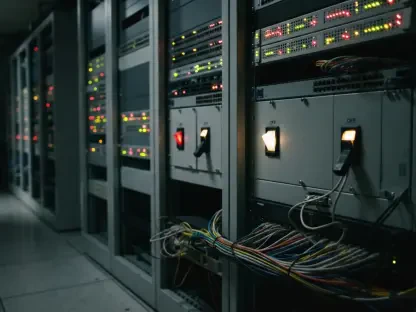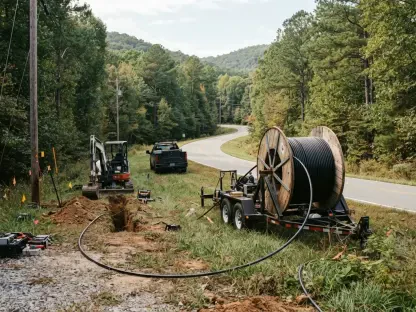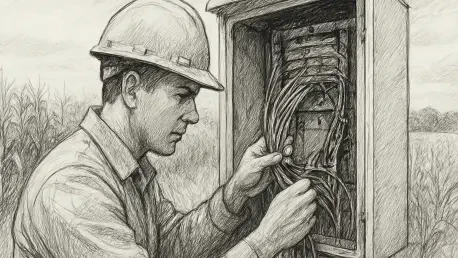

Local government leaders are increasingly bypassing large corporations by partnering with cooperatives to treat fiber-optic connectivity as a public utility for their constituents. This strategic pivot comes at a time when the “last mile” problem has evolved from a technical hurdle into a glaring social inequity, particularly across the rolling hills and agricultural heartlands of Wisconsin. For many rural residents, the sight of fiber-optic markers along their property lines has become a symbol of exclusion rather than progress. While massive rolls of glass-fiber cable are buried beneath the soil to feed distant cellular towers or metropolitan hubs, the homes and barns situated directly above these lines remain trapped in a pre-digital age. This phenomenon highlights a profound disconnect in the state’s infrastructure planning, where the “middle-mile” backbone—the superhighway of information—exists in abundance, yet the individual “driveways” that connect citizens to that highway are never built. The result is a landscape where high-tech potential is literally within arm’s reach, yet remains functionally inaccessible to the people who need it most. This geographic irony is best exemplified by the experience of farmers who can see the utility caps for fiber lines from their porch but are told that no service is available for their address.
Statistical Progress and the Reality of Underserved Communities
Over the last decade, Wisconsin has tracked significant upward trends in overall connectivity, yet these metrics often fail to capture the nuanced difficulties faced by the remaining unserved populations. In 2016, approximately 13 percent of the state lacked basic internet access, a figure that has since been whittled down to roughly 6 percent. On paper, the state’s progress appears exemplary, with 92.8 percent of locations now technically capable of accessing speeds of at least 100/20 Mbps. However, for the 165,000 locations still languishing without even the most rudimentary service, these percentages offer little comfort. These are not merely remote outposts but clusters of communities in counties like Jackson, Monroe, and Trempealeau, where the digital divide is expanding rather than shrinking. The data points used by state agencies often overlook the “pockets of darkness” within regions that are officially marked as served. This statistical optimism creates a significant barrier to funding, as many areas are deemed ineligible for grants based on their technical proximity to fiber lines that they cannot actually utilize for residential or small business purposes.
The transition from establishing a robust middle-mile infrastructure to completing the residential hookups required for true universal access has hit a significant bottleneck in several key administrative regions. While state-wide initiatives have successfully linked major municipal centers and industrial parks, the final stretch of cable required to reach individual residences—the “last mile”—remains prohibitively expensive for many stakeholders involved in the rollout. In the aforementioned rural counties, thousands of residents live in a state of digital limbo, where no active expansion plans exist for the next two to four years. This lack of a clear roadmap is particularly devastating because it discourages private investment and leaves homeowners with no timeline for when they might achieve parity with their urban neighbors. For these underserved citizens, the digital divide is not a theoretical debate but a daily reality that affects everything from educational opportunities for their children to the ability to access modern healthcare via telehealth services. Without a concerted effort to bridge this specific gap, the progress made in urban and suburban areas will only serve to further isolate those living in the rural periphery.
The Economic Consequences of the Digital Divide
Reliable high-speed internet has transitioned from a modern luxury to a foundational utility, ranking alongside electricity and clean water as an essential requirement for economic survival in the modern era. In rural Wisconsin, the absence of this infrastructure acts as a massive anchor on local development, preventing small businesses from scaling their operations or even maintaining basic modern standards of customer service. For example, local service-based enterprises like kennels, repair shops, and boutique retailers find it nearly impossible to operate modern security systems or maintain interactive online customer platforms without a stable connection. This puts these rural entrepreneurs at a profound disadvantage compared to competitors in better-connected regions, effectively capping their growth potential and limiting the economic diversity of their communities. Economic directors across the state have noted that without high-speed access, the traditional “Main Street” model of rural commerce is increasingly unsustainable in an economy that demands real-time responsiveness and global visibility for even the smallest local vendors.
The impact on the agricultural sector is perhaps the most critical concern for Wisconsin’s long-term economic health and food security. Modern farming is no longer just about manual labor; it is an information-intensive industry that relies on precision technology, automated machinery, and real-time data analysis to remain viable in a competitive global market. When a farm is unable to connect its specialized equipment to the cloud or access real-time weather and market data, it loses its ability to optimize crop yields and manage resources efficiently. Furthermore, the lack of connectivity severely hampers the state’s ability to attract and retain a younger workforce in rural areas. Telecommuters and young professionals, who could bring fresh capital and vitality to rural towns, are increasingly unwilling to consider areas that do not offer the “gold standard” of high-speed fiber connectivity. This inability to attract new residents leads to stagnating property values and a shrinking tax base, which in turn reduces the funds available for other essential local services like schools and infrastructure maintenance, creating a cycle of decline that is difficult to break without significant technological intervention.
Corporate Profit Motives and Market Failures
A fundamental cause of the persistent “last mile” gap is the inherent conflict between corporate profit incentives and the public service mandate required for rural expansion. Major internet service providers operate on a business model that favors high-density urban and suburban markets, where the cost of infrastructure per customer is low and the return on investment is immediate. In these environments, the density of subscribers justifies the immense expense of laying fiber-optic lines. However, in the sprawling rural landscapes of Wisconsin, where homes may be separated by miles of forest or farmland, the cost-benefit analysis often turns negative for traditional publicly traded companies. Corporations frequently demand the presence of “anchor tenants,” such as large manufacturing facilities or government offices, before they will even consider extending fiber into a new area. This leaves individual residents and small family farms in a digital “no-man’s land” where their business is simply not lucrative enough to warrant corporate attention, even if a high-capacity fiber-optic cable is already running across their property to serve a more profitable destination miles away.
This market failure is further exacerbated by the restrictive practices and exorbitant fees that some legacy providers impose on rural customers who attempt to gain access to existing infrastructure. There have been numerous documented instances where a provider acknowledges that a high-capacity fiber line exists on a resident’s land but flatly refuses to offer a residential connection, citing internal policies that reserve the line for commercial or industrial use only. When these companies do offer to bridge the gap, the financial burden placed on the individual resident can be staggering. Homeowners and small-scale farmers have reported being quoted “hookup fees” or “disconnect penalties” that can reach as high as $20,000. These costs are often intentionally prohibitive, acting as a barrier to entry that ensures only the largest corporate entities can afford the benefits of high-speed connectivity. This creates a tiered system of digital citizenship, where the infrastructure built across private rural land serves the interests of distant shareholders while providing zero benefit to the property owners who host it, further deepening the resentment felt by rural populations toward large telecommunications firms.
Technical Limitations and the Cooperative Solution
For those trapped in the void of the “last mile,” the available technical alternatives are often both costly and fundamentally flawed. Many residents are forced to rely on “bonded” copper DSL lines, a process that involves linking multiple antiquated telephone wires together to achieve speeds that still fail to meet the modern definition of broadband. This hardware is not only slow but also extremely fragile; the aging copper infrastructure is highly susceptible to environmental degradation and electrical surges. A single lightning strike in the vicinity can destroy expensive modems and specialized equipment, leading to recurring hardware costs that add a significant financial burden to an already inferior service. While satellite-based solutions have offered a temporary reprieve for some, providing speeds that far exceed old copper lines, they remain vulnerable to weather-related outages and lack the low-latency stability required for intensive applications like video conferencing or real-time data syncs. These are stopgap measures that do not address the fundamental need for a “future-proof” fiber-optic network that can grow with the community’s needs.
Recognizing that legacy providers are unlikely to change their strategy, local governments in Wisconsin have begun to look toward a model that once brought electricity to the rural masses: the cooperative. By partnering with local energy and telecommunications cooperatives, counties are reclaiming control over their digital destiny. These member-owned organizations are not driven by the same quarterly profit demands as multinational corporations, allowing them to take a longer-term view of infrastructure investment. In counties like Jackson, local leaders are now treating fiber-optic connectivity as a public utility, much like sewer or water systems. By utilizing state and federal grants to fund the construction of the network, they are building the infrastructure that specifically targets the thousands of unserved dwellings that major companies have ignored for years. This cooperative approach ensures that the “last mile” is prioritized, as the primary goal is universal service for the community rather than the maximization of profit margins for distant investors. This shift represents a return to a community-based infrastructure model that values local stability over corporate growth.
Strategic Pathways: The Future of Digital Equity
The path toward achieving true digital equity in Wisconsin required a fundamental shift in how the state managed and allocated its resources during the current expansion phase. Previously, a significant portion of federal broadband funding was tied up in administrative restructuring, which caused a temporary stall in “non-deployment” activities such as workforce training and regional planning. However, the move toward a more decentralized, local-first strategy proved to be the catalyst for meaningful change. By empowering counties to take direct ownership of their broadband goals, the state allowed for more flexible and responsive projects that addressed the unique geographical challenges of the Midwest. This decentralized approach encouraged the development of localized workforce initiatives, training a new generation of technicians capable of maintaining the complex fiber networks in rural environments. These steps were essential in ensuring that once the fiber was laid, the communities had the internal capacity to keep the systems running without relying on the often-slow response times of major national providers headquartered out of state.
To ensure these gains remained permanent, the state emphasized the importance of rigorous regulatory oversight and the elimination of anti-competitive barriers that had historically protected legacy monopolies. Policies were implemented to prevent providers from charging exorbitant hookup fees, ensuring that if a fiber line crossed a property, the owner had a legally protected right to access that service at a fair price. Furthermore, the focus shifted toward “future-proofing” the network, prioritizing fiber-optic technology over less reliable wireless or satellite alternatives. This long-term vision recognized that internet speed requirements would only continue to grow, and that an investment in fiber would pay dividends for decades. By treating connectivity as a fundamental right rather than a market commodity, Wisconsin eventually established a framework where no citizen was left behind simply because of their zip code. The lessons learned during this period demonstrated that the “last mile” was never an insurmountable technical problem, but rather a challenge of political will and community-focused investment that prioritized the needs of people over the profit margins of large corporations.