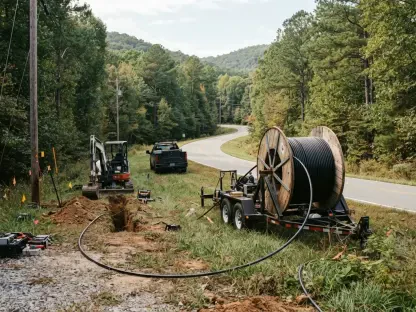

The nationwide effort to expand high-speed internet access has hit a massive physical roadblock in the form of the aging wooden utility poles that line American roads. While federal agencies have poured billions into fiber optic expansion, the physical reality of stringing miles of glass depends on a network under the control of local utilities.
This friction is not just a technical challenge but a deep-seated conflict between providers and asset owners. The outcome of these disputes will determine whether rural America joins the modern digital economy or remains isolated behind a wall of bureaucratic and physical hurdles.
The Physical Bottleneck: Why Wooden Poles Control the Future of High-Speed Internet
The Federal Communications Commission has introduced the Rapid Broadband Assessment Team to speed up deployment, yet deep-seated conflicts persist. Experts suggest that while fiber technology is ready, the administrative process for accessing poles remains archaic and contentious.
Disputes over infrastructure access and pricing have become a high-stakes standoff, putting billions in public investment at risk. Without a resolution, the connectivity of millions of citizens in unserved rural areas could remain in jeopardy for years as legal battles continue.
The Growing Friction Between Connectivity Goals and Utility Control
A widening gap has emerged between the federal government’s connectivity goals and the operational control maintained by local utility companies. This friction is particularly evident in regions where aging infrastructure requires significant upgrades before new fiber can be safely installed.
Utilities argue that they must protect the integrity of their grids, while broadband providers claim these concerns are used to delay competition. These competing priorities have turned a technical upgrade process into a prolonged legal and administrative battle across several states.
Administrative Defiance: How Infrastructure Owners Are Ignoring Federal Mandates
Despite clear rulings from federal regulators, some utility companies treat federal orders as optional suggestions rather than legal requirements. One example involves a utility disregarding mandates to stop charging providers for infrastructure damage they did not cause.
By treating final orders as starting points for further negotiation, utilities create bureaucratic loops that halt construction. This defiance leaves households in the dark while legal teams argue over the interpretation of federal authority and compliance standards.
The Hidden Cost of Connectivity: Financial Friction and Inflated Rental Rates
The dispute extends into operational costs, specifically regarding rental rates for pole attachments. Major providers have filed formal complaints alleging that utilities leverage their monopoly over physical poles to extract millions in overcharges through unjust fees.
These financial hurdles siphon away capital originally earmarked for expanding service into unserved communities. When rental fees are inflated, the cost of reaching the last mile becomes prohibitive, slowing the pace of regional broadband expansion significantly.
Jeopardy for the BEAD Program: Scaling the Wall of Regional Resistance
Friction on the ground has direct consequences for the Broadband Equity, Access, and Deployment program, the centerpiece of national strategy. Regional resistance has already stalled projects intended to serve thousands of locations, placing nearly $1 billion in funding at risk.
This trend suggests that without a breakthrough in physical asset management, the most ambitious infrastructure project of the decade could fail. Local disputes over wooden poles are no longer just business disagreements; they represent a significant barrier to national progress.
From Mediation to Mandates: The Case for Aggressive Regulatory Enforcement
As mediation efforts show signs of fatigue, there is a growing consensus that regulators must transition from facilitators to strict enforcers. Current strategies may no longer be enough to compel compliance from utilities prioritizing their own financial interests over connectivity.
Regulators may need to pivot toward forfeiture proceedings and heavy monetary penalties to ensure the rule of law. Signaling that obstructing broadband expansion carries a high cost is essential to ensuring that national goals are met without further delay.
Navigating the Gridlock: Strategies to Safeguard Universal Access
To prevent local disputes from undermining national progress, policymakers should adopt a more proactive and unified approach. Streamlining the make-ready process and standardizing rental fee structures across state lines could eliminate the ambiguity that utilities currently exploit.
Broadband advocates also push for transparent data sharing regarding pole health and availability. Settling disputes based on objective technical needs rather than competitive posturing would speed up deployment and reduce the need for constant litigation between companies.
Securing the Last Mile: Why Regulatory Teeth Are Essential for Broadband Success
The success of the U.S. broadband expansion finally rested on the realization that digital infrastructure was only as strong as its physical foundation. It was recognized that if utility companies were allowed to bypass federal orders, universal internet would remain a distant ambition.
Actionable steps involved transitioning toward a regulatory environment where cooperation was the standard and defiance carried heavy consequences. By prioritizing federal enforcement, the nation finally secured the pathways needed to close the digital divide and support the modern economy.