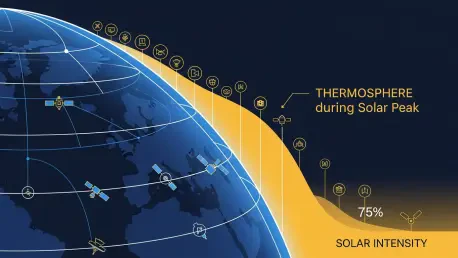

The vast graveyard of defunct satellites and spent rocket stages orbiting the Earth has long been viewed primarily as a hazardous obstacle course for modern space flight, yet a groundbreaking study from the Vikram Sarabhai Space Centre has revealed that this cosmic debris actually serves as a sophisticated set of diagnostic instruments for understanding our planet’s atmosphere. By treating these derelict hulls as passive sensors, researchers have identified a precise solar activity threshold that triggers an abrupt acceleration in orbital decay, potentially revolutionizing how we predict the final moments of objects reentering the atmosphere. These passive probes are uniquely suited for this task because they lack active propulsion systems that would otherwise mask the subtle effects of atmospheric drag with manual orbital corrections. By meticulously tracking the altitude of these objects over more than sixty years, scientists have constructed a high-fidelity record of the upper atmosphere’s density fluctuations, providing insights that go far beyond previous generalized estimates or theoretical simulations. This shift in perspective transforms space junk from a liability into a vital resource for space weather science, offering a rare opportunity to observe the long-term interaction between solar energy and the thermosphere without the high costs associated with launching dedicated new scientific missions for this specific purpose.
Analyzing the Legacy: The Silent Seventeen
The researchers zeroed in on a specific cohort known as the “Silent Seventeen,” comprising a diverse mix of weather satellites and discarded rocket fragments launched during the height of the space race in the 1960s. These particular items were selected for their remarkable longevity and stability in orbits situated below 800 kilometers, a region of space where the atmosphere is thin but still dense enough to exert a measurable influence over several decades. Because these objects have remained completely inactive and devoid of internal propulsion for over half a century, their gradual descent toward Earth offers an exceptionally clean signal of external environmental forces. This massive dataset spans three complete solar cycles, allowing the research team to observe how the thermosphere responds to varying intensities of solar output without the interference of orbital maneuvers or internal mechanical failures. The result is a historical timeline that transforms what was once considered “dead” weight into a vital dataset for modern orbital mechanics, showing that the steady decay of these objects is a perfect mirror for the energetic state of the Sun itself. Each object in this group acted as a constant, unchanging reference point that allowed scientists to filter out noise and focus on the fundamental physics of atmospheric drag.
The primary driver behind the changing fortunes of these orbiting relics is the Sun’s predictable yet volatile 11-year cycle, which dictates the amount of extreme ultraviolet radiation hitting the Earth’s upper layers. When solar activity ramps up, this intense energy is absorbed by the thermosphere, causing the gas molecules to heat up and the entire atmosphere to expand outward like a balloon being inflated by heat. This swelling effect places more air molecules in the path of orbiting satellites, significantly increasing the aerodynamic drag they experience even at altitudes that are usually considered almost empty vacuum. The Vikram Sarabhai team discovered that this expansion is not a linear or gradual process that scales perfectly with solar brightness as previously assumed by many older models. Instead, the research points toward a specific tipping point where the resistance from the atmosphere shifts from a negligible background force to a powerful decelerating drag that can shorten a satellite’s remaining life by years in a very short span of time. This discovery clarifies why certain objects appear to hover in space for years with little change, only to suddenly begin a rapid, terminal descent that catches ground controllers and tracking networks off guard, emphasizing the need for a more nuanced understanding of solar-atmospheric coupling.
Solar Dynamics: The 67-75% Tipping Point
Central to the study’s findings is the identification of a specific marker within the solar cycle: once sunspot activity reaches approximately 67% to 75% of its peak for a given cycle, orbital decay rates accelerate dramatically. This threshold remained remarkably consistent across all seventeen observed objects and held true throughout three distinct solar cycles, suggesting a fundamental physical relationship between solar energy and atmospheric density that remains stable over time. Before reaching this critical percentage, the rate of altitude loss remains relatively slow and predictable, but crossing this line causes a sharp uptick in friction that forces objects into lower, denser altitudes much faster. This immediate reaction indicates that the Earth’s thermosphere possesses a high level of sensitivity to solar inputs, responding almost instantaneously once the energy threshold is surpassed by the Sun’s radiation. Understanding this specific trigger point allows mission planners to move away from vague, long-term forecasts and instead target specific phases of the solar cycle to estimate when a defunct satellite will finally meet its fiery end in the lower atmosphere. By monitoring the solar flux as it approaches this 67-75% range, operators can finally predict the onset of rapid decay with a degree of accuracy that was previously impossible.
The research also highlighted that the magnitude of this decay is intimately tied to the overall intensity of the solar cycle, creating a distinct “staircase” pattern in the historical data. During periods of high solar intensity, such as the peak observed in the early 1990s, the rate of orbital decay was found to be more than twice as fast as the rates recorded during the historically weak solar cycle that began around 2014. This discrepancy suggests that during prolonged periods of solar minimum or exceptionally weak cycles, space debris can persist in orbit for significantly longer durations than standard models might predict. This phenomenon complicates the ongoing problem of orbital overcrowding, as “cleansing” the sky of debris through natural atmospheric drag happens much more slowly during quiet solar years. Consequently, if the Sun remains in a lower-activity state for multiple decades, the accumulation of space junk could reach critical levels faster than expected because the natural “sink” provided by the atmosphere is effectively turned off. This realization has significant implications for long-term space sustainability, as it suggests that the environment’s ability to self-clean is highly dependent on the Sun’s unpredictable long-term trends, requiring more aggressive active debris removal strategies from international space agencies through 2026 and the following years.
Model Refinement: Addressing the Polar Gap
In analyzing which factors most accurately predict orbital decay, the scientists found that steady solar radiation is a far more reliable indicator than the sporadic magnetic storms that often dominate space weather headlines. Solar radiation indices, specifically those measuring the F10.7 centimeter radio flux, were able to explain nearly 75% of the observed variations in decay rates, whereas geomagnetic indices—which track disturbances in the Earth’s magnetic field—showed almost no correlation with long-term orbital trends. This finding is significant because it suggests that while a major solar storm might cause a brief, intense spike in atmospheric drag, it is the constant, day-to-day energy output of the Sun that determines the ultimate lifespan of an object in space. For satellite operators, this means that tracking the long-term progression of the solar cycle is more crucial for orbital maintenance than reacting to individual geomagnetic events. This clarity allows for more stable, long-term mission planning and helps engineers better allocate fuel reserves for altitude-boosting maneuvers over the course of a satellite’s operational life. By focusing on the correct solar indicators, the industry can develop more efficient propulsion strategies that extend the working life of multi-billion dollar orbital assets.
Despite the progress made in identifying solar thresholds, the study exposed a significant deficiency in the atmospheric models currently used by the aerospace industry, particularly regarding objects in polar orbits. Existing standard models frequently failed to accurately predict the behavior of debris passing over the Earth’s poles, often underestimating the density of the air in those specific geographic regions and leading to errors in reentry timing. This “polar gap” posed a genuine challenge for weather monitoring and Earth observation satellites, which frequently utilized polar orbits to achieve global coverage of the planet’s surface. Inaccurate predictions of atmospheric drag in these areas lead to premature mission failures or unexpected reentries that posed risks to ground-based infrastructure. To solve this, the researchers proposed a transition toward dynamic density models that accounted for the non-linear expansion of the thermosphere at high latitudes. They concluded that integrating the 67-75% solar threshold into these revised models improved prediction accuracy by a substantial margin. This shift allowed for better coordination of reentry windows and more precise fuel budgeting for active satellites, ensuring that the next generation of space missions operated with a clearer understanding of the invisible forces shaping their trajectories in an increasingly crowded orbital environment.