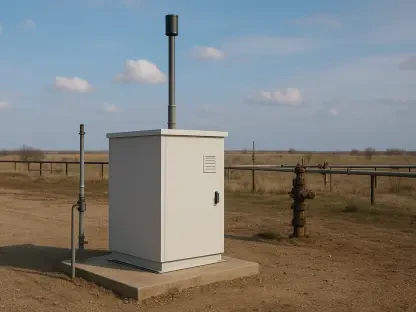

The sight of an autonomous tractor traversing a muddy field in the British countryside should be the ultimate advertisement for a 5G-enabled future, yet the reality remains stubbornly tethered to older generations of connectivity. On the famous Diddly Squat Farm, featured in the television series Clarkson’s Farm, the AgBot represents a pinnacle of agricultural engineering. It is a driverless, high-tech machine designed to revolutionize farming efficiency. However, a closer inspection of its operational requirements reveals a glaring hole in the telecommunications narrative. Instead of utilizing the high-speed, low-latency 5G networks that were promised to transform rural industry, the AgBot relies predominantly on 4G and GPS signals to navigate and communicate. This reliance exposes a significant disconnect between the technological capabilities of hardware and the actual availability and reliability of modern network infrastructure.
The “expectation gap” between the original 2015 vision for 5G and the lived experience of 2026 has become impossible to ignore. A decade ago, the industry introduced the “5G triangle,” a conceptual framework that positioned Massive Machine Type Communications (mMTC) as one of the three critical pillars of the network’s purpose, alongside enhanced mobile broadband and ultra-reliable low-latency communications. The dream was an world where billions of sensors and industrial machines would be seamlessly integrated into a unified cellular ecosystem. Today, that corner of the triangle looks remarkably unstable, as the anticipated explosion of high-bandwidth, 5G-dependent industrial IoT has largely failed to materialize outside of specific controlled environments.
This failure matters because the telecommunications industry is already beginning to beat the drums for 6G. If the foundational errors of the 5G era—over-promising on coverage, underestimating hardware costs, and failing to deliver a consistent global standard—are not addressed, 6G risks becoming another expensive upgrade that serves only a fraction of the devices it intends to connect. The AgBot is not an isolated case; it is a symptom of a broader strategic misalignment. To understand why the 6G lifecycle is in jeopardy, one must first dismantle the myths that led to the stagnation of the cellular Internet of Things (IoT) over the past several years.
Why a High-Tech Tractor on a British Farm Exposes the 5G Myth
The paradox of the AgBot lies in its sophistication compared to the network environment it inhabits. Agricultural robots require precision and constant uptime to be effective, qualities that 5G marketers once claimed would be standard across every acre of arable land. However, the cost of deploying 5G base stations in rural areas remains prohibitive for most carriers, who prioritize high-density urban zones where smartphone traffic yields immediate returns. Consequently, industrial-grade equipment must fall back on 4G, which, while functional, lacks the advanced features like network slicing or extreme density management that were supposed to define the “smart” economy. This reliance on legacy systems highlights that the “5G revolution” has been more of an incremental evolution for most practical applications.
The disconnect is further exacerbated by the failure of the industry to fulfill the promise of 5G Standalone (SA) networks. While non-standalone 5G offered a speed boost by hitching a ride on 4G infrastructure, the true benefits of the 5G triangle required the deployment of independent core networks. In reality, the rollout of 5G SA has been agonizingly slow in Western markets, leaving high-end hardware like the AgBot without the low-latency “nervous system” it was designed to exploit. This infrastructure lag has created a vicious cycle: manufacturers are hesitant to build 5G-only hardware because coverage is spotty, and carriers are slow to expand coverage because there are not enough 5G-native devices to justify the investment.
In contrast to the sleek marketing brochures, the agricultural sector demonstrates that reliable connectivity often trumps cutting-edge speed. For a farmer, the risk of an autonomous tractor losing its signal in the middle of a field is not just a technical glitch; it is a significant safety hazard and a disruption to the food supply chain. By failing to provide a robust, wide-area foundation for these devices, the cellular industry has allowed alternative technologies, such as satellite-based GPS and localized mesh networks, to become the preferred solutions. This trend suggests that the 5G vision was built on a fundamental misunderstanding of what industrial users actually value in a connection.
The Widening Gap Between Cellular Hype and 22 Billion Devices
The scale of the industry’s forecasting failure is perhaps best illustrated by the wildly optimistic predictions made at the beginning of the last decade. In 2011, prominent futurists and networking giants like Cisco predicted that the world would be home to 50 billion connected devices by 2020. This figure was not just a guess; it was the bedrock upon which billions of dollars in infrastructure investment were justified. However, recent data from the Ericsson Mobility Report shows that the global total of IoT devices reached only 22.3 billion last year, missing the target by more than half. Even more telling is the fact that only a small portion of these devices—roughly 4.5 billion—actually utilize cellular networks.
The uncomfortable truth for mobile operators is that the vast majority of the “connected world” functions perfectly well without them. Short-range technologies like Wi-Fi, Bluetooth, and Zigbee continue to dominate the consumer and home automation markets, while proprietary long-range systems like LoRaWAN have carved out significant niches in industrial sensing. Cellular’s share of the broader IoT landscape has remained modest because the overhead of a SIM card, a data plan, and cellular power consumption is often too high for a simple temperature sensor or a smart meter. Despite the hype, the mobile industry has struggled to prove that a cellular connection is worth the extra cost and complexity for the “massive” part of the IoT equation.
Furthermore, the quality and generation of existing cellular connections tell a story of technological inertia. Even within the 4.5 billion cellular IoT connections, a significant portion still operates on legacy 2G and 3G systems. These decades-old technologies continue to outperform 5G in terms of active connections in many regions because they are cheap, the hardware is ubiquitous, and the coverage is universal. The industry’s push to migrate these “low-value” connections to 5G standards like NB-IoT has met with resistance from enterprises that see no reason to replace a functioning $5 sensor with a $30 5G module. This creates a stagnant market where the “cutting edge” is largely ignored by the very entities it was designed to serve.
A Broken Ecosystem of Fragmented Standards and Regional Divides
One of the most significant barriers to a unified IoT future has been the “technological bewilderment” caused by a profusion of competing standards. Instead of a single, streamlined path for IoT, the 5G era introduced a confusing array of options, including Narrowband IoT (NB-IoT), Cat-M, and more recently, RedCap (Reduced Capability). Each of these standards was designed to solve a specific problem, but the result has been a fragmented hardware ecosystem that lacks economies of scale. Manufacturers are forced to choose which standard to support, often leading to regional incompatibilities that prevent a device built for the American market from functioning efficiently in Europe or Asia.
This fragmentation has also created a stark geopolitical divide in how IoT is deployed. China has moved aggressively to achieve massive scale by mandating the use of NB-IoT and providing heavy government subsidies for domestic giants like Huawei. This top-down approach has resulted in China hosting nearly 90% of the world’s NB-IoT connections, creating a localized ecosystem that thrives while Western carriers struggle to find a profitable path. In contrast, many Western operators have abandoned their IoT networks or consolidated their offerings. For instance, NTT Docomo in Japan shuttered its NB-IoT network years ago, and major U.S. carriers have decommissioned similar systems in favor of Cat-M, leaving developers in a state of constant uncertainty.
The bottleneck of 5G Standalone (SA) infrastructure further compounds these issues. Because technologies like RedCap—designed to bridge the gap between simple sensors and high-end smartphones—require a 5G SA core to function, their adoption has been paralyzed. In Europe, 5G SA adoption remains in the single digits, and even in the United States, it has only reached roughly 50% of the network footprint. This means that a developer creating a “middle-tier” 5G device, such as a connected industrial tool or a high-end wearable, cannot guarantee its performance across different carrier networks. Without a consistent infrastructure foundation, the fragmented standards of the 5G era have become a graveyard for innovation.
Moving the Goalposts from Simple Sensors to High-Value Physical AI
As it became clear that the “massive” volume of low-cost sensors would not drive the expected revenue, the industry began a strategic pivot. The new narrative focuses on “Physical AI,” a term used to describe high-value, high-bandwidth devices like smart glasses, autonomous drones, and humanoid robots. By rebranding the IoT as a foundation for artificial intelligence, carriers hope to justify higher service fees and move away from the low-margin business of smart meters. This shift is essentially an admission that the original 5G IoT business model failed and that the industry is now chasing “premium” device revenue to recoup its investment.
However, research from firms like Omdia suggests that this pivot faces a massive economic roadblock: the pricing of hardware modules. For a technology like RedCap to succeed where NB-IoT failed, it needs to be affordable. Currently, RedCap modules are priced far too high for widespread enterprise adoption, often costing several times more than the 4G modules they are meant to replace. If a connected screwdriver or a pair of industrial smart glasses requires a $50 radio module and a $20 monthly data plan, the return on investment for a factory manager disappears. The industry is currently repeating the mistake of building sophisticated technology without considering the price sensitivity of the mass market.
There is also a growing concern among experts that this focus on “Physical AI” will lead to the neglect of practical, unglamorous infrastructure. While humanoid robots and augmented reality glasses are exciting for keynote presentations, they do not address the fundamental need for reliable, low-cost connectivity in utilities, logistics, and agriculture. By “moving the goalposts” toward high-value gadgets, the telecommunications sector risks leaving behind the very industries that could benefit most from a unified 6G network. Chasing the next “shiny object” in the form of AI-powered hardware may result in 6G being even more niche and inaccessible than its predecessor.
Strategic Corrections Required to Save the 6G Lifecycle
The telecommunications sector eventually realized that sustainable growth necessitated a radical overhaul of its approach toward massive machine-type communications. Stakeholders recognized that bridging the ARPU (Average Revenue Per User) gap was essential for the long-term viability of cellular IoT. Carriers moved away from rigid smartphone-style billing and adopted more flexible, automated business models that allowed millions of low-revenue sensors to be profitable. This shift required a fundamental change in how network resources were allocated, ensuring that a simple temperature sensor did not consume the same administrative overhead as a high-end data plan.
Aggressive mandates for 5G Standalone migration became the cornerstone of the transition toward a more functional 6G ecosystem. Regulatory bodies and industry leaders prioritized the deployment of independent core networks to provide the necessary foundation for advanced features like network slicing and low-latency communication. This effort ensured that when 6G hardware finally hit the market, the infrastructure was already in place to support it, preventing the “dead on arrival” scenarios that plagued early 5G IoT devices. The industry also worked to consolidate the profusion of competing standards, settling on a more unified global roadmap that encouraged manufacturers to invest in standardized, high-volume hardware production.
Standardization bodies prioritized hardware affordability as a primary design goal for the 6G lifecycle, learning from the pricing failures of the RedCap era. By focusing on reducing the complexity of radio modules and lowering the cost of entry for developers, the industry successfully lowered the barriers to entry for small and medium enterprises. These strategic corrections allowed the cellular industry to finally reclaim its place as a dominant force in the IoT landscape. The lessons learned from the failed promises of the past provided a blueprint for a future where high-tech tractors and simple sensors alike could coexist on a robust, reliable, and economically viable network.