
Vladislav Zaimov has built a career navigating the intricate world of enterprise telecommunications, focusing specifically on the high-stakes environment of risk management for vulnerable networks. As the digital demands of modern living shift from simple web browsing to fully integrated smart environments, Zaimov has become a leading voice on how infrastructure must evolve to keep pace. His expertise lies in the physical and logical architecture of connectivity—understanding that the “last mile” is often the most difficult and critical part of the journey. In this conversation, we explore the significant shift toward dedicated fiber in multi-dwelling units, a move that promises to eliminate the bottlenecks of shared bandwidth and redefine the residential experience.
How does the transition from traditional rooftop fixed wireless systems to a dedicated “home-run” fiber architecture fundamentally change the daily digital experience for residents in high-density living environments?
It represents a total departure from the shared-resource mentality that has dominated apartment living for the last decade. Historically, services like Webpass utilized rooftop antennas to catch a signal and then distributed that connectivity through a building’s existing, often aging, wiring. By moving to a “home-run” fiber model, like the one seen at the 896-unit Pacifica Place in Irvine, California, we are providing 3 gig symmetrical service directly to every single unit rather than forcing neighbors to fight over one large pipe. You can actually feel the difference in the responsiveness of the network; it’s the difference between a crowded highway and a private lane. When you have an ONT and a Wi-Fi 7 access point terminating right in your unit, the latency drops and the reliability skyrockets, making the connection feel like a solid utility rather than a fluctuating airwave.
Beyond the impressive speed increase, this new rollout emphasizes a “managed Wi-Fi” experience with Wi-Fi 7 and IoT integration; how does this level of connectivity redefine the concept of a “smart” community?
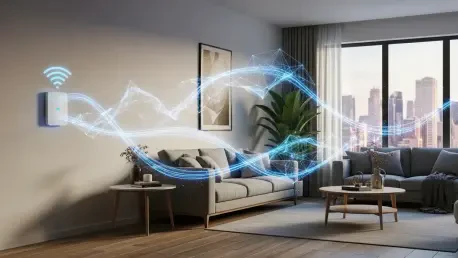
We are moving away from the idea of “home internet” being confined to the four walls of an apartment and toward a seamless blanket of connectivity that covers the entire property. By mounting Cambium Network Wi-Fi 7 access points to the ceilings, the signal becomes a deliberate architectural feature rather than an afterthought tucked behind a television. Residents can walk from their living room to the pool area or down into the parking garage without ever seeing a loading spinner or losing their connection. Through the partnership with Quext, this 3 gig backbone allows for the instantaneous control of thermostats, lights, and smart locks, creating a sensory environment where the building responds to the tenant. It transforms the living space into a truly “always-on” ecosystem where the digital and physical worlds are completely intertwined.
Bulk-billing arrangements have faced significant scrutiny from regulators in the past; how does the opt-in design of this model address those concerns while still providing a viable business case for property owners?
The regulatory landscape for multi-dwelling units has been quite volatile, especially when you consider the previous FCC initiatives aimed at banning these arrangements to promote competition. However, by designing this as an opt-in model at its core, the service respects the current regulatory environment while still offering the convenience of a turnkey solution. Property owners like The Irvine Company see this as a premium amenity that can be marketed to new tenants who want immediate access to high-speed fiber the moment they move in. It mitigates the risk of legal friction because it doesn’t necessarily lock out other providers, though the sheer performance of a 3 gig symmetrical line makes it a very difficult service to turn down. This balanced approach allows for the efficiency of bulk-billing without the controversy of depriving residents of their choice.
With the recent corporate transition and the merger with Astound Broadband, what does the future look like for the current product roadmap and the expansion of these fiber-to-the-unit projects?
The internal momentum for these fiber-to-the-unit projects is remarkably resilient, even in the face of major corporate shifts like a spin-off from Alphabet or a merger with a private equity-backed operator. The product roadmap is essentially “full steam ahead,” with the plans for MDU expansion remaining exactly as they were before the Astound announcement. This consistency is vital because there is already a very healthy sales pipeline across all major markets that relies on the success of launch properties like Pacifica Place. The technical demand for dedicated fiber in high-density housing is far too great for a merger to derail, and the engineering teams are focused on execution rather than boardroom changes. We are seeing a commitment to the long-term vision of bringing 3 gig speeds to every unit, regardless of who owns the parent company.
What is your forecast for the evolution of fiber-to-the-unit technology in the next five years?
I believe we are entering an era where dedicated “home-run” fiber will become the absolute requirement for any new high-end residential development, effectively making shared-pipe systems a relic of the past. As Wi-Fi 7 matures, we will likely see the 3 gig benchmark become the new floor for performance, with 10 gig symmetrical services becoming the new target for premium MDUs. The integration of IoT will become so deep that the network will manage everything from building-wide energy efficiency to automated maintenance alerts, all invisible to the resident. Ultimately, the network will stop being something people “sign up for” and instead become a foundational part of the building’s infrastructure, as essential and expected as running water or electricity.