
Vladislav Zaimov is a seasoned telecommunications expert with a deep focus on enterprise-grade networks and the complex risk management required to secure vulnerable infrastructure. His extensive background in bridging the digital gap for underserved regions makes him a leading voice in the evolution of modern connectivity. In this discussion, we delve into the massive full-fibre expansion currently sweeping across North East Scotland, exploring how gigabit speeds are transforming rural economies and why the collaboration between government initiatives like Project Gigabit and commercial providers is essential for a truly connected future.
Rural regions like Angus and Perth & Kinross are finally seeing major infrastructure upgrades to reach 1Gbps speeds; what does this technical leap mean for the daily rhythm and quality of life in these villages?
The shift to 1Gbps speeds in towns such as Montrose and Dunkeld is nothing short of a digital revolution for the people living there. For years, these communities have dealt with the frustration of lagging connections, but this upgrade introduces the sensory thrill of “lightning-fast,” ultra-reliable internet that makes buffering a thing of the past. It allows families to enjoy seamless streaming while simultaneously supporting professionals who need to maintain stable, high-bandwidth connections for remote work. By bringing this city-level infrastructure to rural Scotland, we are ensuring that the digital divide is closed, allowing residents to participate fully in the modern economy without being held back by their geography.
With the UK and Scottish governments appointing providers to reach 63,000 remote premises, how do these public-private partnerships influence the scale of broadband rollouts compared to purely commercial ventures?
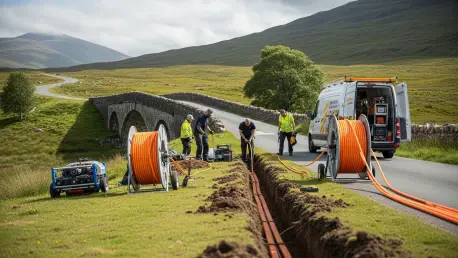
The appointment by the government in 2025 to reach 63,000 remote premises through Project Gigabit provides the essential framework needed to tackle the most difficult terrain. However, the real power lies in how this government-backed initiative complements commercial growth, where an additional 100,000 premises are being reached at no public cost. This blended approach allows for a much wider technological footprint across Angus and Aberdeenshire than any single entity could achieve alone. It creates a robust, sustainable network that leverages public funding for the hardest-to-reach areas while allowing commercial success to fuel further expansion into surrounding villages.
Beyond the immediate benefit of faster internet, how does a project of this magnitude impact the local workforce and the broader economic landscape of North East Scotland?
This expansion is a massive catalyst for local employment, directly creating 30 jobs and supporting a total of 180 roles over the entire lifespan of the project. These roles bring tangible skills and specialized training into the community, fostering a workforce that is equipped for the future of telecommunications. There is a profound emotional boost when local residents see their own towns becoming hubs of technological activity, knowing that these upgrades are unlocking new opportunities for small enterprises to compete globally. By investing in the physical cables in the ground, we are also investing in the people above it, significantly improving the economic vitality and long-term prospects of the entire region.
What is your forecast for the digital landscape of North East Scotland over the next decade?
I expect that within the next decade, the distinction between urban and rural digital capabilities in North East Scotland will vanish entirely as this full-fibre footprint continues to broaden. As more households and businesses register for these ultra-fast services, we will see a surge in local innovation and a new wave of “digital-first” residents moving to these scenic areas because they no longer have to sacrifice connectivity for quality of life. This infrastructure will serve as the permanent backbone for future technologies, ensuring that the North East remains a competitive and vibrant part of the UK’s digital economy. The success of this rollout today ensures that Scotland is not just catching up, but is actually setting the pace for rural connectivity worldwide.