
The rapid expansion of artificial intelligence infrastructure has fundamentally rewritten the financial trajectory of the global telecommunications industry, catapulting fiber manufacturers into a new era of prosperity. As the mid-2026 financial reporting season gets into full swing, it is becoming clear that the telecommunications hardware sector has undergone a massive structural transformation. For years, manufacturers of optical fiber and cable struggled with sluggish growth, overcapacity, and debilitating price wars that threatened the long-term viability of even the largest players. However, the shift toward intensive artificial intelligence computing has acted as a powerful catalyst, fundamentally altering the global supply and demand balance. This transition has effectively turned specialized manufacturers into high-profit powerhouses, as the infrastructure required to support massive AI clusters demands far more sophisticated and abundant optical connectivity than previous internet eras ever did.
Sector Performance and the Artificial Intelligence Catalyst
Profit Surges Among Industry Leaders
Yangtze Optical Fibre and Cable has emerged as the primary beneficiary of the current technological pivot, demonstrating an extraordinary recovery that has caught many analysts by surprise. By maintaining a disciplined focus exclusively on the fiber value chain, the organization was able to leverage the sudden spike in demand more effectively than its more diversified peers. During the first half of 2026, the company reported that its net profits grew by more than 700% compared to the same period in the previous year. This staggering increase suggests that the earnings generated in just six months have likely surpassed the total combined profits from the years spanning 2023 to 2025. Such a dramatic financial turnaround marks a definitive conclusion to the industry’s extended period of survival mode, characterized by razor-thin margins and fierce domestic competition. The company’s ability to capitalize on high-end niche markets has proven to be a decisive factor in this success.
The wave of prosperity has not been limited to a single entity, as other major players like Hengtong Optic-Electric and Zhongtian Technology have also reached historic financial milestones. Hengtong achieved its strongest performance in over a decade, with net profits for the first two quarters of 2026 exceeding the entirety of its total earnings from the previous year. Similarly, Zhongtian reported an impressive profit increase ranging between 50% and 60%, showcasing that even companies with multifaceted business models are reaping the rewards of the AI infrastructure boom. This widespread growth indicates that the rising tide of investment in high-performance computing is lifting the entire sector, rewarding those who maintained their manufacturing capacity through leaner times. The sheer scale of these gains reflects a fundamental shift in how the global market values the physical backbone of the digital world, moving away from commodity pricing toward a value-driven procurement model.
Shifting Demands for Data Infrastructure
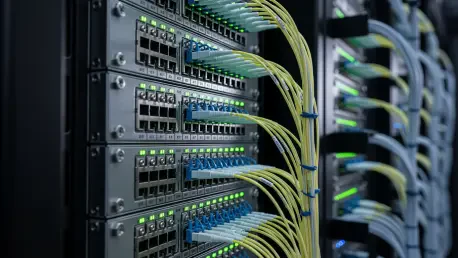
The underlying engine of these financial results is the rapid global expansion of artificial intelligence computing clusters, which require a different architectural approach than traditional data centers. Modern AI-driven architectures are built around massive 10,000-GPU scale clusters that necessitate a level of high-performance interconnectivity previously unseen in the enterprise space. This shift has resulted in a five-to-tenfold increase in optical fiber consumption per server cabinet to manage the colossal data flows and rigorous low-latency requirements essential for machine learning. Unlike the standard cloud environments of the past, AI training processes involve constant, high-speed communication between thousands of nodes, making the physical cabling a critical bottleneck if not properly addressed. Consequently, data center operators are no longer looking for the cheapest available fiber but are instead seeking high-density solutions that can sustain peak performance.
Beyond the sheer volume of material required, the quality of fiber utilized for artificial intelligence projects has significantly shifted, driving up industry profit margins across the board. Standard optical fiber is increasingly being replaced by premium products, most notably the high-end G.654.E ultra-low-loss fiber and pioneering hollow-core designs. These advanced materials are essential for high-performance computing because they offer the signal integrity and speed required for the latest generations of processors to function at full capacity. By producing these specialized materials, manufacturers have been able to command significantly higher prices, successfully boosting their gross margins from historical lows to well over 40% in many specialized cases. This movement toward premium, computing-grade fiber has transformed what was once a commoditized market into a high-tech frontier where technical expertise in material science translates directly into substantial financial premiums.
Supply Constraints and Future Strategic Growth
The Critical Influence of Optical Preforms
A significant driver behind the industry’s resurgence is the dramatic price correction for optical preforms, the high-purity glass rods that serve as the essential precursor for drawing fiber. For several years, a state of overcapacity had driven the prices of these preforms down to levels that were largely unsustainable for long-term manufacturing health. However, the sudden and intense spike in demand from global cloud service providers has caused the price of these critical components to skyrocket. This preform bottleneck has effectively converted the industry into a seller’s market, where the leading producers now hold significant leverage over procurement timelines and costs. Major manufacturers are currently reporting that their order books are filled well into the next calendar year, as customers scramble to secure the raw materials needed for their upcoming data center expansions. This scarcity has placed a premium on domestic production capabilities and supply chain security.
The current supply shortage is a direct consequence of previous market consolidation that took place during the industry’s leanest years. Prolonged periods of aggressive price wars and reduced profitability forced many smaller or less efficient competitors out of the market, while also discouraging new capital investments in manufacturing capacity worldwide. As a result, when the demand for high-grade fiber suddenly surged, only a handful of large-scale enterprises remained with the technical expertise and infrastructure to meet the needs of North American and domestic tech firms. The three giants of the Chinese market now occupy a uniquely advantageous position, possessing the vertically integrated capabilities required to produce high-purity preforms at scale. This concentration of manufacturing power has created a formidable barrier to entry for potential new competitors, ensuring that the existing market leaders can maintain their dominance and pricing power for the foreseeable future.
Strategic Evolution: Technical Integration and Next Steps
The industry successfully navigated the shift toward computing-grade fiber, ensuring that major manufacturers remained central to the global artificial intelligence ecosystem throughout this cycle. Leading firms utilized their recent financial windfalls to double down on research and development, specifically focusing on the next generation of hollow-core fiber and integrated optical modules that reduced signal latency to near-physical limits. The sector effectively leveraged a dual-drive model, where the immense profitability of optical communication segments supercharged adjacent ventures in submarine cables and renewable energy. This diversification created a more resilient business structure that allowed these companies to weather the inherent cyclicality of the telecommunications sector. By prioritizing innovation in high-end optical infrastructure, the major players transformed themselves from simple parts suppliers into indispensable partners for the technology firms driving the revolution.
Decision-makers within these organizations implemented more sophisticated demand-forecasting tools to avoid a return to the overcapacity issues that had plagued the market in previous years. This proactive stance allowed the sector to transition into a stable and high-value infrastructure pillar, where production was closely aligned with the hardware release cycles of AI chip designers. Manufacturers also explored new sustainability initiatives, such as reducing the energy intensity of the preform manufacturing process, which directly addressed the environmental concerns of their global enterprise clients. By evolving into strategic infrastructure architects, these giants moved beyond the limitations of the old commodity market and secured their position in the future digital economy. The successful management of the 2026 boom provided a clear roadmap for how traditional manufacturing sectors could thrive in an age of rapid and unpredictable computational evolution.