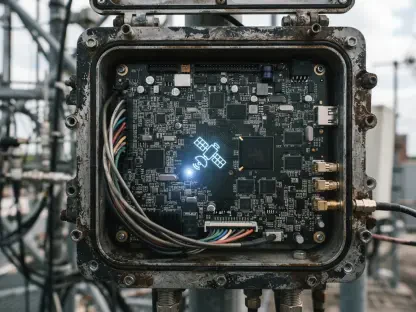

A dual-channel experimental setup allowed for a direct comparison between a wireless path and a fully wired control path to benchmark signal integrity at absolute zero. This breakthrough addresses the primary physical barrier preventing the expansion of superconducting quantum computers from a few hundred qubits to the millions required for fault-tolerant computation. As developers push the limits of modern cryogenic environments, the traditional reliance on rigid coaxial cabling has created a nightmare of thermal management and spatial congestion. The complexity of routing thousands of individual wires into a space no larger than a standard kitchen refrigerator has forced engineers to reconsider the fundamental architecture of quantum control. By moving toward a wireless paradigm, researchers are attempting to decouple the scaling of qubit counts from the physical volume of the cabling infrastructure, which currently acts as a literal tether on technological progress. This shift is essential for the transition from lab experiments to industrial utility.
Challenging the Status Quo of Quantum Scalability
Overcoming the Constraints: Traditional Cabling and Thermal Loads
The physical density of semi-rigid coaxial cables in modern superconducting systems presents an immediate threat to the continued growth of qubit counts. Each microwave line occupies valuable cross-sectional area within the dilution refrigerator, and as we move from hundreds to thousands of qubits, the sheer volume of metal becomes unmanageable. This cable forest not only makes maintenance and assembly incredibly difficult but also creates a significant thermal mass that must be cooled to near absolute zero. Every physical connection is a potential point of failure and a conduit for thermal noise, which can degrade the coherence of the qubits. The industry has reached a point where the mechanical limits of traditional wiring are dictating the maximum size of the quantum processor. By seeking to eliminate these physical interconnects, engineers are attempting to resolve the spatial and thermal imbalances that currently define the boundaries of quantum hardware. Replacing these wires with wireless microwave links represents a fundamental shift.
Managing the thermal load at the millikelvin stage is perhaps the greatest challenge when using traditional cabling for high-qubit-count processors. Coaxial cables are made of conductive metals that naturally transport heat from the room-temperature environment into the core of the quantum computer. Even with the use of advanced materials like superconducting niobium-titanium, the cumulative thermal leakage from thousands of individual lines would eventually exceed the cooling capacity of even the most powerful dilution refrigerators available in 2026. This thermal bottleneck forces a compromise between the number of qubits and the duration of the experiments, as excessive heat can cause the superconducting circuits to lose their state. Wireless microwave links bypass this problem by transmitting control and readout signals through vacuum gaps rather than solid conductors. This significantly reduces the total heat flux reaching the cold stage, allowing the refrigerator to maintain a more stable and lower base temperature. This cooling budget can be redirected toward the processor itself.
Engineering Precision: The Mechanics of Wireless Architectures
Engineering a wireless interface for the cryogenic environment required the development of specialized metamaterial lenses designed to collimate microwave signals. At the heart of this architecture are double split-ring resonators, which allow for the precise manipulation of electromagnetic waves at sub-wavelength scales. By arranging these resonators in a flat, planar configuration, researchers created a metalens that can focus diverging microwave radiation into a narrow, non-diffracting beam. This collimation is essential because it allows the signal to travel across the various temperature stages of the cryostat without dispersing or losing power. Unlike traditional bulky lenses, these metamaterial surfaces are thin and lightweight, making them ideal for integration into the limited vertical space of a dilution refrigerator. The use of these lenses ensures that the microwave energy is delivered with surgical precision to the intended qubit readout device. This minimizes the amount of stray radiation that could otherwise cause unwanted heating or interference.
The successful transmission of control signals depends on a precise line-of-sight arrangement between the warm and cold stages of the quantum hardware. Researchers designed the system so that the microwave beam passes through small, carefully positioned apertures in the radiation shields that protect the millikelvin core. These apertures must be large enough to accommodate the focused beam from the metalens but small enough to block the infrared radiation that carries heat from the room-temperature environment. This geometric optimization allows for a vertical microwave bus that can replace hundreds of individual horizontal wires, drastically reducing the complexity of the interior layout. By aligning multiple wireless channels in parallel, the architecture can support the simultaneous readout of multiple qubits, which is a key requirement for error correction and complex gate operations. This spatial arrangement also facilitates a more modular design, where entire arrays of qubits can be addressed by a single interface as we expand quantum capacities.
Evaluating Performance and Environmental Interference
Technical Validation: Comparing Wireless and Wired Standards
To ensure that wireless links did not introduce detrimental noise, the experimental team focused on measuring the transmission coefficients of the superconducting resonators. The dual-channel setup provided a direct benchmark, showing that the frequency response of the resonators was virtually identical regardless of whether the signal was delivered via a wire or a wireless beam. This lack of deviation is a critical finding, as it proves that the wireless interface does not disrupt the delicate energy states of the superconducting qubits. Furthermore, the signal-to-noise ratio in the wireless path was found to be sufficiently high for reliable state readout, matching the standards required for commercial-grade quantum processors. This data provides the necessary technical validation for hardware companies to begin the transition toward non-contact interconnects. By demonstrating that the fundamental physics of the resonator remain unchanged, the research team removed one of the primary theoretical barriers to wireless integration.
The validation of wireless signal integrity offers a strategic roadmap for the development of scalable quantum systems throughout the rest of the decade. For engineers working on the current generation of hardware, these results signify that the interconnect bottleneck is no longer an insurmountable physical limit. Instead, it has become a challenge of integration and mechanical optimization. The shift toward wireless buses will allow for a significant reduction in the physical footprint of the control electronics, which currently take up a large portion of the laboratory space surrounding a dilution refrigerator. By moving some of the signal processing and routing into the microwave domain, the industry can simplify the interface between the room-temperature pulse generators and the cryogenic processor. This evolution is likely to result in more robust and reliable systems, as the reduction in physical connectors also reduces the number of potential failure points. From 2026 to 2028, these advancements will be the catalyst for the first large-scale systems.
Parasitic Pathways: Managing Reflections and Internal Geometry
Addressing the parasitic electromagnetic pathways revealed during testing required a sophisticated combination of physical shielding and signal processing. Because the metallic interior of a cryostat acts as a resonant cavity, stray microwave signals often reflected off surfaces and created unintended interference with the quantum bits. To resolve this, researchers implemented lossy dielectric absorbers to dampen these reflections while maintaining the necessary vacuum integrity. Beyond materials, the mechanical alignment of the transmitter and receiver modules was optimized to minimize the spillover of microwave energy into the wider cryostat chamber. This focus on environmental management ensured that the wireless signals reached their destination with the same level of fidelity as traditional wired connections. As systems scale from 2026 toward even larger arrays, managing these parasitic pathways will become the primary focus of microwave engineering to transform the cryostat from a passive box into a precision instrument.
The successful integration of wireless links into the quantum hardware stack demonstrated a clear path toward overcoming the interconnect bottleneck. To maintain this momentum, the industry prioritized the development of standardized microwave-transparent materials that could be used for thermal shielding. Engineers moved away from retrofitting existing cryostats and instead began designing the internal geometry of refrigerators to be electromagnetically neutral. The research underscored the necessity of implementing wideband wireless buses that could handle the simultaneous control of thousands of qubits without causing thermal instability. By treating the communication link and the cryogenic environment as a single entity, developers finally achieved the spatial efficiency required for large-scale processors. These actionable steps transitioned the field from a reliance on bulky physical wires to a streamlined, scalable architecture. Ultimately, the adoption of these wireless design principles provided the foundation for modular systems.