
The rapid evolution of wireless communication toward 6G standards has revealed a fundamental conflict between the demand for unprecedented data speeds and the uncompromising physics of high-frequency radio waves. As the industry moves into the sub-terahertz range to achieve speeds nearing one terabit per second, it faces a landscape where signals no longer penetrate obstacles but instead bounce off them like beams of light. This shift transforms simple indoor environments, filled with walls, furniture, and human movement, into obstacle courses that create persistent dead zones or shadowing effects. To address these connectivity gaps, researchers at Aalto University have pioneered a revolutionary approach using 3D-printed metacrystal panels. These devices act as passive traffic directors for radio energy, navigating waves around physical barriers without the need for additional power-hungry electronic equipment. This innovation represents a major departure from the expensive and complex infrastructure of previous years.
The Physical Limitations of Sub-Terahertz Signal Propagation
The transition to sub-terahertz frequency bands constitutes the backbone of the 6G revolution, providing the immense bandwidth necessary for real-time holographic communication and ultra-reliable low-latency applications. However, these extremely high frequencies exhibit physical properties that differ significantly from the lower-frequency bands used in 4G and 5G networks. In this range, radio waves behave much more like visible light, traveling primarily in narrow, straight lines and suffering from severe attenuation when they encounter solid objects. Even a common office partition or a piece of wooden furniture can act as an impenetrable wall, leaving the space behind it in a total signal shadow. Because these waves do not easily diffract or bend around corners, the traditional approach of relying on signal scattering is no longer viable. This creates a critical infrastructure challenge where users might lose connection simply by stepping behind a pillar or closing an office door.
Infrastructure Challenges and the Limitations of Network Densification
Expanding traditional network densification strategies to solve these indoor coverage issues presents significant economic and environmental hurdles for modern building managers and telecommunications providers. Under current models, ensuring a reliable 6G connection in complex environments would require the installation of dozens of mini-base stations or active repeaters throughout every floor of a building. Each of these units consumes a continuous supply of electricity, requires complex wiring, and demands regular software updates and physical maintenance over its operational lifespan. Furthermore, the massive increase in active hardware components leads to a substantial rise in total energy consumption, which directly contradicts the sustainability goals set by the global tech industry. Consequently, the search for a passive, energy-free solution has become a priority for engineers. By leveraging the geometry of the environment itself, it is possible to redirect existing signals into dead zones without adding more sources.
Metacrystal Engineering and the Role of Advanced Dielectric Materials
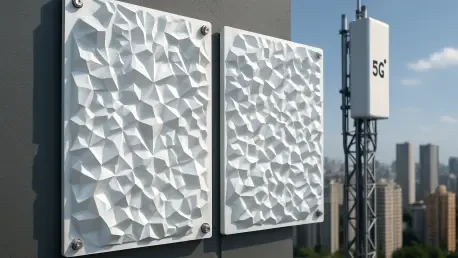
The development of 3D-printed metacrystal panels offers a sophisticated alternative to active hardware by utilizing the principles of advanced material science to manipulate radio waves. These panels are constructed from dielectric materials, which are non-conductive polymers that can be shaped into intricate three-dimensional geometries to control the flow of electromagnetic energy. Unlike traditional flat surfaces that simply reflect signals in a single direction, these metacrystals contain complex internal architectures defined by precisely calculated air gaps and material thicknesses. When a high-frequency wave enters the panel, it interacts with these internal structures, which slow down or redirect the wave according to the design of the crystal lattice. This allows for precise control over the exit angle of the signal, essentially steering the beam around a corner or through a narrow corridor. The use of additive manufacturing ensures that these complex designs can be produced with high precision.
Computational Design through Inverse Topology Optimization Techniques
To achieve the necessary level of precision in signal steering, researchers utilize a computational design method known as inverse topology optimization to determine the ideal internal structure of the panel. Instead of engineers manually guessing which shapes might work, they input the desired signal outcome into a software algorithm that works backward to generate the most efficient geometry. This process allows the creation of panels that can manage complex tasks, such as maintaining signal polarization across multiple reflection angles or focusing energy onto a specific small area. These optimized structures are far more efficient than standard surfaces, as they minimize the amount of energy lost during the redirection process while maximizing the coverage area. The resulting metacrystal designs are so complex that they would be nearly impossible to manufacture using traditional subtraction methods. However, high-resolution 3D printing makes it possible to mass-produce these optimized panels using affordable materials.
Economic Viability and the Scalability of Passive Infrastructure
From a practical and economic standpoint, the integration of passive metacrystal panels into modern architectural design represents a significant opportunity for cost reduction in 6G deployment. The material costs for a single panel are estimated to be remarkably low, often amounting to just a few dozen dollars depending on the size and the specific polymer used during the printing process. Because the panels do not contain any electronic components, sensors, or power systems, they are entirely maintenance-free once they have been installed on a wall or ceiling. This set-and-forget nature makes them particularly attractive for environments like large-scale warehouses, industrial manufacturing plants, and long office corridors where signal consistency is vital but active hardware is difficult to install. Custom-designed panels can be tailored to the specific floor plan of a facility, ensuring that even the most tucked-away corners receive a reliable signal. This modularity allows for a highly flexible rollout.
Strategic Integration and the Future of Environmental Signal Adaptation
The evaluation of 3D-printed metacrystal panels demonstrated that passive signal management offered a viable path toward solving the inherent limitations of high-frequency 6G connectivity. Researchers discovered that by focusing on the geometry of the physical environment, they could significantly reduce the number of active base stations required to achieve full coverage in indoor spaces. Although these panels could not amplify weak signals or generate new energy, their ability to redirect existing beams with minimal insertion loss proved sufficient for most local area applications. The study also highlighted the importance of reconfigurable designs that allowed the panels to adapt to changing furniture layouts or the movement of heavy machinery in industrial settings. Strategic implementation of these dielectric structures provided building owners with a sustainable and low-cost method for future-proofing their wireless networks. Ultimately, the integration of material science and computational design established a new standard.