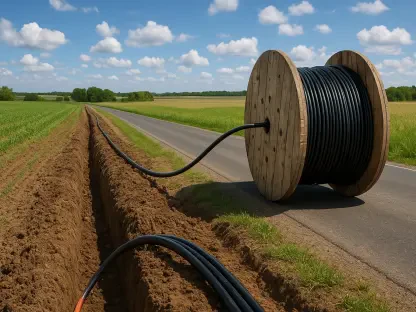
Structural deficits in the global supply chain are expected to persist as 2026 demand growth is projected at 28 percent while supply capacity only increases by 11 percent. This imbalance has fundamentally altered the trajectory of the optical fiber industry, turning what was once considered a commoditized utility into the most sought-after asset in the technology sector. The recent gathering at the 27th China International Optoelectronic Exposition in Shenzhen served as a definitive turning point for global stakeholders. While previous years focused heavily on the flashing lights of optical modules, this year’s event saw a massive migration of interest toward the physical glass that enables high-speed data transmission. With over 4,000 enterprises represented, the narrative shifted from theoretical capacity to the practical limitations of manufacturing. This transition was not merely academic; it was immediately reflected in the valuation of major industry players like Yangtze Optical Fibre and Cable, which saw significant market rebounds as the reality of a fiber-scarce environment began to sink in among institutional investors who had previously written off the sector as a legacy industry.
Market Recovery: The AI Infrastructure Boom
Indicators of a Genuine Supply Shortage
The most visceral evidence of this market tightening appeared during the latest centralized procurement cycle conducted by China Mobile. In a move that sent shockwaves through the supply chain, the telecommunications giant allocated a budget exceeding 7 billion yuan for nearly 70 million core-kilometers of cable. However, the true story lay in the pricing dynamics rather than the sheer volume of the order. The average winning bids represented a staggering 90 percent increase compared to prior procurement rounds, signaling that the era of aggressive price erosion has been decisively replaced by a sellers’ market. Even more telling was the fact that nearly half of the available tenders for bare optical fiber remained unfulfilled. Manufacturers, sensing their growing leverage, flatly refused to commit to bulk contracts at tender prices of 85 yuan when the spot market was already commanding prices well over the 100-yuan threshold. This collective refusal to compromise profit margins for the sake of volume suggests a disciplined industry that is no longer willing to subsidize network expansion at its own expense.
This refusal by manufacturers to buckle under the pressure of large-scale tenders highlights a fundamental shift in the bargaining power within the telecommunications ecosystem. In previous years, the massive purchasing power of state-owned operators could force manufacturers into razor-thin margins just to keep production lines running. Today, the diversification of the client base—specifically the inclusion of hyperscale data center operators—has provided fiber producers with alternative, higher-margin outlets for their products. The supply shortage is not just a localized phenomenon but a global reality that is forcing a reevaluation of inventory management strategies across the board. As lead times for specialized fiber orders continue to stretch from weeks into months, the industry is seeing a transition where procurement is no longer about finding the lowest price but about securing any available capacity to prevent project delays in the critical artificial intelligence infrastructure rollout that defines the current technological landscape.
Global Demand Revisions: National Connectivity
The bullish sentiment is further supported by a wave of upward revisions in global demand forecasts from leading financial institutions. Analysts have had to recalibrate their models as the sheer scale of the optical module market expansion becomes apparent, with projections now suggesting the sector will reach a valuation near 1.5 trillion USD by 2028. This growth is not occurring in a vacuum; every high-speed optical module deployed in a server rack requires a corresponding length of high-quality fiber to function. The transmission logic of the modern data center dictates that as speeds move from 400G and 800G toward 1.6T and 3.2T, the demands on the physical medium become exponentially more stringent. This has triggered a massive procurement wave from companies that were previously on the sidelines, as they realize that the physical layer of the internet is the ultimate bottleneck for their ambitious artificial intelligence roadmaps and large language model training requirements.
Beyond the confines of the data center, the scale of infrastructure investment is taking on a national character. Telecommunications giants like Verizon have made headlines by securing multi-billion dollar, long-term agreements with specialized manufacturers like Corning to supply tens of millions of miles of high-density optical fiber. These are not standard residential broadband plays; these investments are specifically targeted at the national backbone networks required to support the massive data transfers inherent in distributed computing and inference. The shift toward high-density, high-fiber-count cables indicates that the industry is preparing for a future where data centers are no longer isolated islands but are interconnected in a seamless, high-capacity grid. This move toward national-level computing connectivity represents a new frontier for the fiber market, as it requires a level of durability and performance that standard fiber products simply cannot meet, further straining the capacity of top-tier manufacturers.
Comparative Dynamics: The Shift to Computing Power
Part 1. Distinguishing the 2018 Cycle from the Modern Era
To appreciate the current market strength, it is essential to contrast the present environment with the “Broadband China” era that spanned from 2015 to 2018. That previous cycle was defined by a focus on “connecting people” through massive home broadband expansion. It was a market characterized by a handful of large buyers and a product range that was largely homogeneous. Because there was little technical differentiation between manufacturers, the competition inevitably devolved into a price war. When the initial wave of home installations was completed, the market faced a massive oversupply, causing prices to crater and leaving many companies with stranded assets and unusable capacity. The trauma of that crash kept institutional investors away from the sector for nearly a decade, leading to a period of chronic underinvestment that has contributed to the supply constraints witnessed today.
In contrast, the current cycle is driven by the necessity of “connecting computing power.” The primary drivers are no longer cost-conscious regional operators but global cloud giants who are investing hundreds of billions of dollars annually into AI-ready hardware. This demand is far more “rigid” and less sensitive to price fluctuations because the cost of the fiber is a small fraction of the total investment in a multi-billion dollar data center, yet its failure or poor performance can render the entire facility inefficient. Furthermore, the products required today are highly specialized, ranging from ultra-low-loss fibers for long-haul connectivity to bend-insensitive fibers for compact data center environments. This diversification of product requirements means that the commoditization that ruined the 2018 cycle is no longer the dominant market force, allowing for sustainable margins and a more stable industrial base.
Part 2. Technical Barriers: The Role of Preforms
A common misconception among casual observers is that the optical fiber industry has low technical barriers to entry. While the process of drawing fiber from a glass rod is relatively standard, the actual creation of that rod—the optical fiber preform—remains one of the most complex challenges in high-end manufacturing. Preforms are ultra-pure glass structures that must be produced under perfectly controlled conditions using advanced chemical vapor deposition techniques. The barriers to entry are not just technical but also temporal and environmental. It takes approximately two years to bring a new preform production facility from the planning stage to full operational status, including the rigorous environmental assessments and process verification cycles required to ensure the purity of the glass. This physical time lag acts as a natural break on sudden capacity expansion, preventing the market from being flooded with new supply.
Because of these inherent barriers, the current market recovery disproportionately benefits established leaders who have maintained their own preform production capabilities. These self-sufficient companies are essentially insulated from the rising costs of raw materials that plague smaller, downstream players who must purchase preforms on the open market. In a period of rising fiber prices, a company that produces its own preforms can capture the entire price increase as gross profit, leading to the explosive earnings growth that has caught the attention of the financial world. Moreover, as the industry shifts toward high-end fibers like the G.654.E standard, the complexity of preform production increases further. The slower manufacturing speeds required for these advanced glass compositions effectively reduce the total “core-kilometer” output of a factory, even if the machinery is running at full capacity, creating a phantom capacity reduction that keeps the market perpetually tight.
Innovation: High-Growth Specialized Segments
Next-Generation Fiber Architectures: CPO and NPO
The industry is currently prioritizing the development of Polarization-Maintaining Fiber (PMF), which has become essential for modern optical architectures like Co-Packaged Optics. As data transfer speeds increase, the heat generated by traditional optical modules becomes a critical failure point. To combat this, engineers are moving the laser source away from the main processing unit, a move that requires specialized PMF to transmit the light while maintaining its polarization state. These fibers are significantly more expensive and complex to manufacture than standard variants, requiring precise geometric control and specialized materials. The shift toward these architectures is transforming the fiber from a simple “pipe” for data into a critical component of the optical engine itself, which in turn demands a higher level of collaboration between fiber manufacturers and semiconductor designers than ever before.
In addition to polarization control, the rise of Data Center Interconnects (DCI) has spiked the demand for ultra-low-loss fibers that can span long distances without the need for frequent signal amplification. As computing power pools are distributed across different geographic regions to take advantage of energy availability or cooling conditions, the “highways” connecting these pools must be as efficient as possible. This has made G.654.E fiber the new standard for the AI era. These fibers use a pure silica core to minimize attenuation, allowing data to travel further and faster. The transition to these high-margin products is a major driver of the “value revaluation” seen in the industry, as the revenue generated per kilometer of fiber is several times higher than that of the standard products used in the previous decade, fundamentally changing the revenue profile of the major manufacturers.
Emerging Technologies: Hollow-Core and Niche Markets
Looking toward the horizon of the next few years, hollow-core optical fiber represents the absolute cutting edge of the industry. Unlike traditional fiber that transmits light through a solid glass core, hollow-core fiber uses a complex microstructured arrangement to guide light through an air-filled center. This technology reduces latency by approximately 30 percent because light travels faster through air than through glass. In the world of high-frequency AI training, where microsecond delays can accumulate into significant performance bottlenecks, this reduction in latency is invaluable. While still in the early stages of commercialization, hollow-core fiber is already being tested in high-stakes environments like financial trading networks and experimental AI clusters. The companies that master the fabrication of these complex structures will likely define the next decade of the industry’s technological leadership.
Beyond the data center, the drone and defense sectors have emerged as surprising sources of high-frequency demand for specialized optical fiber. High-end drones used in surveillance and secure communication often utilize fiber-optic links to prevent electromagnetic interference and ensure a secure data stream that cannot be easily intercepted or jammed. Because this fiber is often treated as a consumable—deployed and then discarded or lost during operations—it creates a reliable and recurring repurchase cycle that is entirely separate from the traditional infrastructure market. This “consumable” model for fiber is a radical departure from the traditional view of fiber as a permanent installation with a 20-year lifespan. It provides a steady stream of high-margin revenue that helps to smooth out the cyclicality of the larger telecommunications market, providing manufacturers with a diversified portfolio of demand sources.
Strategic Investment Logic: Risk Factors
Profitability: Margin Capture and Elasticity
For institutional investors, the current profitability of the optical fiber sector is tied directly to the concept of price elasticity and the self-sufficiency of manufacturers. In an environment where the spot price of fiber is rising by 50 to 100 percent in a single year, the financial performance of a company is determined by how much of that price increase it can retain. Companies with integrated upstream preform production are seeing their operating leverage work in their favor; since their fixed costs are largely stable, every additional yuan in the price of a core-kilometer of fiber translates almost directly to the bottom line. This makes the sector uniquely attractive during an inflationary period where other manufacturing industries are struggling with rising input costs. The ability to control the “source” of the glass is the ultimate competitive advantage in the 2026 market.
However, the logic of investment also requires a deep understanding of the “drawing speed” economics. As manufacturers prioritize the production of high-end, specialized fibers for AI and data center applications, they often have to slow down their production lines to ensure the necessary precision and quality. This means that even as demand rises, the total volume of fiber produced by the industry might actually decrease or plateau. This “capacity contraction” is a powerful force for maintaining high prices. Investors who only look at the total number of kilometers produced might miss the fact that the industry is moving toward a “value over volume” model. The companies that successfully navigate this transition will be those that can optimize their product mix to maximize profit per hour of machine time, rather than simply trying to flood the market with low-grade cable.
Navigating Potential Market Risks: A Realistic View
While the outlook is overwhelmingly bullish, stakeholders must remain cognizant of several risks that could temper the current enthusiasm. One of the primary concerns is the potential for performance lag in corporate earnings reports. Many of the high-priced contracts being signed today will not show up on balance sheets for several quarters, which could lead to temporary periods of stock market volatility if quarterly results do not immediately match the hype. Additionally, the industry is heavily dependent on the continued capital expenditure of a few dozen global technology giants. If the anticipated returns on AI investments do not materialize as quickly as expected, these companies could suddenly scale back their infrastructure spending, leading to a rapid cooling of the fiber market. This “concentration risk” is something that all major manufacturers are currently trying to mitigate through diversification.
Geopolitical tensions also remain a significant factor, as the supply chain for high-purity chemicals and specialized manufacturing equipment is highly globalized. Trade restrictions or regional conflicts could disrupt the flow of these critical inputs, leading to localized shortages even in a well-funded market. Furthermore, while the current demand for AI is “rigid,” the demand from traditional telecommunications operators remains sensitive to government budgets and regulatory environments. If operators in major markets like Europe or South Asia delay their 5G or 6G rollouts due to economic pressures, it could create a bifurcated market where high-end data center fiber is in short supply while standard telecommunications fiber faces a temporary glut. Navigating these complexities requires a sophisticated understanding of both global macroeconomics and the specific technical requirements of different industry segments.
Strategic Advancements: Future Connectivity
The industry successfully navigated the initial volatility of the transition period by focusing on high-margin, specialized products rather than competing for volume in the commoditized segments. Strategic leaders recognized that the value was no longer in the glass itself, but in the precision of the manufacturing process and the purity of the chemical composition required for the intelligent era. Moving forward, the most effective approach involved deep integration between fiber producers and AI chip manufacturers to ensure that physical infrastructure could keep pace with silicon-level breakthroughs. Companies that prioritized the development of hollow-core and polarization-maintaining fibers gained a significant first-mover advantage, effectively insulating themselves from the price fluctuations of the standard market. This period proved that the physical layer of the network was not a passive utility but a dynamic component that required constant innovation and strategic investment to meet the voracious appetite for computing power. Moving into the next phase of development, the focus shifted toward establishing more resilient, localized preform production to mitigate the risks associated with global supply chain disruptions. In doing so, the industry established a solid foundation for long-term growth that was built on technical excellence rather than mere market speculation.