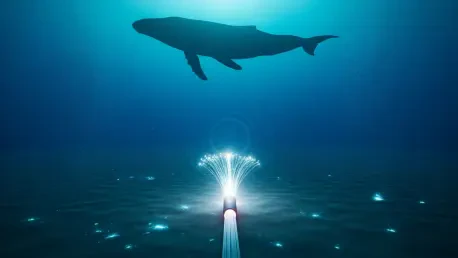

The vast, lightless depths of the global ocean floor are no longer hidden from human observation, as the extensive network of subsea fiber-optic cables originally laid for the internet is being reimagined as a planetary sensor array. This invisible backbone of the digital world, which facilitates trillions of dollars in financial transactions and near-instantaneous international communications, is now being repurposed to serve as a revolutionary scientific observatory. By tapping into these existing lines, researchers have discovered a way to monitor the deep ocean with unprecedented precision, effectively turning standard communication tools into incredibly sensitive instruments for biological and environmental study. This breakthrough represents a significant shift in how humanity interacts with the maritime environment, moving from a model of intermittent exploration to one of continuous, real-time surveillance of the most remote regions on the planet, all without the need for expensive new hardware deployments in the abyss.
The Science: Hydrodynamic Detection
Evolution: Shifting Focus from Vocalizations to Physical Displacement
In the initial stages of this technological development, researchers utilized Distributed Acoustic Sensing (DAS) to transform standard fiber-optic cables into massive, underwater microphones. By injecting laser pulses into the glass fibers and measuring how they were reflected back due to external vibrations, the system could record the low-frequency rumbles and complex songs of various whale species. However, this method faced a fundamental limitation: it could only identify animals that were actively making noise. Large whales often spend significant periods in silence during deep dives or resting phases, making them effectively invisible to traditional acoustic sensors. This gap in data meant that population counts and behavioral studies remained incomplete, as the “silent” majority of the marine mammal population was missed by the technology. The need for a more comprehensive tracking method led scientists to search for signals that did not depend on the animal’s vocalizations, focusing instead on the physical presence of the creatures themselves.
Mechanics: Identifying the Pressure Waves of Moving Giants
The latest iteration of this sensing technology has shifted its primary focus from sound waves to hydrodynamic signals, which are created by the physical movement of massive bodies through a fluid medium. As a whale swims, it displaces a significant volume of water, generating a low-frequency pressure wave comparable to the bow wave of a massive ship. These pressure waves interact with the seafloor and the fiber-optic cables buried within or resting upon it, causing minute deformations in the glass fibers that can be detected by DAS equipment. Unlike acoustic songs that vary by species and individual intent, the hydrodynamic signature is a constant byproduct of motion, ensuring that any moving whale can be tracked regardless of whether it is singing or silent. This technique allows for a continuous observation of the whale’s trajectory, providing a more detailed narrative of its movements through the water column and its interactions with the surrounding environment, even in the darkest and most remote parts of the ocean.
Overcoming Technical Obstacles
Calibration: Utilizing Ship Signatures as Ground Truth
Detecting the subtle hydrodynamic signals of a whale is an immense technical challenge because low-frequency pressure waves dissipate rapidly as they move away from the animal. To successfully identify and isolate these faint patterns from the background noise of the ocean, the research team at the Norwegian University of Science and Technology turned to a readily available source of data for calibration: commercial shipping traffic. Large vessels produce powerful and predictable pressure signatures that are far easier to detect than those of biological organisms. Because ships are required to broadcast their identity, speed, and precise location through the Automatic Identification System (AIS), the team was able to correlate specific pressure disruptions in the fiber-optic data with the known passage of particular vessels. This provided a reliable baseline for the system, allowing the software to learn how to distinguish between the massive pressure waves of steel hulls and the more nuanced signatures produced by the movements of living organisms.
Mathematics: Bridging Historical Physics and Modern Data
To accurately interpret the complex fluid dynamics at play, the researchers reached back into the history of physics to apply a mathematical framework originally developed by Lord Rayleigh in 1917. Initially designed to describe the physics and pressure changes of bubbles in boiling water, Rayleigh’s equations proved to be the perfect tool for understanding how pressure waves propagate through the water and affect the adjacent seabed. By adapting these century-old formulas to the modern context of subsea fiber-optic sensing, the team created a robust analytical model that could calculate the size, speed, and depth of an object based on the pressure signals it left behind. This mathematical bridge allowed the scientists to move beyond the simple detection of man-made ships and begin accurately recognizing the unique physical signatures of large whales. The integration of classical physics with cutting-edge optical sensing technology transformed the cables from mere data conduits into a high-fidelity diagnostic tool capable of seeing the invisible.
Field Success and Conservation Implications
Validation: The Blue Whale Case Study in Svalbard
The theoretical potential of hydrodynamic tracking was recently validated during a successful field test involving a blue whale in the waters near the Svalbard archipelago. Initially, the research team tracked the whale using traditional acoustic methods while the animal was vocalizing near the surface. As the whale ceased its calls and began a deep dive into the frigid Arctic waters, it would have normally disappeared from the researchers’ view. However, by switching to the detection of low-frequency hydrodynamic signals, the team maintained a continuous and precise track of the whale’s movements throughout its entire descent and subsequent underwater transit. This successful demonstration proved that fiber-optic networks could provide a seamless, 24-hour narrative of an animal’s behavior, bridging the gaps left by traditional acoustic or visual observation methods. The ability to follow a single individual from vocalization through silent movement confirmed that the technology is ready for broader application in real-world marine biology research.
Conservation: A Non-Invasive Network for Endangered Species
The implications of this technology for global marine conservation are profound, offering a cost-effective and non-invasive alternative to traditional tracking methods. Historically, monitoring whale migrations and population health required the deployment of expensive satellite tags or the use of dedicated research vessels, both of which can be intrusive and limited in scope. By leveraging the millions of miles of existing subsea infrastructure, scientists can now monitor endangered species across entire ocean basins without ever disturbing the animals or introducing new hardware into the environment. This persistent presence allows for more accurate population estimates and a better understanding of how migration patterns are shifting in response to changing ocean temperatures. Furthermore, the ability to track silent whales near busy shipping lanes could lead to the development of real-time collision avoidance systems, where vessels are alerted to the presence of whales in their path, significantly reducing the risk of lethal ship strikes for these vulnerable populations.
The Future of Marine Monitoring
Integration: Building a Global Earth-Ocean Observatory
Beyond the realm of marine biology, the successful repurposing of fiber-optic cables paved the way for a comprehensive Earth-Ocean-Atmosphere observatory. This vision utilized the global grid of telecommunications infrastructure to provide a multi-layered view of the planet’s health, turning every undersea cable into a multi-purpose scientific instrument. Such a network could simultaneously monitor seismic activity along tectonic plate boundaries, providing earlier warnings for earthquakes and potential tsunamis that threaten coastal communities. Additionally, the sensitivity of the cables allowed for the tracking of climate-driven changes in ocean currents and temperatures, providing critical data for meteorologists and climate scientists. By integrating these various streams of information into a single, cohesive monitoring system, researchers began to develop a much deeper understanding of the complex interactions between the atmosphere, the deep sea, and the biological life that inhabits the world’s oceans, creating a holistic view of the global environment.
Conclusion: Implementing Actionable Solutions for Ocean Stewardship
The transition from acoustic sensing to hydrodynamic tracking marked a definitive turning point in the management and protection of marine ecosystems. This advancement provided the necessary data to implement dynamic shipping lanes that adjusted in real-time to avoid migratory pods, ensuring safer passage for both vessels and whales. Governments and international organizations utilized these insights to establish more effective marine protected areas based on actual habitat usage rather than historical assumptions. The project successfully demonstrated that existing industrial infrastructure could be transformed into a powerful tool for environmental preservation, setting a clear precedent for future technological reuse. These efforts fostered a new era of ocean stewardship where data-driven decisions led to measurable improvements in biodiversity and seafloor health. The implementation of this planetary-scale observatory ensured that the silent inhabitants of the deep were no longer overlooked, allowing for a more harmonious coexistence between human technology and the natural world.