
The telecommunications landscape has shifted from a focus on raw connectivity toward a model where the network serves as an intelligent, self-healing organism that optimizes itself without human intervention. The Nokia AI-RAN Integration represents the vanguard of this movement, moving beyond the theoretical constraints of laboratory testing into the unpredictable environment of live network infrastructure. In partnership with global operators like Orange, this technology is currently being scrutinized to determine if the infusion of Artificial Intelligence directly into the Radio Access Network can actually deliver the efficiency gains promised during its development. This review examines the architectural shifts, performance benchmarks, and the pragmatic realities of deploying AI-native systems in an industry traditionally defined by rigid, deterministic hardware.
At its core, this integration treats the network not as a static arrangement of antennas and cables, but as a programmable, multi-purpose compute fabric. By embedding machine learning directly into the physical layer, the technology attempts to solve the fundamental physics problem of spectrum scarcity. The relevance of this shift cannot be overstated, as the global demand for data continues to outpace the availability of frequency bands. In 2026, the transition to AI-native RAN is viewed as the bridge that connects the high-speed promise of 5G-Advanced with the eventual cognitive requirements of 6G, effectively making the network hardware “aware” of the traffic it carries.
The Evolution of AI-Native Radio Access Networks
The journey toward an AI-native radio environment was born from the limitations of traditional software-defined networking. For years, the industry relied on human-coded rules to manage radio resources, which often failed to account for the chaotic nature of urban interference or rapid user mobility. The evolution began with the virtualization of the RAN (vRAN), which decoupled software from proprietary hardware, but the true breakthrough occurred when Nokia integrated high-performance accelerated computing—specifically leveraging GPU-based processing—into the radio stack. This allows the network to process complex neural networks in milliseconds, a task that traditional CPUs were never designed to handle efficiently.
This evolution is significant because it marks the end of the “black box” era of telecommunications equipment. By adopting an open, AI-driven architecture, Nokia has differentiated its platform from competitors who remain tethered to specialized, less flexible silicon. The integration represents a fundamental move toward the “cloud-ification” of the radio layer, where network functions are treated as software workloads that can be updated, scaled, and optimized on the fly. This context is essential for understanding why the current trials are more than just a software patch; they are a total redesign of how radio waves are managed and monetized.
Technical Architecture and Core Capabilities
Spectral Efficiency and Intelligent Optimization
The most immediate technical victory of the AI-RAN platform is its impact on spectral efficiency, which is the lifeblood of any mobile operator. Nokia’s algorithms utilize deep learning to predict signal interference and adjust beamforming parameters in real time, far more accurately than legacy systems. In the current 2026 landscape, these optimizations are already delivering a measurable 20% increase in capacity. As the models continue to ingest data, the roadmap suggests a 50% improvement by 2027, with the ultimate goal of doubling the spectral capacity by 2028. For an operator, doubling efficiency is equivalent to discovering a massive new cache of spectrum without the multi-billion dollar price tag of a government auction.
Beyond simple capacity, the intelligent optimization extends to energy management, a critical factor for both environmental sustainability and operational cost reduction. The AI-RAN system analyzes traffic patterns to identify periods of low demand, during which it can put specific hardware components into deep-sleep modes without affecting the user experience. This dynamic power scaling is a departure from the “always-on” philosophy of previous generations. The significance here lies in the precision; the AI can wake up the radio in microseconds when a user requests data, ensuring that energy conservation does not come at the cost of latency or reliability.
Modular Deployment and Cloud-Native Models
Flexibility is the second pillar of the Nokia architecture, evidenced by its three-tier deployment strategy. The first tier involves AI-RAN Capacity Plug-ins, which allow operators to inject AI capabilities into existing AirScale hardware. This is a vital bridge for companies that cannot afford a complete infrastructure overhaul but need immediate performance boosts. In contrast, the second tier features standalone AI-RAN nodes designed for greenfield deployments, where the hardware and software are fully optimized for GPU acceleration from day one. This modularity ensures that the transition to AI-native networking is an evolution rather than a disruptive “rip-and-replace” event.
The third tier, which focuses on Cloud-Native COTS (Commercial Off-The-Shelf) deployments, represents the ultimate vision for the industry. By running the RAN on standardized IT servers, Nokia is effectively turning the cell site into a distributed data center. This architecture is unique because it utilizes a unified software foundation across all deployment models, ensuring that a network engineer sees the same interface whether they are managing a legacy site or a cutting-edge cloud node. This consistency reduces operational fragmentation and lowers the total cost of ownership, making it easier for operators to manage the increasing complexity of modern networks.
Current Trends in Telecom AI Integration
A major trend currently dominating the sector is the concept of “fallow compute,” where the dormant processing power of a cell site is repurposed for non-telecom tasks. Traditionally, RAN hardware was designed to handle peak loads, meaning that for most of the day, a large portion of the processing capacity sat idle. Nokia and its partners are now exploring how to use this excess capacity to host local AI workloads, such as real-time video analytics or autonomous vehicle coordination. This shift transforms the cell tower from a simple transmitter into a revenue-generating edge computing hub, fundamentally changing the business model of the telecommunications provider.
Moreover, the industry is seeing a move toward “AI-as-a-Service” within the network fabric itself. Instead of merely transporting data to a distant cloud for processing, the AI-RAN can perform inference locally at the edge. This trend is driven by the need for ultra-low latency in applications like industrial robotics and augmented reality. By integrating Nvidia’s accelerated computing directly into the RAN, Nokia is positioning itself at the intersection of AI and connectivity, a space where the network is no longer just a “dumb pipe” but an active participant in the AI economy.
Real-World Applications and Industry Use Cases
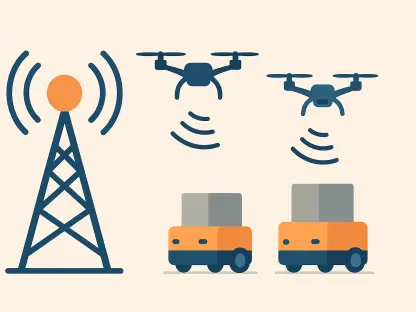
The practical applications of AI-RAN are already manifesting in sectors that require high-precision sensing and reliable uplink. One of the most compelling use cases is Integrated Sensing and Communications (ISAC). In this scenario, the radio signals used for mobile data are also utilized as a form of radar. This allows the network to detect the movement of objects, such as unauthorized drones near sensitive infrastructure or the flow of traffic in a smart city, without the need for dedicated sensing hardware. This dual-use capability provides a massive value add for municipalities and industrial partners.
In the manufacturing sector, AI-RAN is being deployed to support massive-scale industrial automation. The high spectral efficiency and low latency of the system allow for the seamless coordination of hundreds of autonomous mobile robots (AMRs) in a single factory environment. Unlike traditional Wi-Fi or early 5G, which could struggle with the interference caused by metal machinery and high device density, the AI-native radio can dynamically adjust its parameters to maintain a “five-nines” level of reliability. This makes it a foundational technology for the current wave of smart factory initiatives worldwide.
Critical Challenges and Implementation Barriers
Despite the technical prowess of AI-RAN, the transition is not without significant hurdles, primarily regarding the “probabilistic” nature of AI versus the “deterministic” requirements of telecommunications. Engineers are accustomed to networks that follow strict, predictable rules; AI, however, operates on probabilities. This creates a trust gap, as operators worry that an AI might make an unpredictable decision that leads to a widespread outage. To mitigate this, Nokia has introduced “glass box” principles, which emphasize transparency and explainability in AI models, allowing human supervisors to understand and, if necessary, override the AI’s decisions.
Regulatory and market obstacles also remain a concern, particularly regarding data privacy and the security of AI models. As the network becomes more software-centric and open, the attack surface for cyber threats increases. Ensuring that the AI models themselves are not tampered with or biased requires a new set of security protocols that the industry is still in the process of standardizing. Furthermore, the economic reality of high-performance GPUs means that while operational costs may drop over time, the initial capital expenditure for AI-native hardware remains a barrier for smaller operators or those in developing markets.
Future Outlook: The Road to 6G and Beyond
Looking ahead, the integration of AI into the RAN is the primary engine driving the development of 6G standards. While 5G focused on speed and capacity, 6G is being envisioned as a fully sentient network that can predict user needs before they are articulated. The work being done today by Nokia and Orange is essentially the beta testing for the 6G era, where the physical and digital worlds are expected to merge through high-fidelity digital twins. The ability of the network to sense its environment and optimize its performance in real time will be the baseline requirement for these future systems.
The long-term impact of this technology will likely extend beyond telecommunications into the broader socio-economic fabric. As the network becomes an ubiquitous source of distributed intelligence, it will enable the widespread adoption of technologies that are currently limited by connectivity constraints, such as remote robotic surgery and fully autonomous transport networks. The success of AI-RAN will be measured by its ability to become invisible—providing such seamless, intelligent connectivity that the complexity of the underlying radio management is completely forgotten by the end user.
Final Assessment of Nokia AI-RAN
Nokia’s AI-RAN integration demonstrated that the transition toward cognitive networking was not only possible but commercially viable in a live environment. The platform successfully balanced the need for immediate efficiency gains with a forward-looking architecture that accommodated the “AI-on-RAN” revenue model. While the industry grappled with the shift from deterministic rules to probabilistic intelligence, the introduction of transparent, explainable AI helped bridge the trust gap between traditional engineering and modern data science. The project proved that spectral efficiency could be significantly enhanced through software intelligence, effectively extending the lifespan of existing frequency assets.
The collaboration with major operators highlighted that the modular approach to deployment was the correct strategy for a diverse global market. By offering a path that included both hardware plug-ins and cloud-native models, Nokia provided a scalable solution that addressed the varying economic realities of the sector. Ultimately, the AI-RAN integration was recognized as a foundational milestone that moved the industry closer to the autonomous, sensing-capable networks of the next decade. It established a new benchmark for how telecommunications infrastructure could contribute to the global AI economy while maintaining the rigorous reliability standards required for mission-critical communications.