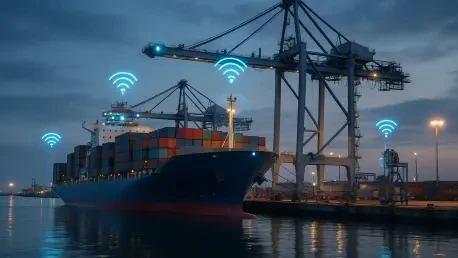

September 2024 marked a historic turning point for Indian maritime infrastructure when the Mormugao Port Authority secured authorization for its own private 5G spectrum. This landmark achievement designated the Goa-based facility as the first major government autonomous body to obtain a Captive Non-Public Network (CNPN) license, signaling a definitive departure from traditional analog workflows. The initiative aligns seamlessly with the national strategy spearheaded by the Ministry of Ports, Shipping and Waterways, which emphasizes the urgent need for digitization to remain competitive in a rapidly evolving global trade landscape. By moving away from shared public cellular resources, the port has established a foundational architecture capable of supporting the high-density data demands of modern logistics. This shift represents more than just a technological upgrade; it is a calculated effort to optimize industrial processes and eliminate the bottlenecks that have historically plagued major cargo hubs. As the maritime sector continues to embrace automated solutions, this license provides the necessary legal and technical framework to explore new frontiers in operational excellence and safety.
Infrastructure Transformation: The Path to Digitization
Technical Integration: From Planning to Execution
The implementation strategy for this private 5G network moved from conceptualization to active deployment with notable precision. The Mormugao Port Authority engaged specialized consultancy services to develop a Detailed Project Report that outlined the specific technical requirements for a harsh maritime environment. This was followed by a Request for Information to identify expert system integrators and original equipment manufacturers capable of delivering industrial-grade hardware. By selecting partners with a proven track record in captive networks, the port ensured that the core architecture would be resilient against the interference often found in heavy industrial zones.
Proof of Concept trials are currently being conducted to stress-test the network under real-world conditions. These trials focus on the seamless transition of data across the vast physical expanse of the port, ensuring that there are no dead zones in critical loading areas. By establishing a dedicated network, the facility gains superior control over sensitive operational data, which is frequently difficult to manage on public systems. This high-speed connectivity and ultra-low latency are essential for the next generation of port management software, allowing for the processing of massive datasets in near real-time without the risk of external network congestion.
Data Security: Maintaining Industrial Autonomy
One of the primary drivers behind securing a private spectrum was the need for absolute data sovereignty. In a public 5G environment, the port would have to share bandwidth with thousands of civilian devices, creating potential security vulnerabilities and unpredictable performance fluctuations. By utilizing a Captive Non-Public Network, Mormugao has effectively created a digital fortress where all internal communications remain isolated from the public internet. This level of isolation is critical for protecting the logistics data of international shipping partners and maintaining the integrity of sensitive customs information.
Furthermore, the dedicated spectrum allowed the port to prioritize traffic based on operational urgency. For instance, emergency response systems and automated machinery receive guaranteed bandwidth, ensuring that safety-critical functions are never compromised by secondary data tasks. This capability to slice the network into dedicated lanes for different departments has provided a level of administrative flexibility that was previously unattainable. As the port transitions into a fully digital hub, this controlled environment serves as the backbone for all future technological expansions, providing a stable and secure platform for long-term industrial growth.
Operational Innovation: The Impact of Smart Solutions
Functional Utility: Automated Logistics and Surveillance
The functional core of the digital transformation at Mormugao revolves around the creation of a smart port ecosystem. Central to this objective is the deployment of automated logistics and real-time cargo tracking systems that leverage 5G connectivity to eliminate manual errors. By integrating high-speed sensors throughout the facility, the port can now monitor the movement of every container with surgical precision. This visibility reduces the time spent on manual inventory checks and allows for more fluid coordination between sea-side operations and land-side transport, significantly increasing the overall throughput of the terminal.
Beyond cargo management, the private network supports sophisticated drone-based surveillance for enhanced security and infrastructure inspections. These drones provide high-definition video feeds to a central command center, allowing security personnel to monitor the entire perimeter and detect unauthorized access or structural issues in real-time. The low latency of the 5G network ensures that these aerial vehicles can be operated with extreme accuracy, even in challenging weather conditions. This multi-layered approach to security not only protects port assets but also enhances the safety of the workforce by reducing the need for manual inspections in hazardous or hard-to-reach areas.
Strategic Roadmap: Scaling the Digital Blueprint
Mormugao’s adoption of 5G technology served as a pilot project that redefined the benchmarks for the entire Indian maritime sector. By modernizing its communication infrastructure, the port authority positioned itself at the forefront of the global logistics chain. The success of this implementation provided a scalable blueprint for other major ports in the region, demonstrating how advanced telecommunications can be used to bolster digital capabilities and international competitiveness. The move toward a standardized digital framework helped ensure that Indian ports could integrate seamlessly with the global supply chain, which increasingly relies on rapid data exchange.
To maximize the benefits of this new infrastructure, the port authority established a specialized team to oversee the continuous optimization of the network. This team analyzed data from the Proof of Concept trials to refine signal strength and capacity in high-traffic zones. It was discovered that the early integration of original equipment manufacturers allowed for a more tailored hardware setup that accounted for the unique geography of the Goa coastline. Future considerations now involve the expansion of sensor arrays to monitor environmental factors, such as water quality and tide levels, directly through the 5G core. These proactive steps ensured that the port remained a resilient and highly efficient hub for the future of maritime trade.