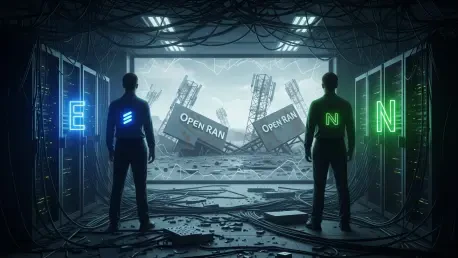

The shimmering promise of a decentralized, plug-and-play telecommunications infrastructure has quietly dissolved into the gray reality of a market dominated by just two European giants. For several years, the United Kingdom positioned itself as the global laboratory for Open Radio Access Network (Open RAN) technology, a radical architectural shift intended to break the stranglehold of traditional vendors. Government officials and industry optimists envisioned a future where specialized startups and diverse software providers would replace the proprietary “black boxes” of the past. However, as the digital dust settles in 2026, the British mobile landscape looks remarkably familiar, having retreated into a rigid duopoly held by Sweden’s Ericsson and Finland’s Nokia.
This consolidation marks a significant turning point for a nation that once championed “vendor diversity” as a matter of national security. After the high-profile expulsion of Huawei, the UK faced a critical choice: foster a new ecosystem of interchangeable parts or rely on the established Nordic incumbents. Despite heavy political backing and experimental trials, the logistical complexities of integrating unproven technology into mission-critical networks proved too steep. Today, the dream of a vibrant, open market has been replaced by a pragmatic reliance on the stability and scale that only the traditional heavyweights can provide.
The Post-Huawei Vacuum: A Two-Horse Race in a High-Stakes Market
The current state of the British market is a direct consequence of the geopolitical seismic shift that began with the removal of Chinese equipment. When the government mandated the purge of “high-risk vendors” from the 5G core and radio networks, it inadvertently stripped away the primary source of price competition. While the initial goal was to avoid a two-vendor dependency, the speed of the transition left operators with few viable alternatives. This immediate infrastructure void forced mobile network operators to prioritize rapid deployment over architectural experimentation, effectively narrowing the field before the “open” revolution could even find its footing.
Furthermore, the early years of the 5G rollout highlighted a stark disparity in vendor readiness that reinforced this consolidation. While Nokia initially struggled with its early product iterations, Ericsson capitalized on the moment to become the primary high-capacity alternative for nearly every major UK carrier. This heightening of the urgency for stability meant that by the time Open RAN standards were mature enough for consideration, the incumbents had already secured the lion’s share of the national footprint. The radical diversity once promised by policy documents was sacrificed at the altar of network reliability and national connectivity targets.
The Catalyst of Consolidation: From Security Bans to Market Realities
The rise of the O-RAN Alliance in 2018 was meant to provide a theoretical “third way” to prevent a total Nordic monopoly. The ambition was centered on a “mix and match” philosophy, where industry-standard components would allow an operator to use one company’s radio with another company’s software. This promise of interoperability was designed to lower the barrier to entry for smaller, innovative firms that could not afford to build entire end-to-end systems. On paper, it was the perfect solution to the security and competition concerns of the post-Huawei era, offering a flexible and transparent alternative to proprietary hardware.
However, the transition from theory to practice revealed deep-seated structural hurdles that the O-RAN Alliance could not easily overcome. The stability gap between lab tests and real-world high-traffic environments became a recurring theme for engineers. While interchangeable components worked in isolation, the complexity of managing a multi-vendor environment created significant integration overhead. Consequently, the very problem Open RAN sought to solve—the reliance on “black box” systems—was replaced by a new problem: the “integration tax,” where the cost of making different parts talk to one another outweighed the savings of avoiding the traditional duopoly.
The Collapse of the Open RAN Hype Cycle
A definitive blow to the movement came from the stagnation of high-profile experiments, most notably Vodafone’s ambitious attempt to overhaul its network. The plan involved replacing 2,500 sites with technology led by Samsung, a move intended to prove that a non-European vendor could deliver at scale. Yet, by the middle of this decade, the volume deployment failed to materialize in any meaningful way. Actual implementation reached only a tiny fraction of the projected sites, confined mostly to rural “golden clusters” rather than the dense urban environments where 5G performance is most critical.
Strategic shifts within the corporate landscape further eroded the appetite for architectural risk. The merger between Vodafone and Three UK forced a pivot toward network integration and logistical synergy rather than experimental diversity. When two massive networks are being folded into one, the priority shifts toward proven reliability and minimizing service disruptions. Simultaneously, the industry’s marketing machinery has moved toward “AI-RAN,” a trend that emphasizes network intelligence over physical openness. This shift has allowed incumbents to repackage their existing software under a new label, effectively distracting from the original goal of supplier diversity.
Institutional Inertia and the Practicality of the Duopoly
The unique structure of the UK telecom market, characterized by deep network-sharing agreements, has created a natural “herd mentality” that favors established players. Partnerships like MBNL and Cornerstone require two different operators to agree on every piece of equipment installed on shared towers. Because one partner’s technical failure could compromise the other partner’s service, there is an inherent allergy to unproven vendors. This institutional inertia means that even if one operator wants to innovate with an Open RAN startup, their partner is likely to veto the move in favor of the safe, predictable choices offered by Ericsson or Nokia.
Pragmatic skepticism from the nation’s largest provider, BT, also played a crucial role in silencing the Open RAN fanfare. BT’s leadership consistently argued that the “best-of-breed” approach, while philosophically appealing, was a nightmare for security and cost-efficiency. By refusing to adopt a rip-and-replace strategy for hardware that was already performing well, BT signaled to the market that the perceived benefits of openness did not justify the operational risks. The consensus among industry experts now favors pre-integrated products that offer a single point of accountability, rather than a fragmented ecosystem where troubleshooting becomes a game of finger-pointing between vendors.
Strategy for a Duopoly World: Navigating the New Vendor Landscape
In this consolidated environment, operators have begun to redefine what “openness” actually means, shifting their focus toward software programmability within the established vendor ecosystems. Rather than trying to swap out Ericsson or Nokia hardware, they are leveraging the RAN Intelligent Controller (RIC) to introduce third-party applications. This allows for a degree of network customization and innovation without the risk of destabilizing the underlying physical infrastructure. It is a compromise that satisfies the need for software flexibility while maintaining the solid foundation of the Nordic duopoly.
Looking ahead, the industry has largely abandoned the pursuit of current-generation architectural churn to focus on 6G planning. The framework for the next generational shift is being built on the lessons learned from the failed Open RAN experiments of the early 2020s. Operators are now working with government regulators to align with diluted diversity mandates that prioritize “open features” rather than “open vendors.” By the time the next decade arrives, the focus will likely be on ensuring that 6G standards are inherently more mature and interoperable from day one, rather than trying to retrofit openness onto an existing 5G framework.
The UK’s ambitious attempt to rewrite the rules of telecommunications through Open RAN reached a definitive conclusion that favored pragmatism over ideology. While the government initially sought to force a more competitive market through policy mandates, the sheer economic and technical weight of the Ericsson-Nokia duopoly proved insurmountable. Operators recognized that the high costs of multi-vendor integration and the risks to network stability were simply too great to ignore in an era of tightening margins. As the focus transitioned toward 6G and AI-driven automation, the goal of hardware diversity was largely set aside in favor of a stable, software-defined future. Moving forward, the industry adopted a strategy that prioritized deep integration with existing partners while using modular software to satisfy the remaining requirements for innovation and security.