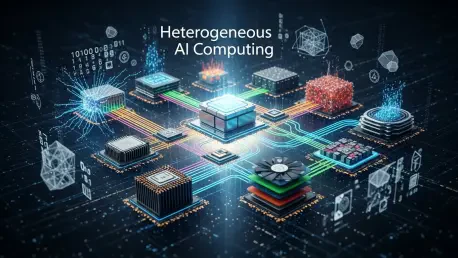

The relentless expansion of large language models has pushed traditional data center architectures to a breaking point, where the sheer electrical demand of monolithic GPU clusters now rivals the consumption of small industrial cities. For years, the industry relied on the brute force of general-purpose graphics processors to handle both the training and inference of neural networks. However, as the focus shifts toward deploying these models at scale, the limitations of this “one-size-fits-all” approach have become glaringly apparent. Heterogeneous AI computing has emerged as the definitive solution to this crisis, fundamentally re-engineering how silicon interacts with software to maximize every watt of energy expended.
This technological shift moves away from the dominance of a single processor type and instead embraces a “divide and conquer” strategy. By utilizing a mix of specialized cores, heterogeneous systems can assign specific mathematical tasks to the hardware best suited for them. This transition is not merely a hardware upgrade; it is a conceptual revolution in the semiconductor landscape. It addresses the growing need for “Sovereign AI,” where nations and enterprises seek to build localized infrastructure that is both cost-effective and independent of the few global providers that currently control the supply chain.
Evolution of Heterogeneous AI Infrastructure
The trajectory of AI computing has transitioned from experimental curiosity to a mission-critical infrastructure requirement in less than a decade. Initially, the industry repurposed GPUs because their parallel processing capabilities were well-suited for matrix multiplication. However, as AI moved from research labs into real-time telecommunications and consumer services, the high latency and massive power draw of these chips became a bottleneck. The current era is defined by the emergence of specialized, multi-processor environments where the goal is no longer just raw power, but targeted efficiency.
This evolution is driven by the realization that inference—the stage where a trained model actually answers queries—requires a different architectural logic than training. While training needs massive memory bandwidth and raw floating-point performance, inference demands low latency and high throughput at a much lower energy profile. Consequently, the landscape has fractured into a more sophisticated ecosystem. We are seeing the rise of orchestration-heavy models where high-performance CPUs manage the “logic” of the system, while dedicated accelerators handle the “math,” creating a balanced internal economy of data movement.
Core Technical Architecture and Components
High-Efficiency General Purpose Orchestration
In a modern heterogeneous stack, the CPU has been reimagined as a sophisticated system orchestrator rather than just a calculation engine. Architectures like the Arm AGI have become central to this movement, providing the “brain” that manages the complex traffic between memory, networking interfaces, and AI-specific hardware. By handling general-purpose tasks and operating system overhead, these specialized CPUs ensure that the AI accelerators are never left idling while waiting for data. This prevents the “starvation” of the processing units, which is a common cause of inefficiency in older server designs.
The importance of this orchestration cannot be overstated when dealing with high-density data centers. A refined CPU architecture reduces the total system power by executing non-AI tasks with minimal energy, allowing the system to maintain a high level of responsiveness. This role is particularly vital in edge computing and telecommunications, where the infrastructure must handle traditional networking protocols alongside AI workloads. The synergy created here allows for a more compact physical footprint, enabling providers to pack more intelligence into existing rack space without exceeding thermal limits.
Specialized AI Inference Acceleration
Dedicated hardware, exemplified by the Rebellions RebelCard, represents the sharp end of the heterogeneous spear. Unlike a general-purpose processor, these accelerators are stripped of the legacy logic required for standard computing, focusing entirely on the silicon structures needed for large-scale inference. This specialization allows for a dramatic increase in computational throughput while maintaining incredibly low latency. For developers, this means that even massive models can generate responses in milliseconds, a requirement for the next generation of interactive AI services.
The technical brilliance of these cards lies in their ability to handle the specific memory access patterns of transformer-based models. By optimizing the way data flows through the chip, they minimize the energy-expensive process of moving bits back and forth between the processor and external memory. This architectural focus results in a performance-per-watt ratio that traditional GPUs struggle to match. When deployed at the scale of a global data center, these marginal gains in efficiency translate into millions of dollars in operational savings and a significantly smaller carbon footprint.
Recent Innovations and Strategic Developments
The most significant recent shift is the move toward highly integrated, low-power hardware stacks fostered by strategic alliances. Partnerships between telecommunications giants and chip designers, such as the collaboration between SK Telecom, Arm, and Rebellions, signify a move toward “full-stack” optimization. By designing the hardware, firmware, and foundational models in tandem, these entities are eliminating the software overhead that usually plagues generic hardware. This integration allows for a “plug-and-play” experience for data center operators who need to scale their AI capabilities rapidly without building their own technical stacks from scratch.
Furthermore, we are witnessing the birth of the AI Data Center (AIDC) as a standardized global commodity. Organizations like the International Telecommunication Union have begun certifying these architectural frameworks, providing a blueprint for how heterogeneous systems should be interconnected. This standardization is a crucial step toward a globalized AI market where different hardware components can work together seamlessly. It lowers the barrier to entry for smaller nations and companies, allowing them to deploy sophisticated AI infrastructure that meets international standards for reliability and performance.
Real-World Applications and Sector Deployment
In the telecommunications sector, heterogeneous computing is already transforming the network core. Providers are using these specialized servers to run “Agentic AI” services, which are autonomous systems capable of managing complex customer interactions and network optimizations in real time. Because these tasks require constant, low-latency processing, the power savings provided by heterogeneous hardware are the difference between a profitable service and an expensive experiment. These deployments prove that AI is no longer a luxury feature but a fundamental layer of modern connectivity.
Beyond telecom, the rise of sovereign AI foundational models, such as the A.X K1, highlights the strategic importance of this technology. Governments and private enterprises are increasingly wary of hosting sensitive data on foreign-controlled clouds. By deploying proprietary models on highly efficient, locally managed heterogeneous hardware, they can ensure data privacy and digital sovereignty. This shift is particularly evident in the Asian and European markets, where regulatory pressure and a desire for technological independence are driving a move away from traditional, monolithic cloud architectures.
Technical Hurdles and Market Obstacles
Despite the clear advantages, the path to universal adoption is fraught with complexity, particularly regarding full-stack software integration. Developing firmware that can perfectly synchronize a specialized CPU with a third-party AI accelerator is a massive engineering undertaking. Without this seamless integration, the hardware’s theoretical performance gains are lost to software bottlenecks. Furthermore, the initial research and development costs for this specialized silicon are astronomical, creating a high barrier to entry that only the most well-funded partnerships can overcome.
Regulatory and standardization issues also persist, particularly concerning how data is processed across these heterogeneous nodes. While international bodies are making progress, there is still no universal consensus on the data privacy protocols for AI inference at the edge. Additionally, the industry faces a talent gap; there are relatively few engineers who possess the cross-disciplinary expertise required to optimize code for both Arm-based CPUs and proprietary AI accelerators simultaneously. Until the software tools become as mature as the hardware, many organizations may remain hesitant to fully commit to these new architectures.
Future Outlook and Technological Trajectory
Looking forward, the trajectory points toward a massive expansion of high-density AI data centers that prioritize energy efficiency over raw, unoptimized power. As global energy prices remain volatile and climate targets become more stringent, the pressure to adopt heterogeneous architectures will only intensify. We can expect traditional, GPU-only environments to be relegated to niche training tasks, while the vast majority of “production” AI—the inference that powers our daily digital lives—will migrate to these more specialized, multi-processor systems.
The long-term impact on global digital sovereignty will be profound. As the cost of building and operating AI infrastructure drops due to these efficiencies, more nations will be able to develop their own “national” AI stacks. This democratization of AI processing power will shift the balance of the global semiconductor value chain, reducing the world’s reliance on a handful of dominant players. The next decade will likely be defined by a shift from centralized, general-purpose computing to a decentralized network of highly specialized, ultra-efficient AI hubs.
Assessment of the Current AI Computing Landscape
The synergy between specialized CPUs and AI accelerators has fundamentally altered the semiconductor industry’s path. Earlier reliance on generic hardware proved to be a temporary bridge rather than a sustainable solution for the AI era. The current landscape demonstrates that true scalability is only possible when hardware is designed with the specific mathematical rigors of neural networks in mind. This evolution has successfully moved AI processing from being an energy-intensive luxury to a viable, high-efficiency utility that can be deployed across diverse industries.
The transition toward heterogeneous models successfully addressed the primary bottlenecks of latency and power consumption that previously limited AI’s real-world utility. By fostering partnerships that bridge the gap between chip design and operational deployment, the industry created a more resilient and versatile infrastructure. This shift not only democratized access to high-performance computing but also provided a clear roadmap for achieving digital sovereignty. The era of the general-purpose data center has ended, giving way to a more intelligent, specialized, and energy-conscious global computing framework.