
Vladislav Zaimov stands at the forefront of the next industrial revolution, bringing years of deep-seated expertise in enterprise telecommunications and the complex world of risk management for vulnerable networks. As global industries shift from standard connectivity to intelligent, self-sustaining ecosystems, Zaimov’s insights into how high-stakes environments—like petrochemical plants and massive shipyards—integrate autonomous technology are more relevant than ever. His work focuses on the intersection of physical AI and private 5G, where the margin for error is nonexistent and the demand for reliability is absolute.
In this discussion, we explore the nuances of the Hyper AI Network program, focusing on the shift from consumer-grade downloads to industrial-grade uplink stability. We delve into the specific deployment strategies at South Korean industrial sites, the role of “Network in a Server” platforms in streamlining edge operations, and the critical importance of vendor comparisons in validating real-world performance. The conversation also touches on the economic and safety justifications required to transition these advanced trials into permanent, nationwide industrial standards.
Industrial environments like shipyards and petrochemical plants are now the primary testing grounds for high-stakes robotics. How does the connectivity required for a welding or painting robot differ from the mobile broadband we use in our daily lives?
In a consumer setting, we are mostly concerned with how fast we can download a video or load a webpage, but in a shipyard like HD Hyundai Samho’s Yeongam facility, those metrics are secondary. When you are managing autonomous welding robots or AI-assisted painting systems, the network must prioritize predictable uplink performance and incredibly low latency to ensure the robot “senses” and “acts” in real-time. We are moving away from headline-grabbing download speeds toward a world where stable control and local processing are the lifeblood of the operation. If a robot loses its connection for even a fraction of a second while applying a coat of paint or performing a precision weld, the result is a costly error or a safety hazard. This is why these trials focus so heavily on the reliability of the signal in environments filled with heavy metal and electrical interference.
Samsung is introducing a “Network in a Server” platform for these specific industrial trials. From an engineering perspective, how does consolidating these functions on-site change the way a private 5G network operates?
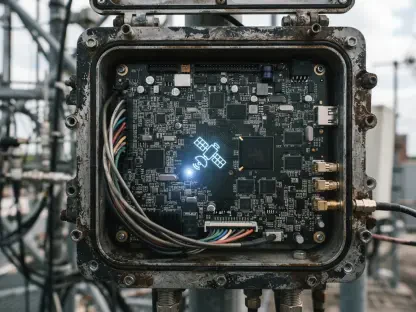
The “Network in a Server” approach is a massive shift because it essentially brings the entire brain of the network directly onto the factory floor or the shipyard. By combining virtualized RAN, an AI core, and specific AI applications into a single on-site platform, we eliminate the delays associated with sending data back to a distant central cloud. For the engineers on the ground, using the CognitiV Network Operations Suite means they can automate the management of this complex environment with much higher precision. It allows for a “physical AI” setup where machines can process LiDAR and sensor data locally, making decisions in milliseconds. This level of integration is essential when you are trying to manage a fleet of autonomous robots without a massive, dedicated IT team on-site at all times.
SK Telecom is utilizing autonomous patrol robots at SK Incheon Petrochem to monitor hazardous areas. What are the specific technical demands of streaming high-definition video for AI risk analysis in such a volatile environment?
Patrolling a petrochemical plant is one of the most demanding tasks you can give a robot because the stakes for safety are incredibly high. These robots are streaming constant, high-definition video feeds back to AI systems that are trained to spot leaks, structural weaknesses, or fire hazards before they become catastrophes. This creates a very heavy upstream data load, which is the exact opposite of how traditional mobile networks are built. To make this work, the network must handle massive amounts of incoming data from the robot’s cameras and sensors without any jitter or packet loss. It’s a sensory-heavy operation where the AI’s ability to “see” a potential explosion risk depends entirely on the throughput of that 5G Standalone connection.
The program involves a direct comparison between major vendors like Samsung, Ericsson, Nokia, and HFR. Why is this competitive evaluation so critical for the future of industrial AI-RAN?
We are currently in a supplier selection and deployment phase, not a full commercial rollout, so having a broad vendor comparison is the only way to get honest data. Each of these companies has a slightly different architecture, and we need to see how they perform under the “real pressure” of an industrial site rather than a sterile laboratory. By testing these systems side-by-side in the two-year program ending in 2028, we can identify which platforms truly deliver on the promise of ultra-low latency. It’s about moving beyond marketing slogans and seeing whose hardware can actually maintain a connection when surrounded by the extreme heat and interference of a refinery. This validation is what will eventually give industrial operators the confidence to invest their own capital into these technologies.
With a total funding of KRW 17.2 billion, roughly $12.7 million, the focus is clearly on validation. What are the primary hurdles that must be cleared before these “physical AI” systems can justify a nationwide rollout?
The financial investment of $12.7 million is a significant start, but it’s a drop in the bucket compared to what a nationwide replacement would cost, so the focus is strictly on proving the return on investment. Engineers and site managers are watching very specific milestones: latency variation, uplink throughput, and the actual task completion rate of the robots. Beyond the connectivity, we have to address the “human” side of the equation, including safety certifications and the complexity of managing edge compute workloads. For an operator to move from 5G Standalone to a full AI-native 6G future, they need to see clear gains in productivity and a measurable reduction in operating costs. Only when the data shows that these robots can work safely and efficiently alongside humans will we see the transition from these pilot programs into the standard operating procedure for global industry.
What is your forecast for the integration of AI-native networks in heavy industry over the next few years?
By 2028, we will see the results of these trials solidify into a blueprint for what I call “intelligent infrastructure,” where the network is no longer just a pipe but a proactive participant in industrial safety. We will transition from simple connectivity to systems that can predict equipment failure before it happens, using the massive upstream data gathered during these current pilots. While we are starting with 5G Standalone technology today, these projects are the essential building blocks for the AI-native 6G era. I expect that within the next three years, the successful “physical AI” use cases we are seeing in South Korea will become the global gold standard for hazardous site management and high-precision manufacturing.