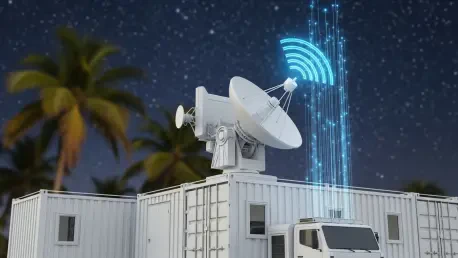

The rapid escalation of satellite deployments in low Earth orbit has transformed the space above our heads into a complex web of high-speed traffic requiring unprecedented monitoring capabilities. This shift from sparse orbital activity to a congested frontier has necessitated the development of more agile, responsive, and geographically diverse sensor networks. LeoLabs, a pioneer in terrestrial-based orbital tracking, has addressed this requirement by deploying its first Scout Hawaii mobile radar facility, which represents a significant departure from the static, permanent installations that traditionally defined the sector. Unlike larger phased-array systems that take years to commission and require massive footprints, this mobile solution provides high-fidelity data on satellites and debris with a much smaller physical and temporal footprint. This deployment marks a pivotal moment for the United States Department of Defense and commercial operators who need real-time awareness in the Pacific theater to ensure the continued safety of multibillion-dollar space assets.
Advancing Tactical Flexibility: Modular Sensor Network Implementation
The Scout system utilizes a modular architecture that allows for rapid shipping and assembly in remote or strategically vital locations without the need for extensive permanent infrastructure. By focusing on X-band radar technology, the Hawaii installation can detect objects as small as a few centimeters, providing the granular detail necessary for identifying potential collisions before they occur. This level of precision is critical for the “New Space” economy, where small satellites and CubeSats have become the norm, often operating in clusters that traditional radar systems struggle to resolve individually. The transition toward mobile sensors allows for the filling of “blind spots” in the existing global coverage network, ensuring that tracking remains continuous even as orbital mechanics shift or environmental conditions change. Furthermore, the ability to relocate these assets ensures that sensor density can be increased in response to specific threats or high-interest events such as satellite breakups or aggressive maneuvers.
Integrating these mobile units into a unified software-defined network creates a resilient ecosystem that is significantly harder to disrupt than a handful of large, vulnerable sites. The Hawaii site specifically leverages its mid-Pacific positioning to capture data on high-inclination orbits that are frequently used by both commercial telecommunications constellations and government reconnaissance platforms. Because the Scout radar is designed with digital beamforming capabilities, it can simultaneously track hundreds of individual objects, updating their orbital parameters with microsecond accuracy. This data is then fed into the LeoLabs Vertex platform, where cloud-based algorithms process the raw radar returns to generate actionable insights for mission planners. The shift toward this decentralized model of space domain awareness acknowledges that the modern orbital environment is far too dynamic for a fixed-site approach. By treating the radar hardware as an adaptable edge-computing node, the system remains robust against the evolving challenges of orbital debris.
Strategic Implications: Enhancing Regional Security and Traffic Management
Positioning the Scout radar in Hawaii provides a unique vantage point that bridges the gap between mainland American sensors and assets stationed throughout the Indo-Pacific region. This geographic advantage is indispensable for maintaining a clear picture of the space-to-ground transition during sensitive launch windows or satellite de-orbiting procedures. As the density of the Pacific satellite traffic increases, the demand for localized, high-priority tracking has surged among both military and civilian stakeholders who require sub-meter accuracy to maintain operational safety. The deployment serves as a proof of concept for how private sector innovation can augment government capabilities by offering rapid-response sensing that complements existing deep-space surveillance systems. Moreover, the modularity of the Scout design allows it to be operational within weeks of arriving at a site, a stark contrast to the decades-long development cycles of traditional military radar programs. This agility ensures that the sensor network can evolve from 2026 to 2028.
The successful implementation of the Scout Hawaii facility established a new standard for international cooperation in space traffic management. By providing high-quality data to a variety of users, the system encouraged transparency and helped mitigate the risk of accidental collisions that could lead to a Kessler Syndrome event. Stakeholders across the aerospace industry recognized that the visibility afforded by mobile radar units was essential for the long-term sustainability of the orbital environment. The data generated during the initial phases of the Hawaii deployment demonstrated that smaller, specialized sensors could deliver mission-critical performance at a fraction of the cost of legacy systems. Consequently, the focus shifted toward building a dense, global mesh of sensors that could track every object in low Earth orbit in real time. Moving forward, the industry adopted a more proactive stance on orbital safety, utilizing the insights gained from mobile surveillance to refine collision avoidance protocols and optimize the paths of incoming spacecraft.