
Navigating the Shift From Connectivity Pipes to Intelligent Foundations
The telecommunications landscape is currently undergoing a metamorphic shift that replaces the simple delivery of bits with a complex architecture of cognitive processing and sensory awareness. This evolution marks the end of the “dumb pipe” era as operators transition into the role of foundational architects for artificial intelligence and integrated sensing networks. In the current global climate, this transformation has become a critical necessity for maintaining national security, technological sovereignty, and a competitive economic edge. As data demands from generative AI skyrocket, the infrastructure supporting these signals must become as intelligent as the applications it carries.
Industry observations reveal that the convergence of localized data centers and advanced radio technology is no longer a luxury but a requirement for survival. The push toward this new model is driven by a complex interplay of geopolitical competition and the need for more efficient resource management. This roundup explores the financial strategies that keep these massive projects viable, the rise of state-backed AI initiatives, and the disruptive arrival of sensing technologies that turn cellular networks into sophisticated radar systems. By understanding these pillars, stakeholders can better navigate the high-stakes environment where connectivity and intelligence are inextricably linked.
The Technical and Financial Blueprint of Next-Generation Connectivity
Balancing Speculative AI Hype With a Pragmatic Pay-As-You-Go Strategy
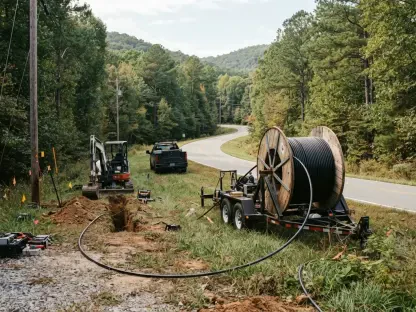
Market analysts note that while the excitement surrounding artificial intelligence is immense, telecommunications companies are adopting a remarkably cautious approach to network expansion. The prevailing strategy focuses on an “incremental expansion” model, where operators scale fiber capacity and data center interconnects in small, manageable stages. Rather than committing vast sums of capital to massive upfront builds, firms are expanding capacity just ahead of demand, often activating only a few wavelengths at a time on optical fiber lines. This measured pace helps protect these organizations from the volatility of a potential AI bubble while ensuring they can support high-capacity traffic from giants like Google or AT&T.
Furthermore, a significant challenge persists in the decoupling of data traffic from revenue, a trend where the cost per bit continues to fall even as utilization increases. To counter this, fiber investments are now categorized as multi-decade assets that provide long-term stability rather than immediate windfalls. Management teams are increasingly focused on “pre-buying” hardware and expanding physical footprints incrementally. This allows them to capture the demand for high-speed interconnectivity without overextending their balance sheets in an era where industry analysts remain wary of speculative overbuilds that might not yield immediate returns.
The Geopolitical Race for Sovereign AI and Regional Technological Independence
A growing consensus among policy experts highlights the rise of state-backed initiatives designed to build localized AI ecosystems, particularly in the European Union. The goal is to establish “technological sovereignty” by creating a network of gigafactories that support domestic startups and academic research. These projects, often funded through billions of euros in public-private partnerships, aim to ensure that regional data management aligns with local legal frameworks and ethical values. For telcos, this represents a unique opportunity to integrate across the full technology stack, providing the essential connectivity that links these new industrial hubs together.
However, the pursuit of regional independence is not without its risks, as it requires navigating complex regulatory landscapes while competing with global hyperscalers. Telcos are positioning themselves as the primary facilitators of these sovereign clouds, offering the specialized infrastructure needed to keep data within borders. By supporting small and medium-sized enterprises through localized edge computing, operators are moving toward a model where they are central to the regional economy. This shift toward localized infrastructure reflects a broader trend of aligning telecommunications with geopolitical interests and national security priorities.
From Signal to Sensor: The Disruptive Impact of 6G-Native Integrated Sensing
The evolution of Integrated Sensing and Communications, or ISAC, is turning cellular networks into radar-like systems capable of tracking and triangulation without the need for additional hardware. Industry leaders recognize that 6G-native technologies are being pulled forward into the current 5G-Advanced landscape to address urgent security needs. By analyzing how radio waves bounce off objects, the network can create a high-fidelity digital map of its environment. This capability is rapidly moving from theoretical research to practical application, driven largely by the immediate military necessity for protecting critical infrastructure against low-cost drone threats.
The assumption that cellular networks exist solely for communication is being challenged as radio spectrum begins to double as a sophisticated monitor. Organizations like Ericsson Federal indicate that military-grade sensing will likely reach commercial maturity by 2028, starting with specialized deployments at sea ports and energy facilities. This dual-use nature of the radio frequency environment allows for a pervasive monitoring system that is far less expensive than traditional radar. As the technology matures, it will provide a foundational layer of situational awareness that was previously impossible to achieve at such a scale.
Cultivating the Drone Economy Through Sensing-as-a-Service Models
The transition from military applications to commercial “sensing-as-a-service” is expected to unlock a new “drone economy” that relies on telcos for airspace management. In this model, logistics and retail companies will pay for access to the network’s sensing capabilities to manage complex flight paths and ensure collision avoidance. This integration of sensing with private 5G networks marks a significant milestone for Industry 4.0, where automated robotics and humans share the same space. By providing the digital guardrails for low-altitude flight, telcos are finding ways to monetize their spectrum in entirely new ways.
Moreover, the combination of automated robotics and high-speed sensing will facilitate more efficient urban planning and retail logistics. Speculative directions for the industry suggest that the network will eventually handle the security of entire metropolitan airspaces, providing a reliable platform for the mass adoption of autonomous vehicles. This evolution suggests that the future of telecommunications lies in being an active participant in the physical movement of goods and services. As the sensing framework becomes more robust, it will allow for the seamless integration of digital intelligence into the physical world.
Strategic Frameworks for Modernizing the Telecommunications Landscape
To capitalize on these shifts, the industry has begun to move toward a “broad church” model that bridges the gap between defense, compute, and connectivity. Decision-makers were encouraged to prioritize sustainable, long-term returns over the short-term gains associated with speculative builds. A successful strategy required operators to leverage dual-use technologies that provide value in both the civilian and government sectors. By focusing on modular infrastructure that can adapt to changing demands, firms ensured they remained relevant in an environment where the boundaries between different technology sectors were increasingly blurred.
Recommendations for stakeholders involved prioritizing the deployment of dark fiber and edge nodes that could support both AI training and real-time sensing. The integration of high-performance computing clusters within the network footprint became a primary objective for those seeking to capture the next wave of industrial value. Those who successfully aligned their infrastructure with national security requirements found themselves at a distinct advantage. These strategies fostered a more resilient ecosystem where the network served as a versatile tool for a variety of high-stakes applications.
Securing the Future Through Intelligent and Integrated Networks
The analysis of the current landscape showed that the network has become inseparable from a nation’s intelligence and security infrastructure. The most successful operators were those who demonstrated flexibility as they navigated the high-stakes requirements of sovereign AI and global competition. It was clear that the infrastructure laid during this pivotal period would define the socio-economic boundaries of the next several decades. Organizations that recognized the importance of integrating sensing with communication were able to provide a level of service that went far beyond traditional connectivity.
Ultimately, the shift toward intelligent foundations demonstrated that the value of the network lies in its ability to perceive and process information, not just transport it. As the industry moved forward, the focus remained on building a robust and secure foundation for the future of digital society. Stakeholders who invested in these intelligent systems prepared themselves for a world where the network is the primary source of environmental and cognitive awareness. The lessons learned during this transition period highlighted the need for a visionary approach to infrastructure that prioritizes both security and innovation.