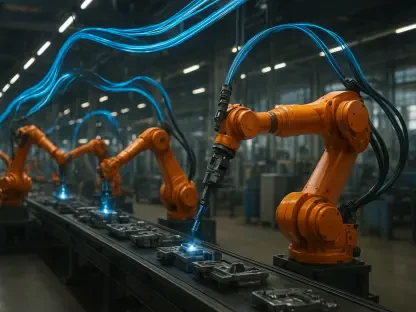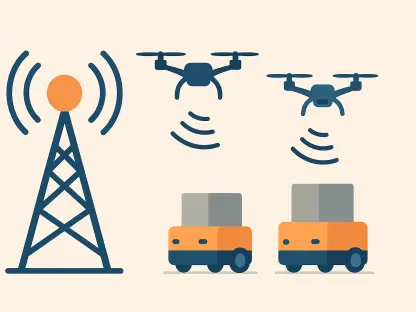

The once-speculative concept of machines that possess both high-level intelligence and physical mobility has transitioned from research labs to the center of global industrial strategy, marking a significant milestone in how humanity approaches mass production. For many years, the telecommunications sector found itself in a challenging position, attempting to “push” private 5G onto enterprises that were not yet convinced of its necessity. This landscape has fundamentally shifted as the rise of “physical AI” has created an undeniable market “pull.” Industrial leaders are now realizing that the complex requirements of autonomous systems—such as real-time computer vision and low-latency motor control—cannot be met by legacy wireless standards. This realization has transformed 5G from an optional upgrade into a foundational requirement for any facility aiming to achieve true autonomy.
This analysis explores the critical intersection where high-performance connectivity meets intelligent physical action. We are moving beyond the era of simple data transmission into a period of capability enablement, where the network serves as the central nervous system for machines that think, adapt, and move. By examining the current market trajectories and the technical advantages that 5G provides over traditional methods, it becomes clear why this specific combination of technologies is now considered the primary driver of industrial efficiency and economic resilience.
The Dawn of a Connectivity-Driven Intelligence Era
The current industrial environment is defined by a shift from static automation to dynamic, intelligent movement. Traditionally, factory robots were stationary, bolted to the floor, and connected via cables to ensure consistent performance. However, the modern requirement for flexibility in manufacturing has led to a surge in mobile assets that must navigate complex, changing environments without human intervention. This demand has exposed the limitations of existing wireless solutions, which often lack the reliability and density needed to support dozens or hundreds of autonomous agents simultaneously.
The relevance of this shift cannot be overstated, as the global labor market continues to face unprecedented challenges. Industries are no longer just looking to improve efficiency; they are looking to maintain operational continuity in the face of worker shortages. Consequently, the adoption of physical AI has become a survival strategy. This article aims to explore how private 5G provides the specific technical parameters—high bandwidth, massive device density, and ultra-reliable low latency—that allow these AI-driven machines to function safely and effectively alongside human workers in high-stakes environments.
Tracing the Evolution of Industrial Connectivity and Market Growth
To appreciate why private 5G has become the dominant choice for modern enterprises, one must look at the progression of factory networking. The earliest days of automation relied heavily on proprietary wired protocols that were stable but inflexible. When Wi-Fi was introduced to the plant floor, it provided mobility but struggled with the metallic interference and high-density requirements of industrial settings. As physical AI matured, integrating deep learning and high-resolution sensor fusion, the bandwidth and latency ceilings of these older systems became major bottlenecks, preventing the scaling of autonomous fleets.
Market data from 2026 to 2029 suggests that the private 5G sector is on a path to exceed a valuation of $6.6 billion, growing at a compound annual rate of roughly 34 percent. This acceleration is closely tied to the massive investments being made in humanoid robotics and autonomous mobile robots (AMRs). With the global humanoid market projected to reach $38 billion by 2035, the economic incentive to build robust networks has never been higher. This historical growth pattern shows that as machines have become more intelligent and mobile, the infrastructure supporting them has had to undergo a parallel revolution to keep pace with the sheer volume of data being processed at the edge.
The Core Pillars of the 5G and AI Integration
Transforming Industrial Operations: Humanoids and Robotics
Physical AI essentially provides a sophisticated “brain” for moving hardware, but even the most advanced brain is ineffective without a fast and reliable nervous system. In the current market, robotics firms are moving away from onboard processing for every task, instead opting for “off-board” AI inference. This approach allows robots to be lighter, more energy-efficient, and less expensive by shifting heavy computational tasks to edge servers. Private 5G is the only medium capable of facilitating this split-second exchange of data without the lag that could result in a mechanical collision or a failed task.
Real-world success stories have already begun to validate this architectural choice. In the automotive component sector, companies like Fulin Precision have successfully integrated nearly 100 semi-humanoid robots into their logistics chains, resulting in a 50 percent reduction in manual transport costs. In the aviation industry, drones and ground robots are being used at major hubs like Auckland Airport and Los Angeles International to automate inventory management and cargo tracking. These applications demonstrate that 5G is the essential link that enables an AI model to translate visual data into physical action in real time, ensuring that robots can operate safely in unpredictable environments.
Infrastructure Efficiency: The Comparative Advantage Over Wi-Fi
The debate between Wi-Fi and private 5G has moved beyond simple performance metrics toward a broader discussion of infrastructure efficiency and total cost of ownership. While Wi-Fi 6 and 7 have made significant improvements, they still operate on unlicensed spectrum, which is prone to interference in dense industrial settings. In contrast, private 5G uses licensed or prioritized spectrum, providing a “clean” lane for mission-critical data. This distinction is vital for AI applications that require deterministic latency to ensure that a robot stops exactly when a sensor detects an obstacle.
Large-scale deployments by companies like John Deere and BP have highlighted the “leaner” footprint of 5G hardware. In many industrial scenarios, a facility that would require over 300 Wi-Fi access points to ensure gapless coverage can be fully serviced by fewer than 25 5G radios. This drastic reduction in hardware points minimizes the complexity of the network, reduces the energy required for cooling and power, and simplifies the long-term maintenance schedule. For a business scaling up its AI operations, the ability to manage a simplified network architecture while gaining superior coverage represents a significant strategic advantage.
Global Market Dynamics: Overcoming Implementation Hurdles
The adoption of these technologies is being shaped by diverse regional priorities and sector-specific needs. In China, there is a massive push toward general-purpose humanoid robots for manufacturing, while in Japan and Northern Europe, the focus is often on specialized autonomous patrols for hazardous environments like gas plants or offshore oil rigs. This variety shows that 5G is not a one-size-fits-all solution; it is a versatile platform that can be tailored to the specific regulatory and operational demands of different markets.
However, the path to full implementation is not without its challenges, particularly regarding the integration of 5G with legacy industrial protocols like Modbus or EtherNet/IP. To address this, the industry has seen the rise of “Network-as-a-Platform” models, where the network itself becomes an intelligent, self-optimizing system. By abstracting the complexity of the underlying hardware, these platforms allow industrial engineers to focus on the AI applications themselves rather than the intricacies of telecommunications engineering. This shift has been instrumental in bringing 5G to sectors like mining and energy, where technical expertise in wireless networking is often limited.
The Rise of Agentic Networks and AI-on-RAN Innovations
The next phase of the industrial revolution involves the embedding of AI directly into the network architecture. We are seeing the emergence of “agentic AI”—systems that autonomously manage and optimize the 5G network itself. These agents can predict signal interference before it happens, adjust power consumption based on real-time traffic, and automatically enforce security protocols. This creates a “living” network that adapts to the specific needs of the autonomous machines it supports, ensuring that a fleet of robots always has the bandwidth it needs for high-priority tasks.
Moreover, the concept of “AI-on-RAN” (Radio Access Network) is beginning to take hold in private environments. These networks are increasingly being used as testbeds for integrated sensing and communication (ISAC), where the radio waves themselves are used to detect the position and movement of objects in a room. This effectively turns the entire network into a giant sensor, providing an additional layer of situational awareness for physical AI. While these innovations will eventually benefit public networks, the controlled environments of private factories and warehouses are where the most significant breakthroughs are currently happening.
Strategic Implementation: Leveraging Private 5G for Industrial Success
For organizations looking to lead in this new era, the strategy must focus on creating a unified infrastructure stack where connectivity and intelligence are treated as a single entity. Private 5G should not be viewed as an isolated IT project but as a core component of the operational technology strategy. The most successful enterprises have been those that identified specific high-value use cases—such as autonomous transport in hazardous areas or high-precision remote inspection—where the benefits of low latency and high device density provide the fastest return on investment.
A recommended best practice for industrial leaders is to move quickly from isolated pilot programs to integrated deployments that solve real-world labor or safety issues. By placing AI processing at the network edge, companies can significantly reduce the amount of data that needs to transit to a distant cloud, ensuring that autonomous fleets remain responsive. This localized approach also enhances data security and sovereignty, which are critical concerns for manufacturers protecting proprietary processes. Building a robust, 5G-enabled foundation today is the most effective way to ensure that a facility is ready for the increasingly capable robots of tomorrow.
Securing a Competitive Edge in the Age of Autonomous Machines
The historical reliance on static automation yielded to a dynamic model where intelligence moved freely across the factory floor, fundamentally altering the competitive landscape of global industry. The analysis revealed that the synergy between 5G and physical AI served as the primary engine for industrial resilience during a period defined by labor scarcity and the need for rapid production shifts. It was observed that organizations which prioritized a unified connectivity strategy were able to scale their autonomous fleets far more effectively than those that attempted to patch legacy systems with disparate wireless solutions.
The transition toward autonomous productivity demonstrated that connectivity was not merely a utility but the central nervous system of the modern enterprise. Decision-makers found that investing in private 5G allowed for the implementation of advanced sensing and edge-based inference that was previously impossible. Looking forward, the focus shifted toward the integration of agentic networks that could self-heal and optimize without human intervention. These findings suggested that the foundation of future industrial growth rested on the ability to merge the digital and physical worlds into a single, cohesive, and intelligent operating environment. Industrial leaders recognized that the era of “smart” machines had truly begun only when the networks supporting them became as intelligent as the machines themselves.