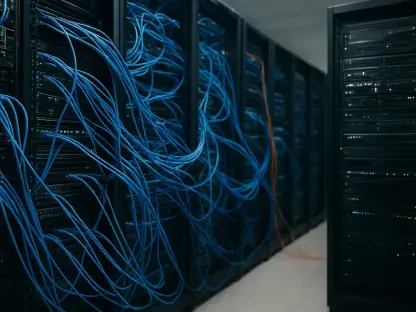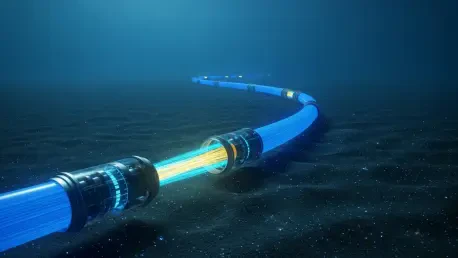

Thousands of miles of glass fibers resting on the abyssal plains of the world’s oceans now serve as the primary circulatory system for the most advanced artificial intelligence models ever conceived by humanity. While modern users interact with sophisticated chatbots through seamless interfaces, the silent reality remains a massive network of fiber-optic cables. This infrastructure is the only reason a complex query processed in a North American data center can return a coherent answer to a smartphone in Tokyo or Singapore in mere milliseconds.
The Invisible Backbone Powering the Intelligence Revolution
The global appetite for artificial intelligence has triggered a construction boom beneath the ocean waves that has not been seen since the peak of the dot-com era. This physical network is the foundation upon which the digital economy rests, serving as the bridge between centralized compute hubs and a worldwide user base. Without these deep-sea arteries, the promise of instantaneous global intelligence would vanish, replaced by the lag and latency of overmatched satellite links or terrestrial relays.
The sheer volume of data being moved across the seafloor today is staggering, as every image generated and every line of code written by AI must traverse these glass strands. Consequently, the industry is seeing a shift in how these cables are perceived—not merely as utility pipes, but as the critical hardware that determines the speed of innovation. This invisible backbone is undergoing a radical expansion to ensure that the intelligence revolution remains unhindered by the physical limitations of current geography.
Why Underwater Capacity Is the New Global Commodity
The current surge in subsea investment is driven by a fundamental shift in how data moves across the planet. With major foundation model builders like OpenAI and Anthropic headquartered in the United States, the nation has become the primary export hub for AI compute. However, because AI consumption is a worldwide phenomenon, the industry is facing an urgent need for higher data capacity and network redundancy. This demand is forcing a total overhaul of the world’s underwater data highways.
Over $16 billion in new cable projects are scheduled to enter service between 2026 and 2029 to replace aging systems that simply cannot handle modern traffic loads. This capital injection is turning subsea capacity into a premier global commodity, as vital as oil or electricity. As AI models become more complex and require larger datasets for real-time inference, the value of having a dedicated, high-speed path through the ocean has reached an all-time high.
Technical Evolution and Strategic Geographic Shifts
Modern subsea cables are undergoing a massive technological leap to accommodate the heavy data requirements of AI workloads. While legacy cables typically functioned with only four pairs of fiber, the latest deployments are scaling up to 24 pairs, exponentially increasing the capacity available for private use. This advancement allows for the massive throughput necessary for training and deploying the next generation of models across multiple continents simultaneously.
Beyond technical specifications, a strategic pivot is occurring in global routing to avoid geopolitical complications. While transatlantic demand remains high, there is a significant uptick in activity connecting the U.S. West Coast to Japan and Singapore. This movement reflects a broader effort to diversify pathways and ensure high-speed connectivity while navigating a complex international landscape. These new routes provide the resilience needed to keep global AI services online during regional disruptions.
The Rise of the Hyperscalers and Proprietary Networks
Industry experts observe that the hyperscalers—tech giants like Google, Meta, Amazon, and Microsoft—are moving away from the traditional model of shared consortiums. Instead, they are building their own proprietary networks to gain total control over their data flows. Google currently leads this infrastructure race with investments in roughly 30 subsea systems, including vital links to Africa and the Middle East. This shift toward private ownership allows these companies to prioritize the low-latency requirements essential for seamless AI.
Meta followed suit with ambitious projects like “Project Waterworth,” a 24-pair cable ring designed to encircle the globe. By owning the physical infrastructure, these corporations can optimize every millisecond of data travel, ensuring that their proprietary models outperform those relying on public bandwidth. This trend toward private control over the seafloor is fundamentally changing the power dynamics of the global internet, placing the keys to the digital kingdom in the hands of those who build the cables.
Strategies for Managing the Next Generation of Global Connectivity
To keep pace with the rapid expansion of AI-driven traffic, telecommunications providers and tech firms adopted specific frameworks for infrastructure development. This included prioritizing the replacement of legacy cables that reached their end-of-life capacity and investing in dark fiber to allow for future scalability. Furthermore, companies implemented diverse routing strategies to ensure that even if one cable suffered damage, services remained online.
The industry successfully built a more resilient, high-bandwidth foundation for the future of global intelligence. By focusing on high-pair count cables and strategic landing points in emerging tech hubs, providers ensured that the infrastructure would not become a bottleneck for innovation. This proactive approach turned the invisible backbone of the internet into a dynamic asset capable of supporting the next decade of cognitive computing across the globe.