
The inherent unpredictability of light traveling through complex optical structures has long frustrated engineers seeking to push the boundaries of modern telecommunications and high-precision laser engineering. In 2026, the demand for increased bandwidth and higher power density has reached a fever pitch, forcing researchers to look beyond traditional single-core fibers. Multicore fibers present a promising alternative, yet they have historically been plagued by erratic energy leakage known as coupling. Recent breakthroughs led by Professor Sergey A. Babin at the Institute of Automation and Electrometry have revealed that high-power light can actually mitigate this chaos. Through a process identified as spatiotemporal beam stirring, intense laser pulses transition from unpredictable fluctuations to a state of remarkable stability. This phenomenon represents a significant shift in how physicists view nonlinear interactions, suggesting that intensity can serve as a stabilizing force rather than a disruptive one in multicore systems.
The Evolution of Optical Control Systems
Analyzing Linear Dynamics: The Barrier of Random Coupling
To appreciate the significance of high-power stabilization, one must first examine the behavior of light at low power levels, typically referred to as the linear regime. In this state, when a narrowband laser pulse is injected into a single core of a seven-core fiber, the light does not remain confined but instead tunnels into adjacent cores. This leakage is not uniform; rather, it is a stochastic process influenced by microscopic imperfections in the fiber and external environmental factors. The resulting output is often characterized by a chaotic speckle pattern, where the intensity of light in each core fluctuates randomly. For applications requiring high precision, such as medical imaging or phase-locked beam combining, this lack of predictability creates an insurmountable barrier. The energy distribution remains uneven, making it nearly impossible to maintain a consistent signal or focus a beam effectively over long distances or through fiber movements.
The Complexity of Environmental Sensitivity in Linear Systems
Furthermore, the sensitivity of these linear systems to temperature shifts and mechanical vibrations exacerbates the problem of instability in real-world environments. Even minor physical disturbances can cause the phase of the light in different cores to shift, leading to massive fluctuations in the far-field profile. Engineers have spent decades attempting to counteract these effects using complex feedback loops and active phase modulation, but these solutions often add significant cost and bulk to the hardware. The persistent randomness of linear coupling means that the potential capacity of multicore fibers remains largely untapped for sensitive tasks. As researchers observed these limitations, the search for a passive, internal mechanism for stabilization became a priority. The discovery that increasing the input power could provide a self-regulating solution was unexpected, as high energy is typically associated with increased turbulence or thermal damage.
Reaching the Nonlinear Threshold: Achieving Symmetry
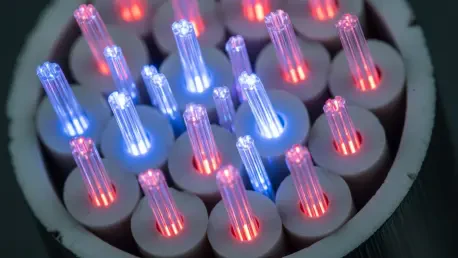
The transition from chaos to order occurs quite suddenly once the peak power of the laser pulses crosses a specific intensity threshold. As the system enters the nonlinear regime, the disorganized energy distribution seen at lower power levels vanishes, replaced by a highly ordered and balanced state. Researchers observed that instead of light being concentrated randomly in a few cores, it begins to distribute itself with remarkable uniformity across all seven channels of the fiber. This near-field transformation is visible as seven spots of identical brightness, indicating that the system has found a way to equalize the power distribution internally. This change is not just a marginal improvement but a fundamental shift in the physical behavior of the light. The chaotic flickering that defines low-power operation is replaced by a steady, reliable output that persists regardless of the initial injection conditions, provided the power remains high.
The Far-Field Transformation: From Speckle to Gaussian Curves
This stabilization is even more pronounced when examining the far-field profile of the exiting light, which shifts from a grainy speckle into a smooth Gaussian curve. This bell-shaped distribution is the gold standard for laser beams, signifying high spatial quality and predictability. In 2026, the ability to generate such a clean profile directly from a multicore fiber without external correction is a major milestone for optical physics. The symmetry achieved in this state suggests that the internal nonlinear dynamics are actively suppressing the random phase differences that normally degrade beam quality. This self-organization allows the multicore fiber to behave like a single, high-power aperture, effectively combining the outputs of individual cores into a coherent whole. By reaching this nonlinear threshold, scientists have unlocked a method to harness the combined power of multiple channels while maintaining the beam quality typically reserved for laboratory systems.
Internal Dynamics of Self-Organization
The Optical Kerr Effect: Inducing Refractive Index Shifts
At the heart of this phenomenon lies the optical Kerr effect, a nonlinear property of silica glass where the refractive index changes in response to the intensity of the light itself. When high-power pulses travel through the fiber, they do not experience a static environment; instead, the light modifies the very material it is passing through. This creates a nonlinear phase accumulation that varies according to the local intensity within each core. As the pulses propagate, these phase shifts fundamentally alter the way light waves interfere with one another. Unlike the linear regime where interference is a byproduct of random path lengths, the nonlinear regime forces a structured interaction. The high intensity creates a potential well of sorts that guides the energy toward a more balanced distribution. This interaction is dynamic, ensuring that any temporary imbalance in power is quickly corrected by the resulting changes in the refractive index, thereby maintaining a steady state.
Internal Feedback Loops: Passively Regulating Energy
Moreover, the Kerr effect allows for a sophisticated form of internal feedback that does not require external electronics or sensors. Because the refractive index is directly linked to intensity, the fiber acts as its own regulator. If one core begins to accumulate more power than others, the local refractive index shifts, altering the coupling coefficient and pushing excess energy back toward the neighboring cores. This natural push and pull mechanism ensures that no single channel becomes a bottleneck or a hot spot. In the context of 2026 technology, this passive stabilization is incredibly valuable for developing compact and reliable fiber systems. The complexity of the nonlinear phase accumulation creates a robust environment where the light is essentially forced into equilibrium. This represents a departure from traditional optical design, where nonlinearity is often viewed as a parasitic effect to be avoided, rather than a tool for achieving unprecedented beam control.
Temporal Averaging: The Mechanism of Spatiotemporal Stirring
To fully understand how stability is maintained, researchers utilized complex numerical simulations to track the evolution of light over extremely short timescales. They discovered that the high-power pulses do not travel as monolithic blocks of energy but instead break down into a series of smaller sub-pulses or temporal fluctuations. This internal structure is crucial because each sub-pulse experiences slightly different propagation conditions and phase shifts as it moves through the multicore lattice. As these sub-pulses interact over the duration of the primary pulse, their individual instabilities and fluctuations are effectively averaged out. This process, known as temporal averaging, is the core component of spatiotemporal beam stirring. It suppresses the rapid, unpredictable power transfers that characterize the linear regime. By the time the light reaches the end of the fiber, the cumulative effect of these interactions is a statistically balanced and stable output.
Sustaining Robustness: Lessons for Future Scalability
The results of these studies demonstrated that the self-organized state was remarkably resilient to external perturbations. When the fiber was subjected to mechanical bending or vibrations, the high-power equalized output remained stable, whereas the low-power output would have fluctuated wildly. This durability suggested that spatiotemporal beam stirring was a fundamental physical property rather than a laboratory coincidence. To capitalize on these findings, developers began prioritizing the production of fiber materials with specific nonlinear coefficients to lower the power threshold required for stabilization. Researchers implemented new protocols for testing multicore systems in high-vibration environments, ensuring that the self-healing properties were utilized in aerospace and industrial manufacturing. By focusing on the interplay between pulse duration and core geometry, the industry successfully transitioned toward high-capacity networks that remained stable under stress.