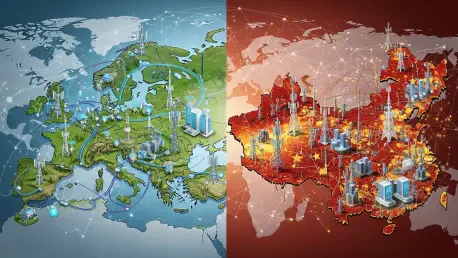

The silent struggle for dominance over global telecommunications infrastructure has evolved from a boardroom competition into a high-stakes geopolitical chess match that threatens to redraw the map of digital connectivity. At the center of this tension lies the friction between the European Union and the People’s Republic of China, a relationship once defined by commercial pragmatism that has now soured into a debate over national security and digital sovereignty. The transition from the voluntary “5G toolbox” recommendations to the rigid, mandatory prohibitions of the revised Cybersecurity Act marks a fundamental shift in how the West views technological dependency on the East.
The key players in this drama represent more than just corporate interests; they are the standard-bearers of their respective economic philosophies. The European Commission acts as the regulatory architect, pushing for a secure digital environment, while Chinese giants like Huawei and ZTE find themselves sidelined by allegations of state-sponsored espionage and a lack of transparency. Meanwhile, European vendors such as Nokia and Ericsson are caught in the crossfire, struggling to maintain a presence in Asian markets while their domestic regulators move to purge Chinese hardware from European networks.
Industrial leaders beyond the telecom sector are also feeling the tremors of this structural realignment. Entities like Siemens and Airbus represent broader European industrial interests that depend on stable trade relations but also require the security of a resilient digital backbone. As the world moves toward a more fragmented global economy, the pursuit of “digital sovereignty” has become a non-negotiable objective for European policymakers, even as they navigate the complex manufacturing web that still ties them to their Eastern counterparts.
Geopolitical and Economic Foundations of the EU-China Telecom Conflict
The 5G infrastructure dispute is rooted in a fundamental shift in the European security paradigm. For years, the EU operated under a risk-mitigation strategy that allowed individual member states to decide how much “high-risk” equipment to permit within their borders. However, as the geopolitical climate shifted, the European Commission realized that a patchwork of voluntary guidelines was insufficient to protect the single market. This realization led to the push for mandatory bans, transforming 5G from a commercial utility into a frontline of national defense.
Huawei and ZTE, once viewed as cost-effective partners for rapid digital expansion, are now primarily analyzed through the lens of their political origin. The concern is not always the hardware itself, but the legal framework in which these companies operate, which could theoretically allow the Chinese state to weaponize telecommunications networks. In contrast, European vendors like Nokia and Ericsson are seen as reliable, transparent entities, though they face the daunting task of competing against state-subsidized rivals while their own market shares in the East continue to evaporate.
The significance of this move extends far beyond the installation of base stations and antennas. It signals a broader European strategy to decouple from critical dependencies that could be exploited during a geopolitical crisis. By prioritizing security over short-term cost-efficiency, the EU is attempting to safeguard its digital future, even if it means slowing down the deployment of 5G or increasing the capital expenditures of its primary telecommunications operators.
Comparative Analysis of Market Dynamics and Security Regulatory Frameworks
Regulatory Approaches and Security Standards
The security philosophies of the European Union and China could not be more distinct. The EU utilizes a risk-based assessment under the Cybersecurity Act, which evaluates vendors not just on their technical specifications, but on the legal and political environment of their home countries. This objective framework is designed to identify potential vulnerabilities before they can be exploited. China, conversely, promotes a narrative of “win-win” collaboration, arguing that technical security should be separated from political considerations and that Huawei’s track record in Europe proves its reliability.
Legal implications remain the primary stumbling block for Chinese vendors attempting to operate in the European market. Under Chinese national intelligence laws, domestic companies can be compelled to cooperate with state security apparatuses, a mandate that fundamentally clashes with the transparency and privacy standards expected of firms in the West. While Huawei and ZTE maintain that they would never compromise their customers, the mere existence of such laws has prompted the EU to apply the “high-risk” designation, a move that is increasingly being translated into enforceable bans across member states.
The transition from non-binding guidelines to hard legislation represents a new era of enforcement. In the past, countries like Germany or Italy might have resisted the total exclusion of Chinese vendors due to economic ties. However, the current regulatory momentum is toward a unified, legally enforceable prohibition that leaves little room for ambiguity. This shift reflects a growing consensus that the integrity of the digital ecosystem is a collective responsibility that outweighs the individual trade preferences of any single member state.
Market Access and the Reciprocity Gap
One of the most glaring disparities in the telecom sector is the lack of reciprocity in market access. Despite the security concerns, Huawei still maintains a significant presence in Europe, holding an estimated 33% to 40% of the market share in several key countries. In stark contrast, the combined market share of Nokia and Ericsson in the Chinese market has plummeted to a mere 3%. This gap suggests that while Europe remained relatively open to Chinese competition, the Chinese market became increasingly hostile to European firms as domestic alternatives reached maturity.
Financial performance metrics for European vendors tell a cautionary tale of this erosion. Ericsson, which once counted China as a primary growth engine, has seen its revenue from the region drop from $2 billion in 2020 to roughly $880 million by the start of 2026. Nokia has faced a similarly steep decline, with its Greater China revenues tumbling by 58% over the last several years. These losses are not merely the result of natural market competition but are often viewed as the outcome of an “invisible hand” that prioritizes national champions through state intervention and procurement policies.
The comparison between the relatively open European regulatory environment and the centralized industrial policy of China reveals a fundamental trade imbalance. European firms operate in a market-driven system where contracts are generally awarded based on merit and cost, whereas the Chinese market operates as a strategic asset for the state. As European regulators tighten their own standards, they are effectively acknowledging that free trade cannot function when one side utilizes its domestic market as a gatekeeping tool for geopolitical leverage.
Economic Interdependence and Trade Imbalance
The broader trade relationship between the EU and China is defined by a massive and growing deficit. Recent data shows that the EU exported approximately €199.4 billion in goods to China, while imports from China surged to €559.4 billion. This resulted in a record-breaking trade deficit of €359.8 billion. This imbalance is particularly acute in the technology sector, where Europe remains heavily dependent on Chinese manufacturing for everything from consumer electronics to the passive components used in European-made telecom hardware.
Supply chain ecosystems are another area of significant contrast. China has spent decades pursuing a goal of self-sufficiency, building an end-to-end manufacturing capability that covers every aspect of the technology stack. In contrast, even “Western” vendors like Nokia and Ericsson still rely on a network of Chinese suppliers for basic components. This dependency means that a total ban on Chinese vendors does not necessarily mean a total decoupling from Chinese industry, as the hardware itself often contains parts manufactured within the People’s Republic.
Trends in export reliance further complicate the narrative. While Chinese imports into Europe have remained robust, EU exports to China have seen a three-year decline leading into 2026. This suggests that China is becoming less reliant on high-value European machinery and vehicles, even as Europe struggles to find alternative suppliers for its digital infrastructure. This shifting manufacturing dependency puts the EU in a vulnerable position, as it must secure its networks without triggering an economic backlash that could devastate its industrial base.
Strategic Challenges and Barriers to Decoupling
The practical difficulties of overhauling a global manufacturing ecosystem cannot be overstated. Decoupling from Chinese telecommunications components is not as simple as signing a contract with a different vendor; it involves replicating a supply chain that has been optimized over thirty years. Rebuilding this infrastructure in the West would require massive capital investment and could take decades to achieve the same level of efficiency and cost-effectiveness that currently exists in the East.
China has not been silent about these developments, issuing “decisive” warnings regarding the potential for economic retaliation. Any move to fully exclude Huawei and ZTE could lead to countermeasures targeting European high-value sectors, such as the automotive industry or precision machinery. For countries like Germany, where the automotive sector is a pillar of the economy, the threat of losing access to the Chinese consumer market is a significant deterrent that complicates the push for a unified European security strategy.
Internal fragmentation remains Europe’s greatest weakness. Some critics have described the region as a “museum” of technology, where outdated regulatory frameworks and a lack of unified digital investment have allowed competitors to sprint ahead. Without a centralized industrial policy to match that of China, the EU risks being a secondary player that can only react to the strategies of others. The lack of a unified digital strategy makes it difficult for Europe to scale its own technological innovations, leaving it perpetually reliant on foreign hardware.
Conclusion and Strategic Recommendations
The comparative analysis of the European and Chinese telecommunications landscapes demonstrated that the era of viewing 5G solely as a commercial endeavor ended. The shift from the voluntary “5G toolbox” to the mandatory Cybersecurity Act reflected a hard-learned lesson about the risks of technological dependency. While Nokia and Ericsson remained the primary Western alternatives, their systematic exclusion from the Chinese market highlighted a lack of reciprocity that made the status quo unsustainable. This realignment moved the focus from short-term savings to long-term national security imperatives.
To navigate this landscape, policymakers and industry leaders should prioritize the diversification of supply chains to reduce reliance on high-risk components. This includes investing in domestic manufacturing capabilities and fostering partnerships with trusted allies to create a more resilient digital ecosystem. Criteria for selecting infrastructure vendors must now include an assessment of geopolitical stability and the legal environment of the vendor’s home country, ensuring that the critical nervous system of the European economy is not vulnerable to foreign interference or state-mandated sabotage.
Transitioning away from high-risk vendors will require a phased approach that manages the threat of trade retaliation while maintaining the pace of digital innovation. Member states should coordinate their efforts to prevent a fragmented response that China could exploit. By focusing on “sovereignty by design,” the European Union can build a secure 5G infrastructure that serves its economic interests without compromising its security. The coming decade will be defined by how well the region balances these economic realities with the need for a protected and independent digital future.