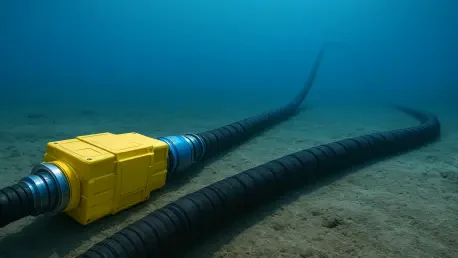

The invention of the transistor in 1947 initiated a technological trajectory that eventually enabled silicon density to increase nearly ten million-fold over six decades. This relentless pursuit of miniaturization and efficiency, often viewed through the lens of Moore’s Law, has fundamentally reshaped the landscape of global telecommunications. Much like biological organisms that adapt to increasingly harsh environments to ensure survival, optical networking hardware is currently undergoing a significant evolutionary shift. The latest development in this cycle is the migration of coherent pluggable optics from terrestrial data centers into the demanding and specialized realm of subsea networks. This transition is not merely a change in form factor but a strategic pivot that leverages decades of silicon innovation to meet the explosive global demand for data. As network operators face the limits of physical space and power at the edge of the ocean, these compact modules provide a viable path forward for the next generation of underwater infrastructure.
The Technological Foundation of Optical Evolution
The transition from traditional land-based hardware to subsea-capable systems was made possible by the rapid development of high-performance Digital Signal Processors. In the early iterations of fiber-optic communication, data was transmitted using simple on-off-keyed methods, which were functional but limited in their ability to scale to higher speeds over vast distances. As global bandwidth requirements surged, the industry turned to coherent optics, which utilize complex modulation and sophisticated algorithms to compensate for signal distortions. This shift allowed for a massive leap in capacity, moving from 10Gb/s to 400G and now reaching 1.6Tb/s in modern laboratory settings. Initially, the processors required for these tasks were large and energy-intensive, confined to fixed linecards within bulky chassis. However, the continuous refinement of silicon manufacturing has finally allowed these powerful capabilities to be integrated into the small, standardized form factors that are now revolutionizing network design.
Silicon Advancements: The Rise of Coherent DSPs
The miniaturization of coherent technology is directly correlated with the industry’s move toward advanced CMOS manufacturing nodes. As the industry transitioned from 130nm to 7nm, and now to the cutting-edge 3nm processes used in 2026, the power consumption per bit of data transmitted has plummeted. This efficiency is critical for pluggable optics, where thermal management is a primary design constraint due to the compact nature of the modules. By packing more transistors into a smaller area, engineers have successfully integrated high-performance Digital Signal Processors and optical components into packages that fit within the palm of a hand. These 3nm-based processors are now capable of executing the intense mathematical computations required for subsea transmission, such as chromatic dispersion compensation and non-linear effect mitigation, while operating within the strict power envelopes required by modern routers and compact transponders.
Standardized Performance: Bridging the Reach from Land to Sea
The adoption of coherent pluggables was further accelerated by the establishment of robust industry standards like 400ZR and 800ZR+, which ensured interoperability across different vendors and platforms. These standards provided a common framework for cloud providers and telecommunications carriers to deploy high-speed connections across metro and regional distances. Building on this terrestrial success, the latest 800G modules utilize advanced features such as Probabilistic Constellation Shaping and extremely high baud rates to push the boundaries of optical reach. These technological refinements have effectively closed the performance gap that previously existed between compact pluggable modules and performance-optimized embedded optics. Consequently, hardware that was once reserved for short-range data center interconnects now possesses the signal integrity and spectral efficiency necessary to cross oceanic spans, marking a turning point for global subsea cable architectures.
Strategic Drivers for Subsea Integration
Subsea network operators are facing unprecedented challenges as they attempt to scale capacity while managing rigid physical constraints at Cable Landing Stations. While the implementation of Spatial Division Multiplexing has allowed new cables to carry staggering amounts of data, the equipment required to light these fibers often consumes excessive power and floor space. Cable Landing Stations are frequently located in remote or space-constrained areas where expanding the physical footprint is either impossible or prohibitively expensive. Coherent pluggable optics offer a direct solution to this bottleneck by providing significantly higher port density than traditional transponders. By integrating the optical interface directly into high-density routing platforms, operators can maximize the throughput of their existing facilities without the need for additional bulky hardware, thereby extending the operational life of critical landing infrastructure.
Operational Efficiency: Solving Density and Power Constraints
The shift toward pluggable optics facilitates a broader strategy of network convergence that simplifies the entire operational lifecycle. Historically, subsea networks required specialized, proprietary hardware that was distinct from the equipment used in terrestrial backhaul segments. This bifurcation created complex supply chains, required specialized technician training, and led to redundant spare parts inventories. By adopting standardized 800G pluggables, operators can now use the same high-performance optics across their entire global network, from the data center to the deep sea. This uniformity not only reduces capital expenditures through economies of scale but also streamlines network management. A unified optical layer allows for more agile responses to traffic fluctuations and simplifies the automation of network provisioning, which is essential for managing the massive data flows generated by modern artificial intelligence and cloud services.
Field Validation: Proven Performance and Future Tiering
Recent empirical data from major underwater routes has confirmed that the theoretical benefits of pluggable optics translate into real-world success. Notable trials on trans-atlantic and regional cables demonstrated that 800G-class pluggables can maintain high-capacity transmission over thousands of kilometers, navigating the complexities of underwater repeaters and significant signal dispersion. These successful deployments proved that for a large percentage of subsea routes, the performance of compact modules is more than sufficient to meet current demand. However, the industry is not moving toward a one-size-fits-all approach but rather a tiered ecosystem where hardware is matched to specific route requirements. For the most extreme trans-oceanic spans exceeding 15,000 kilometers, performance-optimized embedded optics remain the preferred choice to maximize spectral efficiency, while pluggables have become the standard for the growing festoon and regional cable markets.
The Path Forward: Strategic Recommendations for Network Growth
The successful integration of coherent pluggable optics into subsea environments demonstrated a fundamental shift in how global connectivity is achieved. To capitalize on these advancements, operators should prioritize the deployment of open, disaggregated architectures that allow for the seamless addition of new optical modules as technology continues to mature. This approach ensures that landing stations can remain flexible as 1.6T and subsequent generations of pluggables emerge, preventing hardware lock-in and allowing for rapid capacity upgrades. Furthermore, investing in advanced telemetry and automation tools will be essential to manage the increased density and complexity of these converged networks. By embracing the modularity and efficiency of pluggable optics, the industry has established a robust foundation that is capable of supporting the world’s expanding digital economy while maintaining a sustainable and cost-effective operational footprint for years to come.