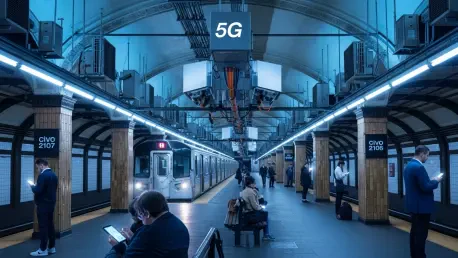

Navigating the subterranean depths of the New York City subway system no longer requires a temporary surrender of digital life as high-speed 5G signals begin to permeate the iron and concrete of the world’s most famous transit network. For millions of New Yorkers, the daily descent into the transit tunnels has long served as a mandatory digital blackout, forcing an unwanted pause on professional calls, media streaming, and essential stay-in-touch texting. While the city above ground operates at the blistering speed of 5G, the labyrinthine tunnels below have historically remained a graveyard for cellular signals, isolating commuters from the digital world for hours every week.
The recent expansion of AT&T’s network through a strategic partnership with Boldyn Networks marks a pivotal shift in this urban narrative. It transforms one of the most difficult telecommunications environments on the planet into a fully connected transit corridor. By conquering the unique geographical and architectural hurdles of the subway, the project ensures that the rhythmic transit of New York life is no longer interrupted by a lack of signal. This change reflects a broader commitment to ensuring that the city’s infrastructure keeps pace with the technological expectations of its residents.
The End of the Underground Dead Zone
The transition from a disconnected journey to a fully integrated digital experience represents a massive milestone for urban mobility. In previous years, commuters simply accepted the loss of connectivity as an inevitable tax on their time, but the current expansion proves that no environment is too challenging for modern engineering. The collaboration between AT&T and Boldyn Networks focuses on filling the gaps that have plagued the system for decades, specifically targeting the deep-bore tunnels where signals traditionally fail to penetrate.
This effort effectively erases the boundary between the sidewalk and the station platform. For the average passenger, this means the ability to join a video conference while crossing between boroughs or to stream high-definition content without the frustration of constant buffering. The project is not merely about convenience; it is about reclaiming the productivity and connectivity that were once lost the moment a rider passed through the turnstile.
Why Subterranean Connectivity: The New Urban Standard
Modern transit agencies no longer view high-speed wireless service as an optional perk or a luxury for the tech-savvy; it is now a fundamental requirement for the rider experience and overall urban efficiency. As the city adapts to evolving commuting patterns, the ability to maintain uninterrupted connectivity has become a critical factor in the relevance and reliability of public transportation. To compete with other modes of travel, the subway must offer an environment where the digital lives of passengers are respected and supported.
The challenge in New York City is uniquely daunting, involving aging infrastructure, narrow Victorian-era tunnels, and a 24/7 operational schedule that leaves almost no window for hardware installation. Unlike systems in other global cities that close for several hours at night, the New York subway requires engineers to work in short, highly coordinated bursts to avoid disrupting the flow of millions of people. This constant movement necessitates a sophisticated approach to deployment that respects the historical significance of the tunnels while upgrading them for the modern era.
The Neutral Host Model: Strategic Network Deployment
This expansion relies on a collaborative neutral host infrastructure model, where Boldyn Networks builds and maintains a shared 5G distributed antenna system that multiple carriers can utilize. This approach is essential in the cramped, high-stakes environment of the subway, as it prevents the chaotic redundancy of every provider attempting to install separate, competing hardware in limited tunnel space. By sharing the underlying architecture, the city can achieve maximum coverage with minimal physical disruption to the historic transit environment.
AT&T has leveraged this shared architecture to become the first carrier to go fully “on-air” in new segments of the 4 and 5 lines, as well as the Crosstown G line. These milestones build upon existing high-traffic coverage areas, such as the 42nd Street Shuttle and the L line’s Canarsie Tube, moving the system closer to total “end-to-end” connectivity. The successful activation of these lines serves as a proof of concept for the neutral host model, demonstrating that carrier cooperation can lead to faster and more comprehensive service for the public.
Prioritizing Public Safety: FirstNet Integration
Beyond the daily convenience of scrolling through social media, the partnership addresses a vital security need by providing reliable communication for emergency personnel. By integrating FirstNet, the only nationwide high-speed broadband communications platform dedicated to first responders, the subway’s 5G network provides priority and preemption. This ensures that even during peak congestion or a city-wide emergency, police, fire, and medical teams have an “always-on” connection deep underground.
This integration solves a decades-old communication hurdle for the NYPD and FDNY, who have historically struggled with radio dead spots in the deepest parts of the system. In a crisis, the ability for emergency teams to share data, video, and floor plans in real-time can be the difference between a controlled situation and a catastrophe. The dual-use nature of the network—serving both the general public and the heroes who keep them safe—underlines the strategic importance of the investment beyond mere consumer utility.
A Blueprint: Modernizing Global Transit Infrastructure
The New York City subway project served as a practical framework for how private investment and public utility converged to modernize aging metropolitan hubs. AT&T’s $250 billion national network commitment provided the financial backbone for these complex installations, proving that long-term capital was essential for bridging coverage gaps in difficult terrains. This model—combining infrastructure expertise with carrier investment—offered a scalable strategy for other global cities looking to eliminate digital dead zones while enhancing the safety and satisfaction of their commuting populations.
As transit authorities looked toward the future, the success of the NYC expansion highlighted the necessity of proactive technological integration. The project moved the conversation away from whether subterranean connectivity was possible and toward how quickly it could be implemented across all transit lines. By synthesizing the needs of the consumer with the requirements of public safety, the partnership created a more resilient and connected urban environment. This legacy of innovation ensured that the underground world was no longer an island of isolation, but a fully integrated part of the global digital landscape.