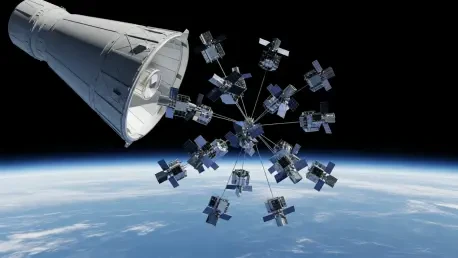

The successful ignition of the Ariane 6 rocket at the Guiana Space Center represents a massive leap forward for European aerospace engineering and Amazon’s ambitious Project Kuiper broadband initiative. This specific mission, designated LE-03, serves as a high-stakes demonstration of the upgraded launch vehicle’s capacity to handle significantly denser payloads than its predecessors. By deploying a record-setting 36 satellites in a single flight, the mission establishes a new benchmark for the Ariane platform, marking the heaviest manifest ever delivered into a precise low Earth orbit. This milestone is particularly impressive given that Arianespace has managed to launch over 100 satellites for this constellation in less than five months, showcasing an unprecedented operational tempo. The sheer scale of this deployment effort underscores a deepening commitment to establishing a global internet infrastructure that can compete with existing providers while reinforcing the strategic autonomy of the European space sector through reliable access to orbit.
Enhancing Lift Capacity: The Arrival of P160C Technology
At the heart of this performance upgrade lies the introduction of the P160C solid rocket boosters, which represent a significant evolution over the P120C models used during the initial testing phases of the Ariane 6 rocket. These newer boosters are characterized by a lengthened casing that accommodates a larger propellant mass, effectively extending the burn duration and providing the necessary thrust to carry heavier loads. By optimizing the internal combustion geometry and utilizing advanced carbon-composite materials for the motor casing, engineers have managed to add more than two metric tons of additional payload capacity to the vehicle. This technical advancement is not merely an incremental change; it is a fundamental shift that allows the Ariane 6 to transition from a developmental asset into a high-capacity workhorse capable of meeting the rigorous demands of modern satellite mega-constellations. The increased thrust profile ensures that the rocket can achieve the necessary orbital velocity with a full manifest of satellites.
The transition to the P160C boosters has fundamentally altered the mission logistics for Amazon, allowing for a 12.5% increase in the number of satellites transported during each individual launch cycle. Moving from a standard load of 32 satellites to a more robust configuration of 36 units allows the project to maximize the utility of every flight, thereby reducing the total number of launches required to complete the initial constellation shell. This efficiency is critical for maintaining the rapid deployment schedule required to meet regulatory deadlines and begin commercial operations across various global markets. Furthermore, the ability to pack more hardware into the fairing reduces the carbon footprint per satellite delivered, aligning the program with broader sustainability goals within the aerospace industry. This shift toward higher-density payloads demonstrates how propulsion technology directly influences the economic viability of large-scale space projects by lowering the cost per unit and accelerating the timeline.
Strategic Impact: Future Directions for Global Infrastructure
This collaboration extends far beyond technical achievements, serving as a vital economic catalyst for the European Union by securing a long-term roadmap for the regional aerospace industrial base. With a binding commitment for 18 launches, Amazon has positioned itself as the largest commercial customer for the Ariane 6 platform, providing the financial stability necessary to sustain high-tech manufacturing across multiple member states. The production of booster segments, core stages, and specialized avionics supports thousands of highly skilled jobs, ranging from propulsion engineers in France to software developers in Germany and composite technicians in Italy. This steady stream of orders ensures that critical infrastructure remains active and that the workforce retains the expertise required for future space exploration missions. The partnership also generates substantial tax revenue for national treasuries, reinforcing the idea that space investments yield tangible economic benefits for the public.
The successful integration of the LE-03 mission into the broader network strategy provided a clear path toward bridging the digital divide for underserved populations in remote regions. By targeting residential, government, and mobility sectors, the constellation offered a transformative solution for areas where traditional fiber-optic infrastructure remained physically or economically unfeasible. Stakeholders recognized that the technical success of the P160C boosters established a new standard for heavy-lift efficiency that other providers sought to emulate in subsequent cycles. Moving forward, the focus shifted toward optimizing the ground station infrastructure and user terminals to handle the massive influx of data promised by the growing satellite fleet. Industry leaders advised that the next logical step involved deep-sea and aviation sector integration to maximize the utility of the low-latency signals. These efforts ensured that high-speed internet became a ubiquitous utility, supporting vital services for millions.