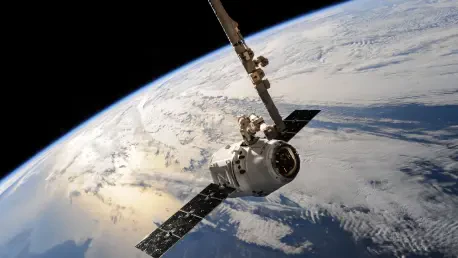

Non-communicative or ‘dead’ satellites pose a unique risk to space sustainability because they cannot perform autonomous maneuvers during their multi-week descent toward the atmosphere. As of mid-2026, this concern has taken center stage as the Starlink network officially surpassed the historic milestone of 11,000 satellites in orbit. This achievement cements the position of SpaceX as the operator of the largest satellite fleet in human history, marking a radical shift in the global telecommunications paradigm. The successful execution of the Starlink Group 17-50 mission from Vandenberg Space Force Base, which carried 24 new units into the sky, represented the 100th successful launch for the company within the current year. This high-frequency cadence, driven by the rapid reuse of Falcon 9 boosters, has allowed the constellation to grow at a rate previously thought impossible by industry experts. Today, a single private entity manages approximately two-thirds of all active satellites currently circling the planet.
Quantitative Foundations and Orbital Statistics
Synthesizing Real-Time Tracking Data
Determining the exact number of Starlink satellites requires a complex analysis of various orbital catalogs because the constellation remains in a constant state of flux. With new batches launching almost weekly and older units continuously reentering the atmosphere, any reported figure serves only as a temporary snapshot of a highly fluid environment. Analysts and orbital mechanists rely heavily on independent trackers to synthesize raw data from the United States Space Command and other international monitoring agencies. These experts provide a real-time count that meticulously accounts for these frequent changes, distinguishing between satellites that are healthy and those that have failed. This rigorous synthesis is essential because official registries often lag behind the actual orbital reality, making independent verification the gold standard for understanding the true scale of the network as it expands during the current 2026 to 2028 period.
The dominance of the Starlink fleet is best understood through the benchmark of global market share, where SpaceX now holds a commanding lead over all other spacefaring nations combined. Recent space indices indicate that while there are over 15,000 active satellites currently in orbit, the Starlink constellation accounts for nearly 66% of that total population. This represents a massive leap from the landscape just a few years ago when the total number of active satellites from every country and company combined was significantly lower. This explosive growth reflects a deliberate refreshed network strategy where SpaceX is not just adding numbers but constantly upgrading the hardware to expand data capacity and replace legacy models. Even as competitors like Amazon’s Project Kuiper begin their initial large-scale deployments, the sheer scale and head start of the Starlink project ensure that SpaceX remains the primary stakeholder in the orbital population for the foreseeable future.
Managing the Constellation’s Fluid Growth
A vital distinction must be made between the satellites that are physically present in orbit and those that are considered fully operational and ready to serve customers. When a new batch is deployed, the satellites initially sit at a very low injection altitude to undergo rigorous health checks before they begin their ascent. Using onboard propulsion systems, the spacecraft slowly climb to their assigned operational planes and altitudes. This complex choreography can take several weeks to complete, meaning that a significant portion of the 11,000-satellite fleet is always in a drifting or orbit-raising phase. These units are not yet part of the active internet-serving grid, though they are counted in the total orbital population. Understanding this distinction is crucial for telecommunications analysts who are attempting to model the actual throughput and global latency capabilities of the massive network as it currently functions.
The total count of the constellation also includes satellites that may be in various stages of retirement or malfunctioning after years of service in the harsh environment of Low Earth Orbit. Independent tracking remains the primary method for distinguishing between these various states, whether a unit is operational, raising its orbit, or actively lowering its altitude for disposal. By monitoring the telemetry and orbital decay patterns, observers can gain a true picture of the functional internet service capacity of the network at any given moment. This level of transparency is necessary because a satellite that has stopped communicating still occupies a valuable orbital slot and must be tracked as a potential hazard. As the network matures, the proportion of satellites in the deorbiting phase is expected to grow, requiring more sophisticated automated systems to manage the transition from active service to atmospheric reentry.
Safety and Environmental Stewardship in Orbit
Navigating High-Density Traffic Corridors
The unprecedented density of the Starlink fleet brings significant responsibilities regarding orbital safety and the management of high-speed traffic in congested regions. With thousands of objects moving at velocities exceeding 17,000 miles per hour, the workload for screening potential collisions has increased exponentially for both SpaceX and international space agencies. To mitigate these risks, SpaceX has implemented a sophisticated autonomous collision avoidance system that allows satellites to perform maneuvers without direct human intervention. This system processes data from space surveillance networks to identify close approaches and calculates the most efficient way to dodge debris or other active spacecraft. Currently, the fleet coordinates thousands of these automated avoidance maneuvers daily, a volume of activity that would be impossible to manage manually. This high level of automation is the only way to ensure that the space lanes remain safe for other operators.
Beyond the immediate risk of physical collisions, the scale of the Starlink constellation has created a new set of challenges for international cooperation and orbital regulation. Because SpaceX operates more satellites than any government, its internal policies regarding maneuvering protocols and satellite disposal often carry more weight than the formal regulations of individual nations. This shift has forced a rethink of how space traffic is managed, with the private sector now leading the development of safety standards. For instance, the commitment to deorbiting satellites within a few years of their mission end has set a new industry benchmark that exceeds the traditional 25-year guideline. However, the sheer number of Starlink units means that even a low failure rate could result in dozens of dead satellites that cannot be moved. This reality has spurred new discussions about active debris removal technologies and the necessity for all space actors to provide telemetry.
Mitigating Impacts on Scientific Research
The scale of the constellation poses unique and ongoing challenges for the global scientific community, particularly in the fields of optical and radio astronomy. Astronomers frequently contend with satellite streaks that can ruin sensitive, long-exposure telescope observations, potentially masking the discovery of distant galaxies or near-Earth asteroids. While SpaceX has worked to reduce the reflectivity of its satellites by using specialized coatings and dielectric mirrors, the sheer volume of spacecraft makes it difficult to maintain a truly dark sky for deep-space research. These visual interferences are not merely an aesthetic concern but a fundamental limitation on the capabilities of ground-based observatories. As the fleet continues to grow toward the 2028 targets, the cumulative brightness of the constellation remains a subject of intense negotiation between the aerospace industry and scientific organizations, highlighting the tension between global connectivity and our ability to study the universe.
In addition to visual interference, radio frequency interference has become a primary concern for radio astronomers who listen for incredibly faint signals from the early universe. The downlink transmissions from thousands of satellites can bleed into adjacent protected frequency bands, creating noise that drowns out natural cosmic emissions. SpaceX has engaged in technical collaborations with major observatories to implement radio quiet zones and timing-based exclusions to minimize this impact, yet the global nature of the service makes total isolation difficult. The impact of these transmissions is particularly felt by large-scale arrays that require pristine electromagnetic environments to function at peak sensitivity. As Low Earth Orbit becomes more crowded, the scientific community is advocating for more stringent international standards on out-of-band emissions. This ongoing dialogue is essential for ensuring that the benefits of high-speed global internet do not come at the expense of our ability to perform research.
Integrating Sustainability into Future Infrastructure
The expansion of the Starlink network through mid-2026 proved that massive satellite constellations were not only technically feasible but also economically transformative for global communication. Stakeholders across the aerospace sector recognized that the milestone of 11,000 satellites necessitated a new era of orbital accountability and standardized traffic management. Industry leaders established more aggressive deorbiting protocols, which moved away from outdated decades-long timelines toward immediate atmospheric reentry at the end of a spacecraft’s functional life. Scientific bodies and private operators successfully negotiated technical mitigations that preserved a significant portion of astronomical observational capacity while maintaining high-speed connectivity for underserved regions. This period demonstrated that the responsible management of the orbital commons required constant innovation in autonomous avoidance and reflective shielding. These efforts ensured that the growth of satellite megaconstellations remained compatible with long-term space sustainability and scientific discovery.