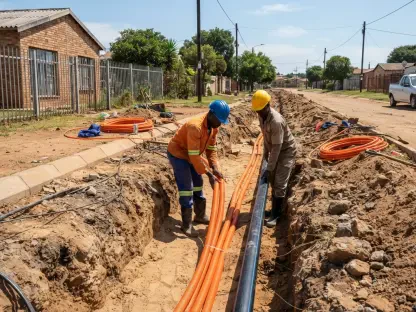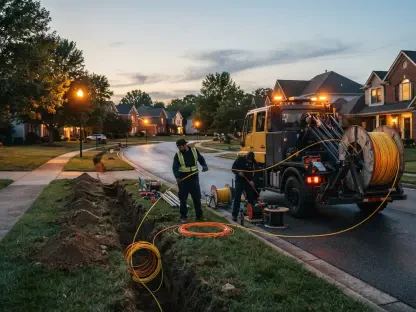

Across the quiet residential streets of Lafayette and the bustling commercial hubs of Broomfield, the pervasive hum of horizontal directional drilling machines has become the definitive soundtrack of a regional infrastructure overhaul. This widespread physical activity signals a profound shift in how the region approaches digital connectivity, moving away from the aging limitations of the late twentieth century toward a high-capacity future. Residents have likely noticed the colorful utility markings and the temporary disruption of sidewalks, which are the necessary precursors to a more robust data ecosystem. This transformation is not merely a technical upgrade but a foundational change in the community’s social and economic fabric. As private providers and municipal entities engage in a high-stakes race to lay thousands of miles of glass strands, the transition from legacy copper systems to advanced fiber-optic networks is effectively redefining what it means to be connected in a modern, data-driven society.
The Shift Toward Advanced Network Standards
Replacing Legacy Systems: The Transition to Optical Performance
The transition from copper-based Digital Subscriber Line technology and coaxial cable to fiber-optic infrastructure represents one of the most significant engineering milestones in the history of regional telecommunications. Historically, the county relied on networks that were originally designed for voice calls or analog television signals, which utilized electrical impulses over metal wires. These systems are inherently limited by physical resistance and signal degradation over long distances, making them increasingly unsuitable for the massive data loads required today. In contrast, fiber-optic technology utilizes pulses of light transmitted through microscopic strands of glass or plastic. This method allows for nearly limitless bandwidth and significantly lower latency, ensuring that data travels at the speed of light from the main data centers directly to individual homes. By eliminating the bottlenecks associated with old copper wiring, the region is effectively future-proofing its ability to support emerging technologies.
Furthermore, the physical durability and efficiency of fiber networks provide a long-term solution that far outlasts the maintenance cycles of traditional metal cables. While copper is susceptible to electromagnetic interference and environmental corrosion, glass fiber remains largely unaffected by these external factors, leading to a more reliable connection during extreme weather events. The current deployment in Boulder County is focused on creating a “deep fiber” architecture, where the optical lines are brought as close to the end-user as possible, often referred to as fiber-to-the-premises. This strategy ensures that the advertised speeds are actually delivered to the consumer, rather than being shared across a large neighborhood node. As these networks become the new standard, the regional reliance on legacy hardware is rapidly fading, paving the way for a more resilient and high-performing digital environment that can accommodate the next generation of innovations without requiring further invasive construction.
Symmetrical Connectivity: Meeting the Modern Data Demand
One of the most critical advantages of the current fiber rollout is the introduction of symmetrical internet speeds, which provide identical rates for both downloading and uploading data. In the previous era of internet usage, networks were heavily weighted toward downloading, reflecting a consumption-based model where users primarily received information from the web. However, the contemporary digital landscape has shifted toward a more interactive and collaborative framework. With the permanence of remote professional environments, residents now require significant upload capacity for high-definition video conferencing, real-time cloud synchronization, and the transfer of massive data files. Fiber-optic architecture is uniquely capable of providing this balance, ensuring that a professional in Louisville can upload a complex architectural rendering just as quickly as a student in Superior can download a lecture video. This symmetry is the key differentiator that makes fiber the preferred choice for a modern workforce.
Beyond professional requirements, the proliferation of smart home ecosystems and high-resolution entertainment has drastically increased the number of connected devices per household. From security cameras that stream live 4K video to cloud-based gaming platforms that demand instantaneous response times, the average home now functions as a micro-data center. Traditional cable networks often struggle to maintain performance when multiple devices are simultaneously requesting high-bandwidth streams, leading to buffering and localized outages. The fiber-optic revolution addresses this by providing a “pipe” that is large enough to handle peak demand without any perceptible loss in quality. This shift is essential for maintaining the quality of life in Boulder County, as residents increasingly depend on their home networks for education, health care via telemedicine, and social interaction. The move to fiber is therefore not just about speed, but about the capacity to support an increasingly complex and interconnected lifestyle.
Competition and Private Sector Strategies
Diverse Business Models: Private Competition Drives Expansion
The landscape of internet service in Boulder County is being shaped by a diverse range of corporate strategies, leading to a highly competitive environment that benefits the consumer through increased choice and innovation. Comcast, the long-standing incumbent, has responded to the fiber challenge by implementing a hybrid approach that integrates fiber deeper into its existing coaxial network. By investing over $1.2 billion in Colorado-based infrastructure upgrades from 2026 to 2028, the company aims to provide multi-gigabit speeds while leveraging its massive existing footprint. This “fiber-rich” strategy allows for rapid speed increases without the need for a total rebuild of every customer connection, providing a middle ground that maintains their market dominance. This approach demonstrates how traditional providers are being forced to evolve their business models in direct response to the threat posed by pure-fiber competitors who are entering the market with newer technology.
In contrast to the incumbent’s model, T-Mobile has utilized a partnership-driven strategy to establish a significant presence in the region. By collaborating with infrastructure specialists such as Intrepid Fiber and Metronet, T-Mobile has been able to deploy nearly 200 miles of new fiber lines across Louisville, Lafayette, and Superior in a remarkably short timeframe. In this arrangement, the infrastructure partners handle the complex task of physical construction and line maintenance, while T-Mobile manages the customer-facing aspects and service delivery. This model allows for a rapid “overbuild” of existing service areas, bringing new competition to neighborhoods that previously had only one or two options. The entry of such a large wireless carrier into the fixed-line fiber market illustrates the blurring lines between telecommunications sectors, as companies seek to offer a unified suite of connectivity services to their subscribers, regardless of whether the data is delivered over the air or through the ground.
Market Specialization: Targeted Growth and Acquisitions
While large national carriers dominate the headlines, the regional fiber revolution is also being driven by specialized providers and strategic asset acquisitions. AT&T has significantly ramped up its efforts in Colorado by acquiring the fiber assets previously held by Lumen, including the Quantum Fiber and CenturyLink brands. This move has allowed AT&T to double its installation rate across the state, focusing on areas where existing infrastructure can be quickly modernized to meet new standards. By purchasing established networks rather than starting from scratch, AT&T has managed to bypass many of the initial regulatory and construction hurdles, allowing them to compete more aggressively with cable providers in established suburban corridors. This consolidation of assets is a clear indicator that the industry is moving toward a few major players who possess the capital necessary to maintain and expand these high-cost optical networks over the long term.
Simultaneously, smaller or more localized companies like ALLO and Google Fiber are carving out specific territories by focusing on superior customer service and hyper-local deployment. ALLO has become a prominent fixture in Erie and has entered into a unique partnership with the city of Boulder, where it utilizes city-owned conduit to deliver services. This strategy of focusing on specific municipalities allows these companies to build deep roots within the community and tailor their offerings to local needs. Google Fiber has similarly targeted Broomfield, bringing its high-profile brand and gigabit-plus speeds to an area hungry for alternatives. These specialized providers often act as the catalyst for broader market changes, as their presence forces larger incumbents to lower prices and improve their own service tiers. The result is a vibrant, multi-layered market where consumers can choose between national giants, nimble specialists, or hybrid public-private partnerships.
The Geography of Access and Public Ownership
Navigating Inequality: The Challenge of Uneven Coverage
Despite the significant investments being made across the region, the deployment of fiber-optic technology remains a complex patchwork that has created pockets of digital inequality. Because private companies typically prioritize neighborhoods with the highest population density or the lowest construction costs, the availability of high-speed service can vary dramatically from one block to the next. In many parts of Lafayette and Superior, it is common to find one street with access to multiple gigabit providers while a neighboring street remains dependent on aging DSL lines with limited capacity. This geographic disparity is often difficult for local officials to track accurately, as private providers are not always required to share their precise coverage maps with municipal governments. This lack of transparency makes it challenging for city planners to identify underserved areas and advocate for universal access for all residents.
The issue of “digital redlining” or selective deployment also has significant implications for property values and economic opportunities within the county. Homes with access to modern fiber networks are increasingly viewed as more desirable by prospective buyers, particularly those who work in the tech-intensive industries prevalent in the Front Range. Furthermore, small businesses located in areas with poor connectivity find themselves at a disadvantage compared to competitors in fiber-rich zones. Municipal leaders are increasingly concerned that if the market is left entirely to private competition, lower-income or more remote neighborhoods may be left behind in the digital race. Addressing this fragmentation requires a coordinated effort between local governments and private entities to ensure that infrastructure expansion is distributed more equitably across the entire regional landscape, rather than just in the most profitable suburban developments.
Municipal Alternatives: Public Ownership and Regional Models
In response to the limitations of the private market, several communities in and around Boulder County have pioneered the concept of municipal broadband, treating internet access as a vital public utility. Longmont stands as the most prominent example of this model with its “NextLight” network, which was launched over a decade ago and continues to be a national leader in speed and reliability. By owning and operating its own fiber network, the city has been able to keep revenue within the local economy while providing some of the fastest internet speeds in the country. Similarly, Loveland recently completed its “Pulse” network, a massive $110 million project that provides city-wide fiber access. These public models demonstrate that when a city takes direct control of its infrastructure, it can prioritize universal coverage and community-focused service over the quarterly profit motives of a private corporation.
Other municipalities have adopted a more conservative or hybrid approach to avoid the significant capital risks associated with building a city-owned utility. Towns like Erie and Superior have opted to facilitate private competition by streamlining the permitting process and encouraging multiple providers to enter the market. Boulder, meanwhile, has pursued a middle-ground strategy by constructing its own dark fiber backbone—a series of underground conduits and cables—which it then leases to private operators like ALLO. This allows the city to retain ownership of the physical assets while outsourcing the operational complexities of service delivery and customer support. These diverse approaches reflect a broader debate over whether the internet should be managed as a private commodity or a public good. As the fiber revolution continues to unfold, the success of these different models will likely influence how other cities across the United States structure their own digital infrastructure.
Strategic Recommendations for Future Connectivity
The rapid expansion of fiber-optic infrastructure across Boulder County reached a critical mass that transformed the regional economic landscape into one of the most connected areas in the country. By moving away from legacy copper systems, local communities successfully built a foundation that supported the massive data requirements of an increasingly digital workforce. This transition was characterized by a healthy mix of private competition and innovative municipal projects, which together pushed the boundaries of what was possible for residential and commercial connectivity. While the early stages of this revolution were marked by construction delays and uneven coverage, the eventual maturation of these networks proved to be a vital asset for regional growth. The lessons learned during this period of intense infrastructure development provided a roadmap for other municipalities looking to bridge the digital divide through strategic partnerships and public investment.
Looking ahead, the focus for the region should shift from initial deployment to ensuring long-term affordability and technological adaptability. Local governments must continue to advocate for transparency in coverage data and support programs that provide low-cost fiber access to underserved populations to prevent the entrenchment of a digital underclass. Additionally, as the next generation of wireless technology and cloud computing emerges, the existing fiber backbone will serve as the essential nervous system for these innovations. Maintaining this infrastructure will require ongoing collaboration between the public and private sectors to ensure that Boulder County remains a leader in the global digital economy. The decisive actions taken during this era of modernization successfully positioned the region as a premier hub for innovation, proving that a robust and equitable fiber network is the most important utility of the modern age.