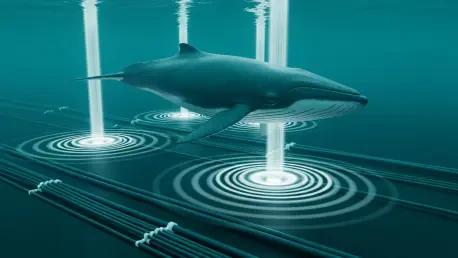

The depths of the world’s oceans have long remained a sanctuary of silence, posing a significant challenge for researchers attempting to track the migration patterns and behaviors of the planet’s largest mammals. Traditionally, marine biologists have relied heavily on hydrophones to capture the haunting songs and clicking sounds emitted by whales, but this methodology fails the moment an animal stops vocalizing. This inherent limitation creates vast data gaps, as many species remain silent for extended periods during deep dives or while traveling through high-risk areas. A groundbreaking study from the Norwegian University of Science and Technology has introduced a transformative solution by utilizing the existing global network of undersea fiber-optic cables. Instead of listening for sound, this new technique detects the physical displacement of water caused by a whale’s movement, effectively turning thousands of miles of telecommunications infrastructure into a passive observatory. This shift marks a pivotal moment in marine science.
Repurposing Global Infrastructure for Marine Discovery
The Mechanics: Understanding Distributed Acoustic Sensing
The primary engine behind this technological leap is Distributed Acoustic Sensing, a method that transforms standard telecommunications fiber into an array of thousands of individual sensors. When a pulse of laser light is sent through the glass core of a cable, most of it travels to its destination, but a tiny fraction is reflected back toward the source due to microscopic imperfections in the glass. This phenomenon, known as Rayleigh backscatter, is extraordinarily sensitive to any physical disturbance that causes the fiber to stretch or compress even by a few nanometers. In the context of the deep ocean, the massive weight and kinetic energy of a swimming whale create low-frequency pressure waves that slightly deform the cable resting on the seafloor. By monitoring changes in the phase of reflected light in real-time, researchers can pinpoint the exact location and magnitude of these disturbances, essentially giving them eyes on the bottom of the sea across vast distances.
The sensitivity of these subsea cables is such that they can detect vibrations from thousands of miles away, but the challenge has always been separating biological signals from the ambient chaos of the ocean. The seafloor is a surprisingly noisy environment, filled with the constant thrum of tectonic movements, the roar of distant storms, and the persistent low-frequency hum of commercial shipping traffic. To overcome this, the engineering team at the Norwegian University of Science and Technology optimized the interrogation units that sit at the ends of the cables. These units utilize advanced signal processing to filter out high-frequency noise and focus on the specific rhythmic pressure patterns associated with large moving masses. This level of precision allows for the detection of “bow waves” produced by a whale’s head as it moves through the water, which are distinct from the chaotic turbulence created by wind-driven surface waves or shifting underwater currents.
Mathematical Frameworks: From Rayleigh to Modern Algorithms
Interpreting these complex signals required revisiting classical physics, specifically a series of equations developed in 1917 by the renowned physicist Lord Rayleigh. While his original work was focused on the collapse of bubbles in fluids and the dynamics of cavitation, the mathematical framework proved to be perfectly suited for describing how pressure waves travel from a large moving body to the seafloor. By applying these century-old formulas, the researchers developed a model that predicts how the water column reacts to the transit of a massive object like a blue whale or a fin whale. This approach allows scientists to work backward from the pressure data recorded on the cable to estimate the speed, direction, and depth of the animal. It is a remarkable instance where historical scientific theory meets modern digital infrastructure, proving that fundamental physics remains the most reliable tool for decoding the complexities of the natural world.
Distinguishing the subtle signature of a whale from the massive acoustic footprint of a cargo ship is no small feat, yet the mathematical models provide a clear pathway for differentiation. While ships generate a significant amount of high-frequency engine noise and propeller cavitation, the bow wave of a whale is a much lower-frequency event that interacts with the water column in a highly specific manner. The software used by the NTNU team analyzes the spectral density of the pressure changes, looking for the telltale signs of a biological mass rather than a mechanical one. This distinction is vital for long-term monitoring, as it ensures that the data collected reflects actual migration patterns rather than just fluctuations in maritime commerce. By refining these algorithms, the researchers have established a baseline that can be scaled across different types of undersea cables, regardless of their age or the specific fiber chemistry used.
Validating the Sensing Method Through Real-World Testing
Calibration Protocols: Using Maritime Traffic for Accuracy
To verify the accuracy of their fiber-optic tracking, the research team conducted extensive field tests in the waters surrounding the Svalbard archipelago, a region known for its dense marine life and heavy shipping traffic. They utilized the Automatic Identification System data from large cruise ships and cargo vessels to provide a ground-truth reference for their underwater recordings. As these massive ships passed over the submerged cables, the team recorded the corresponding pressure signatures and compared them with the ships’ known weight, speed, and GPS coordinates. This calibration process was essential for fine-tuning the system, as it allowed the scientists to see exactly how much water displacement was required to trigger a measurable signal on the seafloor. The results confirmed that the physics of a 100,000-ton ship moving through the ocean provided a reliable proxy for understanding the physical impact of a 150-ton blue whale at various depths.
The most significant milestone occurred when the system successfully tracked a blue whale through a combination of acoustic and physical signals. Initially, the whale was identified by its low-frequency vocalizations, which the fiber-optic cable captured with exceptional clarity over long distances. However, the true breakthrough came when the whale stopped singing and began a deep dive to forage. Despite the absence of any vocal sounds, the cable continued to register the pressure disturbances caused by the animal’s massive body as it navigated the water column. By following the bow wave signatures, the researchers maintained a continuous track of the whale’s path for over an hour, even as it reached depths where traditional visual or acoustic monitoring would have failed. This test proved that the presence of a whale could be confirmed through its physical interaction with the environment, providing a new dimension of visibility for marine biologists.
Behavioral Insights: Monitoring Silent Deep Dives
Beyond mere detection, this technology offers a window into the behavioral patterns of whales during their most vulnerable moments. Many large cetaceans are known to be “silent travelers” when they are navigating through areas with high predator density or when they are conserving energy during long-distance migrations. Traditional hydrophone arrays often miss these individuals entirely, leading to underestimations of population sizes and habitat usage. The ability to monitor the physical displacement of water means that researchers can now study the diving mechanics and swimming efficiency of whales without the need for invasive tagging or expensive aerial surveys. This method provides a persistent presence in the ocean, capturing data across all weather conditions and times of day. It allows for a more holistic understanding of how these animals move through the water column and how they react to changes in their environment, such as shifting temperatures.
The non-invasive nature of fiber-optic sensing represents a major ethical and practical advantage for marine conservation efforts globally. Conventional methods of tracking whales often involve physical tagging, which requires close-quarters interaction and can cause stress or injury to the animals. In contrast, the use of existing telecommunications cables allows for completely passive observation from a distance, ensuring that the natural behavior of the whales remains undisturbed by human presence. This is particularly important for endangered species that are sensitive to noise and human activity. By utilizing infrastructure that is already in place, the scientific community can monitor vast swathes of the ocean floor without adding new equipment that might interfere with the marine ecosystem. This approach effectively repurposes the tools of human connectivity to foster a deeper connection with the natural world, providing the data needed to create effective marine areas.
Implications for Global Conservation and Science
Ecological Impact: Enhancing Habitat Protection and Policy
As the global climate continues to shift, understanding the migration routes of whales is becoming increasingly urgent for international conservation policy and maritime safety. Fiber-optic tracking provides the high-resolution data required to identify critical feeding grounds and transit corridors that may be shifting due to changing ocean temperatures. This information is vital for the development of dynamic ocean management strategies, where shipping lanes can be temporarily rerouted or speed limits enforced based on the real-time presence of whales in a specific area. By integrating this sensing technology into global maritime safety systems, it becomes possible to significantly reduce the risk of ship strikes, which remain a leading cause of death for several whale species. The ability to track silent whales ensures that these protective measures are comprehensive and based on the actual movements of the animals rather than just their vocalizations.
The potential applications for this undersea sensing network extend far beyond the realm of marine biology and into the sphere of planetary security and geological monitoring. Because the fiber-optic cables are sensitive to a wide range of vibrations, they can simultaneously serve as a global seismic observatory, providing early warnings for earthquakes and tsunamis in remote oceanic regions. This dual-purpose infrastructure could revolutionize how we monitor the health of the seafloor, including the integrity of critical undersea pipelines and power cables. As researchers continue to refine the algorithms used to process DAS data, the ocean floor is being transformed into a high-definition sensory skin for the planet. This integrated approach allows for the simultaneous tracking of biological, geological, and anthropogenic activity, providing a holistic view of the oceanic environment that was previously unattainable through isolated sensing methods.
Strategic Development: Scaling the Undersea Sensing Network
To fully realize the potential of this technology, a coordinated effort between telecommunications companies, governmental bodies, and the scientific community is necessary. Future strategies should focus on the standardization of data processing protocols to ensure that information from different cable networks can be aggregated into a single global repository. Implementing interrogation units at key landing stations could transform existing fiber into a permanent observatory without disrupting the primary function of data transmission. This approach offers a cost-effective way to expand our monitoring capabilities across the Atlantic, Pacific, and Arctic oceans, where current sensor coverage is sparse. By establishing international partnerships, researchers can gain access to thousands of kilometers of dark fiber, creating a comprehensive map of marine life and seismic activity that informs global environmental policies and protects the biodiversity of our deep oceans.
The validation of underwater fiber-optic sensing as a tool for tracking silent whales provided a definitive solution to a long-standing gap in marine research. By moving beyond traditional acoustics and embracing the physical reality of water displacement, scientists established a more resilient method for observing the ocean’s most elusive inhabitants. The successful integration of historical physics with modern digital infrastructure demonstrated that the answers to complex ecological questions often resided in the creative reuse of existing technology. This project showed that the global telecommunications network could do more than just facilitate human communication; it served as a vital bridge to the natural world. Stakeholders recognized the importance of maintaining this passive surveillance to safeguard marine ecosystems and enhance planetary resilience. Ultimately, the transition to this high-definition monitoring system changed the way the deep ocean was perceived and protected.