
In the high-speed environment of modern semiconductor manufacturing, even a microscopic deviation in component placement can result in catastrophic failure for an entire production batch. Traditional sensing technologies often struggle to navigate the cramped, chaotic interiors of contemporary assembly lines, where heat and electrical noise are constant. This is where industrial fiber optic sensors provide a definitive advantage by decoupling the sensing element from the processing electronics. This architecture allows a small, passive sensing head to operate in hazardous or extremely confined spaces while the vulnerable control circuitry remains safely tucked away in a remote cabinet. By utilizing light rather than electricity for detection at the point of interest, these systems offer a level of immunity and precision that has become indispensable for achieving the zero-defect standards required in modern industrial facilities. As production speeds continue to accelerate, the demand for such robust and flexible sensing solutions has fundamentally reshaped how engineers design automated workflows to ensure maximum uptime.
Maximizing Operational Efficiency
Spatial Flexibility: Overcoming Physical Constraints
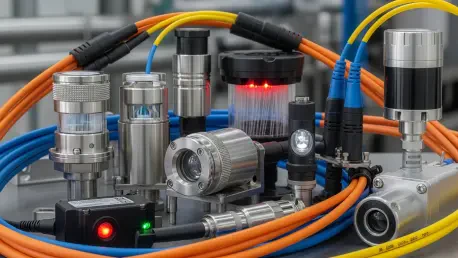
The unique physical configuration of fiber optic sensors addresses one of the most persistent challenges in mechanical design: the lack of accessible space within high-density machinery. Because the active electronic components are housed in a separate amplifier unit, the actual sensing tip can be reduced to a diameter of just a few millimeters, allowing it to be threaded through complex gear assemblies or mounted directly inside robotic grippers. This spatial flexibility means that engineers no longer have to compromise on sensor placement, ensuring that detection occurs at the optimal point for process accuracy rather than where a bulky sensor housing simply happens to fit. Furthermore, the use of flexible fiber cables allows for complex routing that can follow the natural contours of a machine’s frame, reducing the need for specialized brackets or invasive modifications. This streamlined integration not only saves space but also shortens the time required for mechanical installation and calibration during the initial setup of a production line.
Environmental Resilience: Stability in Harsh Conditions
Beyond size advantages, the resilience of fiber optic technology in harsh environments provides a layer of operational security that conventional photoelectric sensors simply cannot offer. In environments characterized by extreme heat, such as glass manufacturing or metal forging, the passive nature of the fiber optic head allows it to function reliably where onboard electronics would quickly overheat and fail. Since the control unit is typically located several meters away in a climate-controlled enclosure, the system avoids the thermal stress that leads to component degradation and unplanned downtime. Additionally, because the cables transmit light pulses rather than electrical signals, they are naturally immune to the massive electromagnetic interference generated by large industrial motors, high-frequency welders, and power transformers. This ensures a clean, noise-free signal even in the most electrically “loud” factory settings, allowing for consistent detection performance that maintains the integrity of the automated process across every shift.
Diverse Principles of Detection
Optical Mechanisms: Through-Beam and Reflective Sensing
To meet the varied demands of the manufacturing sector, fiber optic sensors employ several distinct optical principles, each suited to specific detection scenarios such as long-range monitoring or small-part identification. The through-beam configuration is often the preferred choice for applications requiring high reliability over longer distances, as it utilizes a dedicated transmitter and receiver to create a continuous light path. When an object breaks this path, the sensor registers a change in state with incredible speed, making it ideal for counting fast-moving items on a conveyor or detecting the presence of large assemblies. Alternatively, retro-reflective sensors offer a more compact installation by using a single head that both emits light and receives the reflection from a specialized target mirror. This setup simplifies wiring by requiring power at only one end of the detection zone while still providing a robust sensing range that can handle dusty environments where a clear line of sight might be periodically obscured.
Background Suppression: Precision in Complex Scenes
For more nuanced tasks where installing a separate receiver or reflector is not feasible, diffuse-reflective sensing provides a versatile solution by detecting light scattered directly from the surface of the target object itself. This method is particularly useful in pick-and-place operations where the sensor must identify the presence of a part based on its own physical properties. To further refine this capability, many modern systems incorporate background suppression technology, which uses advanced optics to ignore any light reflected from objects beyond a specific focal distance. This prevents false triggers from moving machinery parts or passing personnel that might otherwise confuse a standard sensor, ensuring that only the intended target is detected within a tightly defined sensing window. By combining these different optical principles with high-resolution amplifiers, manufacturers can tailor their detection strategies to handle everything from transparent films and highly reflective metals to tiny electronic components with sub-millimeter accuracy.
Strategies for Reliable Implementation
Material Science: Choosing Glass and Plastic Fibers
The successful deployment of a fiber optic sensing system hinges largely on the selection of the fiber material itself, with glass and plastic representing the two primary options for industrial use. Glass fibers are typically encased in stainless steel sheathing and are the go-to choice for heavy-duty applications involving intense heat or corrosive chemical exposure that would melt or degrade synthetic materials. While glass offers exceptional durability, it is less flexible than its plastic counterparts and requires careful handling to avoid internal fractures. Conversely, plastic fibers are widely adopted for general-purpose automation due to their superior flexibility and lower cost, allowing them to be cut to length in the field for a custom fit. These plastic variants are particularly effective in dynamic applications where the sensor head is mounted on a moving part, such as a high-speed linear actuator, as they can withstand millions of bending cycles without suffering from signal degradation or physical breakage over the useful life of the machine.
Maintenance Protocols: Preventing Signal Loss and Downtime
Maintaining the long-term health of a fiber optic network requires a disciplined approach to installation and preventative maintenance, particularly concerning the physical management of the cables. One of the most common causes of system failure is exceeding the minimum bend radius, which can cause the light signal to “leak” out of the fiber core or lead to permanent physical damage that blocks transmission entirely. To mitigate this risk, engineers must design cable paths that ensure smooth, gradual turns and use protective conduit in areas where the fibers might be stepped on or pinched by moving equipment. Regularly cleaning the sensing faces of the heads is also a critical step, as the accumulation of oils, dust, or coolant can scatter the light beam and lead to intermittent detection errors or a total loss of signal. By implementing a routine inspection schedule and ensuring that the selected components are properly rated for the specific thermal and chemical profile of the work cell, facilities can maximize their return on investment.
Strategic Outcomes: Ensuring Long-Term Automation Success
The integration of industrial fiber optic sensors proved to be a transformative step for facilities seeking to reconcile high-speed production with extreme precision. Organizations that successfully transitioned to these systems moved beyond the limitations of traditional sensing by prioritizing modular architectures and specialized fiber materials tailored to their specific environmental stressors. It became clear that the most effective implementations were those that treated sensor maintenance as a core component of the overall reliability strategy rather than an afterthought. Looking forward, the focus shifted toward integrating these optical paths with advanced diagnostic tools that could predict signal attenuation before it led to a complete system stoppage. To remain competitive, decision-makers focused on upskilling their maintenance teams to handle delicate optical components and invested in high-resolution amplifiers capable of processing the rapid data flows required by modern automation. These proactive measures ensured that sensing technology acted as a catalyst for efficiency.