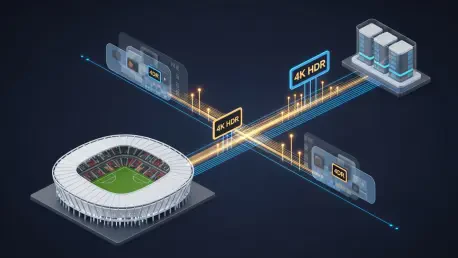

The architectural complexity of modern sports broadcasting requires an unprecedented level of synchronization between remote venues and centralized production hubs located thousands of miles away. As viewers demand higher resolutions and more immersive experiences, traditional methods of signal transmission have been pushed to their absolute limits, necessitating a complete overhaul of how live content is managed. For major international tournaments, the stakes are exceptionally high because any technical glitch or latency issue could disrupt the viewing experience for a global audience of billions. This pressure led to the development of a resilient network architecture that prioritizes both speed and reliability. By moving away from legacy hardware and embracing a software-defined approach, engineers managed to create a system that can handle the massive data throughput of 4K HDR video while providing the flexibility for dynamic live editing. The transition from physical cables to virtualized routes represents a significant shift.
Engineering the Global Backbone
Part 1: Adopting IP Standards
The migration from Serial Digital Interface (SDI) to Internet Protocol (IP) based networking stands as the cornerstone of the modern broadcast strategy utilized during high-profile events. By adopting the SMPTE ST 2110 standard, technicians were able to decouple audio, video, and metadata streams, allowing for much more efficient use of bandwidth and greater control over individual elements of the broadcast signal. This granularity meant that production teams could route specific feeds to different destinations without the need for cumbersome physical patching or massive hardware switchers. The move to IP allowed for a level of scalability that was previously impossible, enabling the network to grow or shrink based on the daily requirements of the tournament schedule. Furthermore, this transition facilitated the use of off-the-shelf IT equipment, which significantly lowered the weight and power consumption of the mobile production units stationed at various stadium locations across the host nation.
Part 2: Precision Signal Timing
This shift also required a robust timing mechanism to ensure that all signals remained perfectly aligned despite traveling through complex network paths. The Precision Time Protocol (PTP) became the heartbeat of the entire operation, providing sub-microsecond synchronization across every piece of equipment in the signal chain. Without this precise timing, the uncompressed IP video feeds would suffer from packet loss or jitter, rendering the final output unwatchable for the consumer. To manage the massive data loads, engineers implemented redundant 100-gigabit fiber optics that acted as the primary arteries for the network. These high-capacity links were critical for transporting uncompressed 4K signals from the pitch to the control rooms with minimal delay. The result was a transparent workflow where editors and directors could interact with live feeds as if they were sitting in a truck just outside the stadium, regardless of the actual distance between the camera and console.
Maximizing System Reliability
Part 3: Seamless Data Redundancy
Building a bulletproof network meant that failure was not an option, leading to the implementation of a hitless merge strategy for all critical signal paths. Under this system, two identical copies of every data packet were sent simultaneously over separate network routes, ensuring that if one path experienced an outage, the receiving hardware could seamlessly switch to the second stream without losing a single frame of video. This level of redundancy extended beyond just the network cables; it included dual power sources, mirrored server clusters, and geographically dispersed data centers. By leveraging a hybrid cloud approach, the production team could offload heavy processing tasks, such as AI-driven highlight generation and multi-language captioning, to the cloud. This allowed on-site staff to focus on the creative aspects of the broadcast while automated systems handled the repetitive technical duties. The integration of cloud resources also provided a reliable failover destination for the team.
Part 4: Cloud-Native Workflows
The successful execution of this complex broadcast architecture demonstrated that the industry had finally reached a point where software-defined networking surpassed traditional hardware in every metric. Technicians utilized automated monitoring tools to scan for anomalies in real-time, allowing them to resolve potential bottlenecks before they impacted the air. This proactive approach to network health ensured that the viewer experience remained consistent throughout the entire tournament. Moving forward, organizations looked toward even deeper integration of edge computing to further reduce latency for interactive features and real-time statistics. The lessons learned from this massive deployment underscored the importance of standardized protocols and rigorous testing in high-stakes environments. It was clear that the future of sports media rested on the ability to blend physical infrastructure with agile, cloud-native services. Professionals were encouraged to adopt similar modular designs for networks.