
Deploying a heterogeneous grid of specialized sensors allows for the detection of ammonia and methane levels that are highly corrosive to avian respiratory systems. This technological pivot marks a departure from traditional poultry management, which has long struggled to maintain consistency across high-density broiler environments. As global protein demand continues to surge, the limitations of manual oversight and threshold-based mechanical systems have become increasingly apparent. Modern agriculture now relies on a sophisticated fusion of the Internet of Things (IoT) and Artificial Intelligence (AI) to bridge the gap between industrial scale and individual animal welfare. By integrating these systems, producers can transition from a reactive posture—where problems are addressed only after they manifest—to a predictive model that maintains a state of homeostasis. This evolution is not merely an incremental improvement in equipment; it represents a fundamental reimagining of the poultry barn as a responsive, data-driven ecosystem. The shift toward Precision Poultry Farming (PPF) is essential for mitigating the physiological stress that often leads to secondary infections and reduced production metrics. Consequently, the industry is seeing a significant investment in infrastructures that prioritize real-time environmental stability over periodic manual checks.
The Sensory Infrastructure of the Intelligent Farm
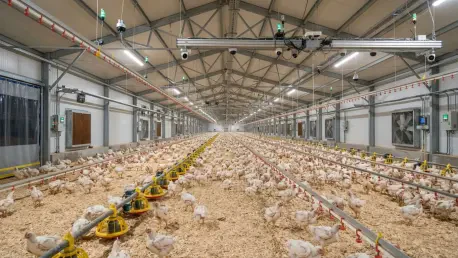
The foundational layer of an intelligent poultry facility acts much like a biological nervous system, extending digital perception into every corner of the housing unit. Rather than relying on a single, centralized thermostat that often fails to account for spatial variability, modern farms utilize high-precision DHT22 and SHT31 sensors distributed in a strategic grid. This granular approach allows for the identification of micro-climates within the barn, such as cold spots near loading bay doors or pockets of stagnant air in far corners. When sensors detect that temperature or relative humidity has strayed from the avian “thermal neutral zone,” the system does not simply react; it cross-references this data with the age and weight of the flock to determine the exact degree of intervention needed. This ensures that every bird, regardless of its location in the facility, experiences identical conditions, which is a critical factor in achieving uniform growth rates across the entire population.
Beyond physical comfort, the modern sensory array addresses the chemical composition of the atmosphere, which is often the silent killer in high-density production. Specialized gas sensors like the MQ-135 and TGS826 are now standard for tracking ammonia, a byproduct of litter decomposition that can cause severe corneal ulcers and respiratory distress. Furthermore, the integration of MH-Z19 sensors allows for the precise monitoring of carbon dioxide levels, ensuring that ventilation rates are high enough to provide oxygen without creating chilling drafts. To augment these chemical readings, producers are increasingly employing “digital eyes and ears” in the form of infrared cameras and omnidirectional microphones. These tools leverage computer vision and acoustic analysis to interpret bird behavior, such as huddling for warmth or panting from heat stress. By analyzing bio-acoustic signatures, the system can even detect the specific frequency of a respiratory cough or a distress call, providing an early warning system for disease outbreaks that would be invisible to the human eye until it was too late.
Data Transmission and Advanced Processing
A sophisticated sensor network is only as effective as the infrastructure that carries its data, making reliable communication protocols a cornerstone of modern agricultural technology. In the expansive and often radio-hostile environment of a poultry barn, where thick concrete and metallic insulation can disrupt standard Wi-Fi signals, protocols like LoRaWAN have become indispensable. Its long-range capabilities and low power consumption allow for consistent data transmission across massive operations without the need for complex wiring. Alternatively, ZigBee mesh networks are frequently utilized for high-density sensor clusters, as they allow data to “hop” from one node to another, ensuring that the system remains operational even if a single sensor fails. This robust connectivity ensures a seamless flow of information from the barn floor to the digital decision-making centers, allowing the entire facility to function as a unified, responsive organism.
Once the data reaches the processing layer, Artificial Intelligence transforms raw numbers into strategic, automated actions. Long Short-Term Memory (LSTM) networks are particularly effective in this context, as they are designed to analyze time-series data to forecast environmental trends. For instance, by processing historical barn data alongside external weather forecasts, the AI can predict a significant drop in temperature hours before it occurs, pre-emptively engaging radiant heaters to maintain a steady environment. Additionally, “fuzzy logic” inference systems are used to resolve conflicting operational goals that often stymie traditional automation. A common scenario involves the need to increase ventilation to clear toxic ammonia while simultaneously trying to conserve heat during a cold snap. The AI evaluates these competing priorities, calculating the optimal ventilation rate that refreshes the air quality without compromising the internal temperature. This level of nuanced control prevents the environmental shocks that typically lead to a spike in mortality or a decline in overall flock health.
Economic Gains and Welfare Improvements
The implementation of AI and IoT in poultry farming delivers quantifiable biological benefits that translate directly into improved economic performance. One of the most significant metrics is the Feed Conversion Ratio (FCR), which measures how efficiently a bird converts feed into body mass. In a traditional setting, birds often expend a large portion of their caloric intake on thermoregulation, trying to stay warm in drafty barns or cool in humid ones. By utilizing predictive climate control to maintain a stable environment, the AI ensures that metabolic energy is redirected toward growth and muscle development. This stabilization leads to more uniform bird sizes and improved meat quality, which are vital for meeting the rigorous standards of modern supply chains. Furthermore, the reduction in physiological stress significantly boosts the immune systems of the flock, reducing the reliance on antibiotics and lowering the overall costs associated with veterinary interventions.
From an operational standpoint, the transition to intelligent systems addresses the increasing need for resource sustainability and cost management. Traditional ventilation and heating systems often operate at a higher capacity than necessary because they lack the real-time data to fine-tune their output. Predictive AI changes this dynamic by running mechanical components only at the exact intensity required to maintain the target environment. This precision results in substantial energy savings, often reducing electricity and fuel consumption by significant margins. Moreover, by automating the most labor-intensive aspects of environmental monitoring, farm managers can shift their focus toward higher-level animal husbandry and strategic planning. This shift not only aligns poultry production with broader global sustainability goals but also makes the industry more resilient to fluctuations in energy prices and labor availability, ensuring long-term profitability for producers.
Strategic Pathways for Implementation and Resilience
While the benefits of these technologies are clear, the actual deployment within a poultry barn requires specific engineering solutions to overcome a notoriously hostile environment. The presence of fine biological dust, high humidity, and corrosive gases like ammonia can cause standard electronic components to lose calibration or fail entirely within a single season. To address this, engineers have pioneered the use of IP67-rated modular casings and non-dispersive infrared (NDIR) sensors, which are far more durable than their electrochemical counterparts. Furthermore, the industry has shifted toward “edge computing” to ensure system resilience. By placing the primary processing power directly on the farm site rather than relying solely on remote cloud servers, the environmental control systems remained fully functional even during internet outages. This local autonomy was vital for protecting life-critical systems, such as fans and waterers, which must operate without interruption to prevent mass mortality events.
The final hurdles to global adoption were historically rooted in high capital costs, yet the industry developed innovative financial models to bridge this gap. The rise of “Hardware-as-a-Service” (HaaS) allowed smaller producers to access cutting-edge AI and IoT kits through monthly subscriptions rather than massive upfront investments. Additionally, modular upgrade paths were established, enabling farmers to retrofit existing facilities with “plug-and-play” sensor kits that integrated with their legacy ventilation hardware. These strategic steps ensured that the transition to precision farming was not limited to large-scale corporations but was accessible to diverse agricultural operations worldwide. As these systems became the standard, the focus shifted toward data security and the standardization of communication protocols to ensure interoperability between different equipment manufacturers. This comprehensive approach to technology and finance solidified the role of AI as a permanent fixture in modern livestock management, creating a more ethical and efficient food system.