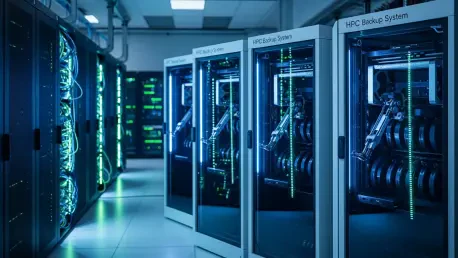

The exponential growth of data generated by modern artificial intelligence training and large-scale scientific simulations has pushed traditional backup methodologies to their absolute breaking point. Organizations operating at the cutting edge of research often find themselves managing billions of objects across heterogeneous environments where even a minor delay in protection protocols can result in catastrophic operational downtime. To address these extreme demands, Bacula Systems recently introduced BsnapDiff, a sophisticated suite of backup tools meticulously engineered to provide rapid, high-security data protection for High-Performance Computing (HPC). This technology represents a fundamental shift away from generic software layers toward deep, file-system-aware integration. By focusing on the specific architectural nuances of modern supercomputing, this solution ensures that backup processes remain invisible to the active workloads they protect. The resulting efficiency allows institutions to focus on innovation rather than infrastructure maintenance.
The Infrastructure Bottleneck: Why Traditional Scans Fail
Standard backup procedures have historically relied on a technique known as a full tree scan, which necessitates the software manually examining every single directory and file to identify changes. While this approach functioned adequately for the terabyte-scale environments of the past, it becomes a severe liability when applied to contemporary exascale storage systems containing hundreds of millions of files. In these high-pressure scenarios, the time required to complete a metadata crawl often exceeds the designated backup window, leading to a state of permanent backup lag. This phenomenon creates a dangerous gap in data protection where new information is generated faster than it can be cataloged or secured. Consequently, the reliance on manual tree walks has become an unsustainable practice for enterprises that prioritize data integrity and uptime in an era of rapid digital transformation and massive data accumulation. This vulnerability is especially critical in fields where data loss can derail multi-year research projects.
Beyond the mere issue of time, exhaustive manual scans impose a heavy metadata tax on the primary storage hardware, often degrading the performance of active applications. When a backup agent traverses a complex file system, it consumes significant input/output resources that would otherwise be dedicated to critical scientific research or real-time AI model training. This resource contention can lead to sluggish performance for end-users, effectively forcing administrators to choose between data security and system efficiency. Furthermore, the sheer volume of metadata queries generated during a traditional scan can overwhelm storage controllers, potentially leading to instability or increased wear on physical media. By moving away from this antiquated model, modern data centers can reclaim their hardware performance while simultaneously ensuring that their most valuable digital assets are protected through more intelligent and less intrusive monitoring mechanisms. Such advancements allow for a more harmonious coexistence between security and throughput.
Leveraging Native Intelligence: Seamless Data Protection
The introduction of BsnapDiff marks a significant milestone by leveraging the built-in intelligence of advanced file systems such as ZFS and IBM Storage Scale, formerly known as GPFS. Instead of performing a blind search across the storage medium, the tool interacts directly with the file system native snapshot capabilities to identify modified blocks or files almost instantaneously. This method bypasses the traditional metadata crawl entirely, allowing the backup software to begin the actual data transfer phase in a matter of seconds rather than hours. For organizations utilizing ZFS, the ability to perform differential snapshot comparisons ensures that only the specific changes made since the last iteration are processed, maximizing throughput and minimizing storage costs. This level of integration allows for more frequent recovery points, which is essential for maintaining the continuity of long-running computational jobs that cannot afford to lose significant progress due to hardware failure. It represents a refined approach to exascale safety.
In the context of Lustre environments, which are typically found in the world’s most powerful supercomputers, traditional snapshot methods are often impractical due to the massive scale and distributed nature of the architecture. To solve this specific challenge, Bacula utilizes a specialized Changelog plugin that tracks file system events in real-time as they occur across the cluster. This proactive approach maintains a highly optimized record of modifications, enabling efficient incremental backups even within the most demanding exascale computing frameworks. By avoiding resource-heavy directory traversals, the system keeps primary storage responsive for intensive scientific simulations and multi-node processing tasks. This integration ensures that even as data volumes continue to swell, the efficiency of the backup process scales linearly with the infrastructure. This architectural shift provides a robust foundation for researchers who require reliable data versioning without compromising the raw speed of their primary compute resources across any scale.
Evolution of Management: Strategic Data Landscapes
The broader industry trend is moving away from generic, agent-based backup solutions in favor of highly specialized tools that are deeply integrated with the underlying storage fabric. This transition is driven by the realization that as data ecosystems become more complex, the overhead associated with traditional protection layers becomes a primary bottleneck for innovation. By virtually eliminating the performance impact on primary storage, technologies like BsnapDiff allow AI developers and research scientists to maintain continuous workflows without the interruptions typically associated with scheduled maintenance windows. This alignment of backup and archival processes into a single, unified workflow provides the scalability and security required for the next generation of global supercomputing projects. As enterprises continue to adopt diverse file systems to meet specific performance goals, having a toolset that can adapt to the unique requirements of each environment has become a critical requirement for modern IT leadership within the global tech landscape.
Looking toward the final implementation phases, IT architects prioritized the integration of these file-system-aware tools into their broader disaster recovery frameworks to ensure maximum resilience. By adopting a proactive stance on metadata management, organizations successfully reduced their recovery time objectives and enhanced their ability to withstand large-scale data corruption events. The focus shifted toward utilizing these specialized plugins to create more granular protection policies that could be adjusted based on the criticality of specific research datasets. Administrators also explored the use of real-time monitoring to further refine the efficiency of their incremental backups, ensuring that no compute cycles were wasted on redundant processes. These strategic advancements provided a clear roadmap for scaling data protection alongside the ever-increasing demands of high-performance computing clusters. This transition ensured that data management strategies remained robust enough to handle the pressures of an increasingly data-centric scientific community.