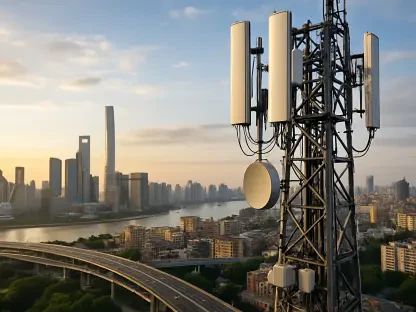

A transformative shift in telecommunications is set to unfold across Africa, promising to connect millions who have long been left behind in the digital revolution. Through a landmark partnership between Airtel Africa and SpaceX, the familiar silhouette of the cell tower may soon be complemented, and in some regions, effectively superseded, by a constellation of satellites in low Earth orbit. This collaboration aims to leverage Starlink’s satellite network to deliver Direct-to-Cell connectivity, directly tackling the continent’s persistent “coverage gap.” For the 174 million Airtel customers across 14 markets, this initiative represents a potential leapfrog over traditional infrastructure hurdles, bringing the promise of reliable communication to even the most remote and sparsely populated areas. The plan, scheduled to begin its rollout in 2026, is not merely an incremental upgrade but a fundamental reimagining of how connectivity is delivered on a continental scale.
Overcoming Earthly Obstacles
The Prohibitive Cost of Ground-Based Networks
The primary barrier to universal mobile broadband in Africa has long been one of economics rather than technology. For telecom operators, the decision to expand a network is a simple calculation of cost versus return, a calculation that frequently fails in rural and remote regions. The construction and maintenance of a single terrestrial cell tower can cost approximately $150,000, a steep investment to serve a community that might only consist of a few hundred people. This high infrastructure cost per user renders such projects financially unfeasible, creating vast dead zones where mobile signals cannot reach. While a separate “usage gap” exists—affecting 960 million people globally who have coverage but do not use mobile internet due to affordability or digital literacy—this initiative targets the more foundational problem. It addresses the 400 million people worldwide who have no coverage at all, nearly half of whom live in Sub-Saharan Africa, by fundamentally altering the economic equation of network deployment.
A Celestial Answer to a Terrestrial Problem
The Airtel-Starlink partnership introduces a paradigm that sidesteps the limitations of ground-based infrastructure entirely. Instead of incurring massive localized capital expenditures to build towers one by one, the solution utilizes Starlink’s existing network of over 650 satellites already orbiting the Earth. This approach effectively spreads the infrastructure cost across a global subscriber base, making it commercially viable to serve customers in areas previously considered unreachable. The elegance of this model extends to the end-user, for whom the experience is designed to be completely seamless. A standard LTE smartphone, without any special hardware or modifications, will automatically switch its connection from a terrestrial tower to an overhead satellite the moment it moves out of conventional network range. This eliminates the need for consumers to purchase new devices or subscribe to a separate service, integrating satellite connectivity directly into their existing mobile plans and making the promise of ubiquitous coverage a tangible reality.
The Strategic and Technological Horizon
Reshaping the Competitive Landscape
This strategic alliance is as much about market positioning as it is about technological innovation. By partnering with SpaceX, Airtel Africa effectively positions itself as the local gateway for Starlink’s Direct-to-Cell technology, a move that preempts SpaceX from entering its 14 markets as a direct-to-consumer competitor. This protects Airtel’s existing customer base while simultaneously offering a powerful new value proposition: unparalleled network coverage. The deal immediately puts immense pressure on rivals like MTN and Orange, who must now consider forging their own satellite partnerships to remain competitive. Failure to do so could result in significant customer attrition as users gravitate toward the provider that can guarantee a connection anywhere. Furthermore, Airtel’s established presence and existing operating licenses in these countries provide a streamlined regulatory pathway for the deployment of Starlink’s service, overcoming a significant hurdle that would otherwise delay a direct market entry by SpaceX.
The Phased Evolution of Orbital Connectivity
The initial service rollout planned for 2026 represents just the first step in a much broader and more ambitious technological roadmap. At launch, the Direct-to-Cell service will focus on providing essential communication capabilities, such as text messaging and select low-bandwidth data services, ensuring a foundational level of connectivity for safety and basic communication. However, the long-term vision is far more expansive. As SpaceX deploys its next-generation satellites, the network’s capacity and speed are projected to increase dramatically, with expected performance improvements of up to 20 times current capabilities. These advancements will unlock the potential for more demanding applications, including high-quality video calls, media streaming, and the use of AI-powered services that require consistent, high-speed data. This evolutionary model has already been validated in other markets, notably by Ukraine’s Kyivstar, which successfully implemented a similar service for its 24 million subscribers, demonstrating the technical viability and consumer demand for such an integrated network.
A New Blueprint for Global Connectivity
The collaboration between Airtel Africa and SpaceX signaled a pivotal moment in the quest for universal digital access. It challenged the long-held assumption that closing Africa’s connectivity gap would require decades of slow, expensive, and geographically constrained tower construction. The decision to integrate orbital infrastructure with existing mobile networks provided an innovative, geography-independent blueprint that could be replicated globally. This strategic pivot shifted the focus from building up from the ground to beaming down from the sky, and in doing so, it established a new precedent for how telecommunications companies could overcome economic barriers to serve the previously unconnectable. The partnership was not merely a business transaction; it was a demonstration of a new technological pathway that redefined the future of connectivity on the continent.